Strong Beer: When Alcohol Becomes an Art
Why do some beers reach 10%, 14%, even 57% ABV? A look at strong beer through Doppelbock, Barleywine, Quadrupel, and barrel-aged stout: four philosophies from four continents.
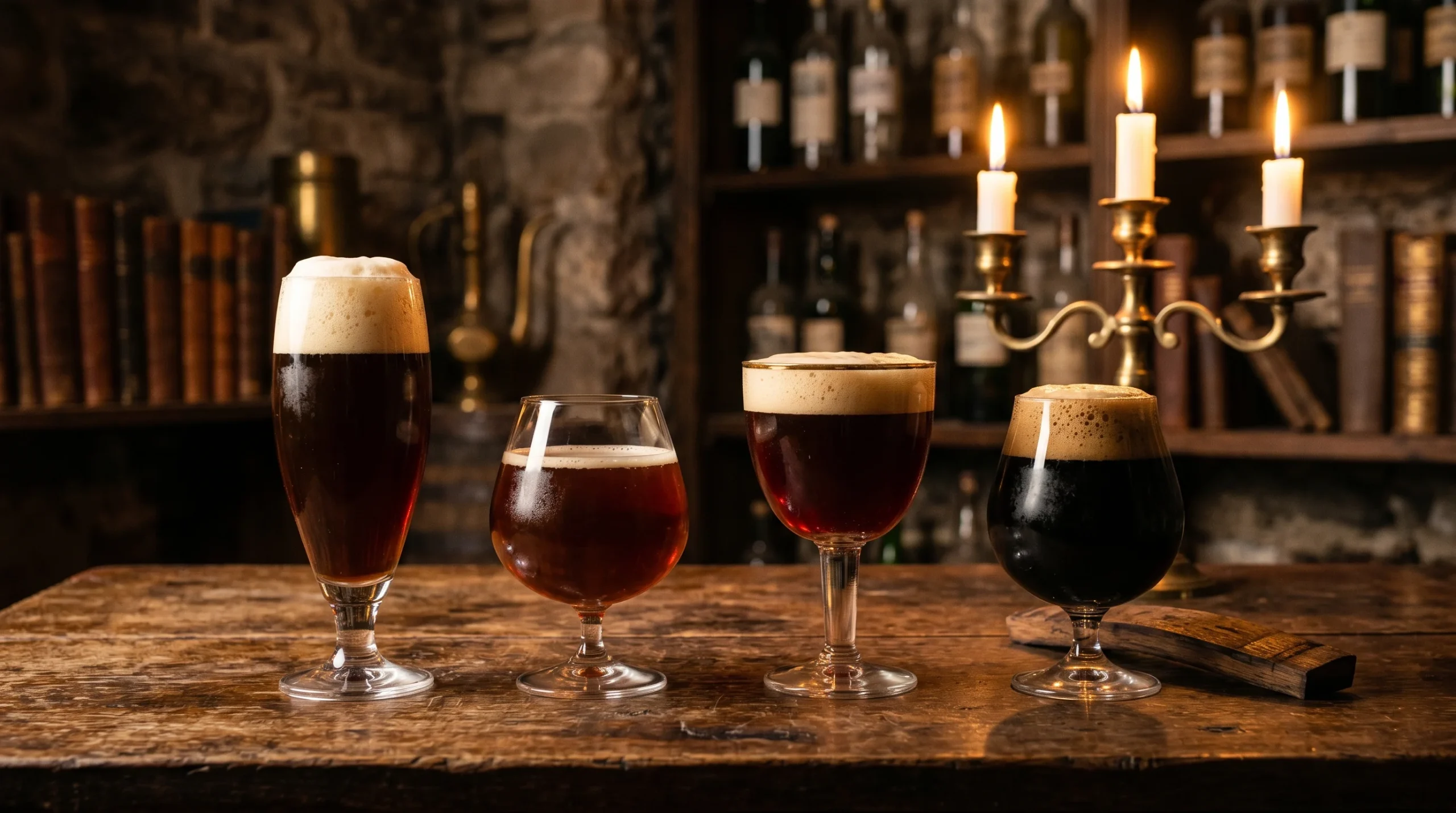
Most of the world’s beer falls between 4 and 6% ABV (alcohol by volume). This is the ordinary range: beer you can drink several glasses of in an evening without getting drunk fast, and that sits easily alongside a meal. Most lagers, pale ales, witbiers, and classic stouts live here.
There is another world of beer, though, where brewers push the alcohol deliberately high. Beers at 8% ABV. Then 10%. Then 12%. Some reach 14–17%, on a par with wine. This is strong beer, and its strength is no accident or brewing fault. It is a deliberate tradition, centuries old.
Which raises the central question: why would brewers put so much work into beer this strong, when a 5% beer is plainly easier to drink and easier to sell?
The answer is a matter of philosophy. Strong beer is not meant to get you drunk. It is meant for slow sipping, for a depth of flavor that beer of ordinary strength cannot reach. A Doppelbock has a depth of malt no Helles can match. A Barleywine approaches the complexity of a port. An Eisbock is concentrated until it becomes something close to a liqueur. At this level, beer becomes a work of art in the glass.
Defining Strong Beer
Brewing has no official definition of “strong beer.” Going by the BJCP (Beer Judge Certification Program) and other standard-setting beer organizations, though, alcohol content falls into four bands:
- Session beer: 3–4.5% ABV, beer you can drink all afternoon
- Standard beer: 4.5–6% ABV, the bulk of commercial beer
- Strong beer: 6–8% ABV, the start of strong territory
- Very strong beer: 8% ABV and up, strong in the formal sense
This piece covers the strong and very strong bands, 6% ABV and above, with particular attention to 8% and up, where a beer’s strength truly starts to shape its character.
Why Brewers Make Strong Beer
Historically, strong styles arose for five reasons:
1. Preservation. Before refrigeration and pasteurization, high alcohol was the natural way to keep beer. At 8% ABV and above, beer could last for months without spoiling. That is why English Barleywine came about: it was brewed strong to be shipped to distant colonies (India, the Caribbean) without going off on the way. It is also why Russian Imperial Stout was developed, a beer for the Russian court strong enough to withstand the harsh Baltic climate.
2. Religion. Trappist monks, and the Paulaner monks in Germany, brewed strong beer for Lent, when solid food was forbidden. The beer became “liquid bread,” with enough calories and nourishment to sustain the body through 40 days of fasting. This is where Doppelbock comes from.
3. Climate. Traditionally, strong beer is winter beer: warming enough to hold off the cold, and full-flavored enough to stand up to stews and heavy food. That is how Scotland’s Wee Heavy came about (a cold country needs a warming beer), along with England’s traditional Winter Warmer.
4. Privilege. In some cultures, strong beer was the drink of the elite. Strong Bavarian beer was brewed for the nobility while ordinary people drank lighter beer. The Belgian Quadrupel (Quad) of the Trappist monasteries was brewed for feast days, not for every day. Strong beer stood for luxury in the beer world.
5. Innovation. In the 20th and 21st centuries, American craft beer added a new reason: experiment for its own sake. Modern brewers make an imperial version of everything (Imperial Stout, Imperial IPA, Imperial Porter, Imperial Pilsner), not for preservation or religion but simply to push a style to its limits. The thinking goes: if style X is good at 5% ABV, see what it does at 10%.
What This Piece Covers
Strong beer is not a single style. It is a cross-category grouping that spans traditions from many countries, taken here school by school:
- The German school: the bock family, Doppelbock and Eisbock, tightly controlled and malt-forward
- The British school: Barleywine, Wee Heavy, and Old Ale, robust, malt-driven, and rooted in old tradition
- The Belgian school: Belgian Quadrupel (Quad) and Belgian Pale Strong Ale, covered in depth in our feature on Belgian beer and summarized here
- The modern American school: imperial everything plus barrel aging, the extreme strong beers of the craft revolution
The final section looks at strong beer in Vietnam and closes on a philosophical question: when does high ABV become art, and when is it just showing off?
First, though, the most classic strong style of all: the Doppelbock of the Munich monks.
IHistory: The Five Origins of Strong Beer
Many styles have a single, clear birthplace: Lambic in the Pajottenland, Hefeweizen in Bavaria, IPA in England. Strong beer has several parallel origins. Each culture had its own reasons for brewing strong, and the result was a set of very different styles emerging from different regions in the same period.
Munich, 17th Century: The Paulaner Monks’ “Liquid Bread”
In 1627, a group of monks from the Paulaner order came to Munich and founded a monastery of their own. They followed the Rule of Saint Francis of Paola, a severe discipline that included the 40 days of Lent each year, during which the monks could take only liquids and no solid food.
The problem was that plain water offers no nourishment. The monks needed a drink with enough calories and protein to carry them through 40 days, so they developed a beer of their own: Salvator (Latin for “Savior”), high in alcohol and brewed with a very large amount of malt, nourishing enough to stand in for food.
This is the beginning of Doppelbock. The monks called it “liquid bread.” In 2011, a journalist named J. Wilson showed the idea was no fable: he lived through the 46 days of Lent on Doppelbock and water alone, with no food at all, and came out in good health.
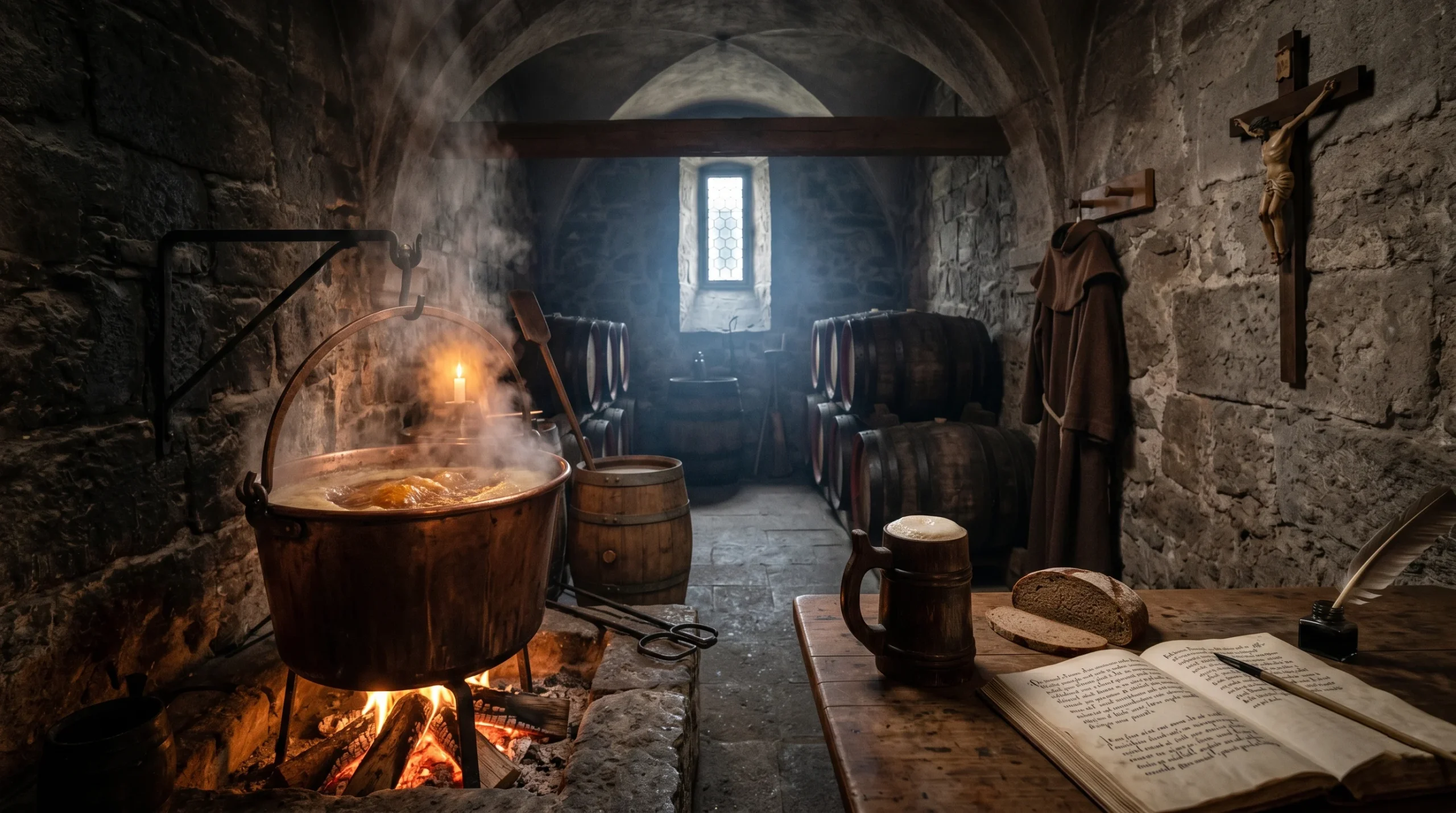
To this day, most Doppelbocks carry names ending in “-ator” in honor of the original Salvator: Celebrator, Optimator, Triumphator, Consecrator. More than 200 “-ator” Doppelbock names have been registered in Germany.
England, 18th Century: Seagoing Beer for an Empire
The British Empire of the 18th and 19th centuries needed beer. The army in India needed it, the Caribbean colonies needed it, and so did the merchants in Australia, Hong Kong, and Cape Town. Ordinary beer, however, did not survive voyages of 4–6 months through the tropics.
English brewers answered with two strong styles made for export:
IPA (India Pale Ale), more heavily hopped and higher in alcohol than ordinary beer, bound for India. We covered it in detail in our feature on hoppy beers.
Russian Imperial Stout, a very strong stout for the court of Catherine the Great. The 18th-century empress was especially fond of English stout, but ordinary beer spoiled on the passage from London to St. Petersburg through the Baltic winter. The London brewer Thrale developed a special stout at 9–12% ABV, heavily hopped and able to withstand Baltic temperatures of −30 °C (−22 °F). That is where the name “Russian Imperial” comes from: an imperial stout for the Russian court.
In the 1990s, American craft brewers revived the style and made it one of the most famous in modern craft beer. Our feature on dark beers tells that story in full.
Scotland: Beer for a Harsh Climate
Scotland is cold, damp, and windy. Its brewers built a strong-beer tradition of their own in Wee Heavy (also called Scotch Ale): a robust, malt-driven beer, high in alcohol and light on hops (hops are hard to grow in Scotland), rich enough to warm a Highland night.
Wee Heavy differs from English strong beer in character. The English focused on hops and alcohol; the Scots focused on malt, with caramel, toffee, and a hint of smoke from kilning the malt over peat. A classic Wee Heavy has been described as “a cup of boozy toffee.” It is a beer to sit and think over, not one to drink quickly.
Bavaria, 19th Century: Eisbock, Born of an Accident
As the legend goes, during a hard 19th-century winter in Kulmbach, Bavaria, a cask of Doppelbock was left outside overnight and partly froze. The young brewer who found it the next morning, afraid of a scolding, decided to draw off the beer that was still liquid and drink it, leaving the ice behind. To his surprise, what remained, its alcohol now concentrated, was far stronger, richer, and more complex than the original Doppelbock.
That is the origin of Eisbock, or “ice bock”: a beer brewed as a Doppelbock, then partly frozen, with the ice removed to concentrate the alcohol. Water freezes at a higher temperature than alcohol, so when beer is partly frozen the ice that forms is mostly water, and the liquid left behind is stronger.
Traditional Eisbock runs 9–14% ABV. Some modern versions pass 30%, such as Schorschbock at 57.5%, one of the strongest beers in the world.
Modern America: Imperial Everything
Last came the American revolution. In the 1980s and ’90s, as craft beer took off in the United States, brewers began attaching the word “Imperial” to every style, not just stout.
Anchor Brewing released Old Foghorn in 1975, the first commercial American Barleywine since Prohibition. Sierra Nevada released Bigfoot Barleywine in 1983 and redefined the American version of the style: hoppier than English Barleywine, with citrus and pine from American hops.
By the 1990s and 2000s, American craft brewers had made imperial versions of nearly every style:
- Imperial Stout (more intense than the original Russian Imperial Stout)
- Imperial IPA (Double IPA, Triple IPA)
- Imperial Porter
- Imperial Red Ale
- Imperial Pilsner (heresy by the lights of the German Reinheitsgebot)
- American Strong Ale, a catch-all for any strong American ale that fits no other category
The shared philosophy: if higher alcohol makes for more interesting character, why not?
A New Dimension: Barrel Aging
From 2000 on, American craft brewers added one more dimension: aging in whiskey and bourbon barrels. The pioneer was Goose Island Bourbon County Brand Stout (BCBS), released in 1992, an Imperial Stout aged in used Kentucky bourbon barrels. The wood gave the beer vanilla, oak, bourbon, and chocolate, flavors only a barrel can provide.
Today, barrel-aged stout is among the most expensive and most sought-after categories in craft beer worldwide. Some bottles sell for hundreds or even thousands of dollars. This is strong beer at its outer limit, pressing against the edge of what beer can become.
IIThe German School: The Bock Family
The German school is the oldest and most disciplined in strong beer. Where American craft brewers experiment at the extremes, German brewers follow strict rules to protect quality and traditional character.
The bock family is large: standard Bock, Maibock (Helles Bock), Doppelbock, Eisbock, and Weizenbock (covered in our feature on wheat beers). This section focuses on the two strongest and most significant, Doppelbock and Eisbock.
Doppelbock: The Monks’ Liquid Bread
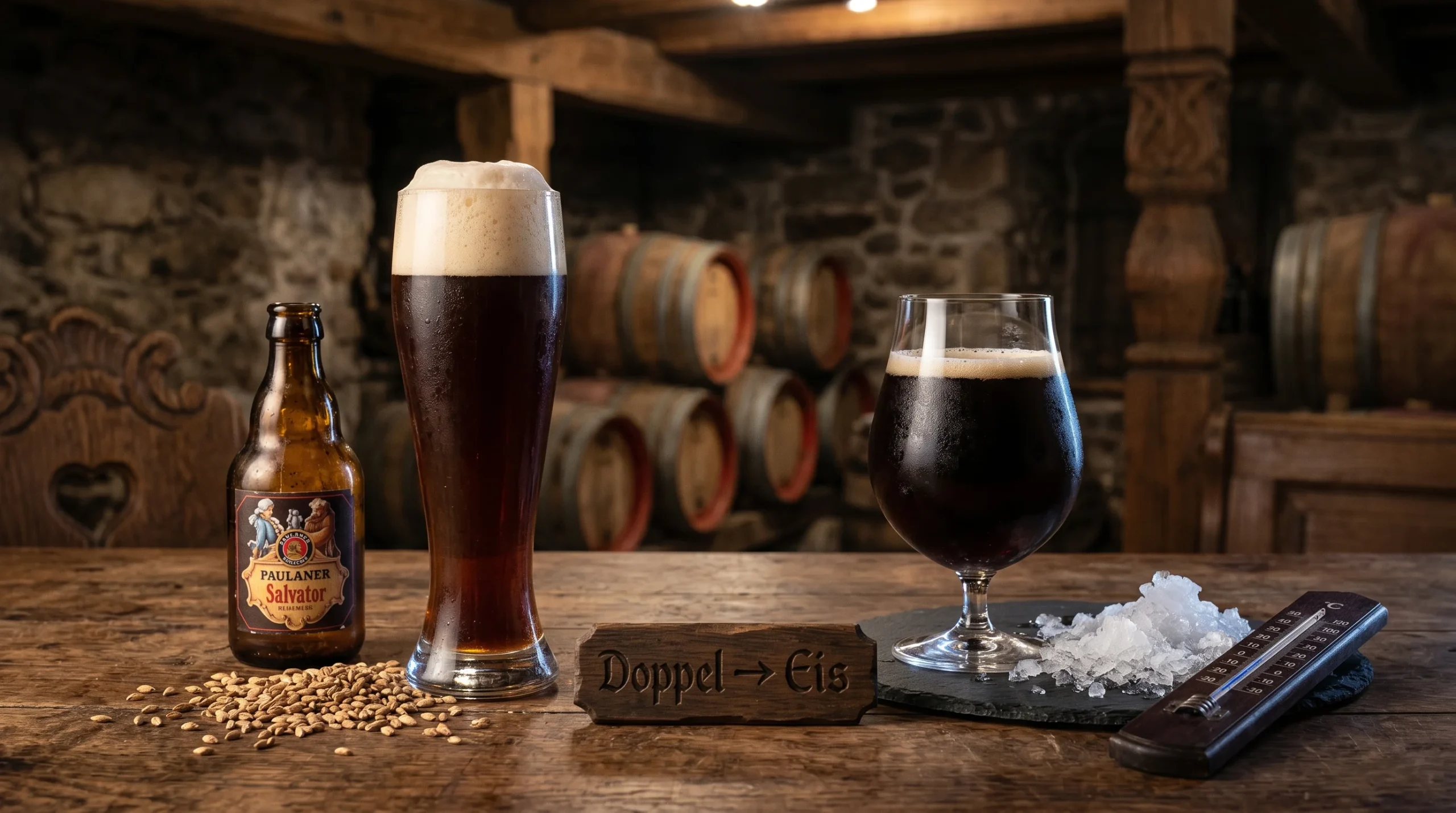
Doppelbock is the archetypal German strong beer. The name means “double bock,” a double-strength version of ordinary bock.
Key characteristics:
- Color: deep gold (helles versions) to dark mahogany brown (dunkel versions)
- Aroma: intense malt, toasted bread, caramel, toffee, dried fruit (raisin, plum, fig), and a hint of chocolate in darker versions
- Flavor: malt-forward and moderately sweet, very full-bodied, with low hop bitterness and alcohol that warms without burning
- Body: medium-full to full, creamy
- ABV: 7–10%
The secret of a good Doppelbock is a long, cold lager fermentation of 4–8 weeks. Lager yeast works slowly at 8–12 °C (46–54 °F), eating through the sugars without producing esters (the fruity aromas that come from yeast). The result is a beer free of yeast character, which leaves the stage to malt and alcohol. Philosophically, it is the opposite of the Belgian strong ales: the Belgians celebrate yeast character, while the Germans remove it.
A good Doppelbock has to carry its alcohol gracefully. You know the beer is strong, but you never feel the alcohol burn on your tongue. Master brewers spend years learning that balance.
Classic examples:
- Paulaner Salvator: the original of the style, brewed without interruption since the 17th century, and the benchmark Doppelbock.
- Ayinger Celebrator: known for its signature bottle with a little goat wearing a bell. Many beer judges rank it the top Doppelbock in the world.
- Spaten Optimator: widely available internationally, with pronounced malt character.
- Weihenstephaner Korbinian: from the world’s oldest brewery (1040), a thoroughly Bavarian Doppelbock.
Pair it with winter stews (Hungarian beef stew, lamb stew), well-spiced grilled German sausage, aged cheeses (Parmesan, old Gouda), chocolate brownies, and raisin or fig desserts.
Eisbock: The Frozen Bock
Eisbock is the most unusual strong style in the world, because it is made by a physical process rather than ordinary brewing technique.
The process:
- The brewer makes a standard Doppelbock (7–10% ABV).
- The Doppelbock is brought down to freezing conditions, −5 to −15 °C (23 to 5 °F).
- Some of the water in the beer turns to ice. The alcohol does not freeze, since its freezing point is −114 °C (−173 °F).
- The remaining liquid is drawn off: a much stronger, denser beer with concentrated character.
- How much is frozen out determines the strength. Removing 10–30% of the water is typical, which raises the ABV to 9–14%.
Traditional Eisbock is deeply complex. It has everything a Doppelbock offers (caramel, toffee, dark fruit, chocolate), concentrated twofold, plus new character from the concentrated alcohol: warmth, full body, and hints of port or whiskey.
This is not a beer to rush. A 33 cl bottle of Eisbock can last 60–90 minutes, and as it warms toward room temperature it opens up, revealing new layers of flavor.
Classic examples:
- Schneider Aventinus Eisbock: the Eisbock version of Schneider Aventinus (a Weizenbock), at 12% ABV, with banana, clove, and concentrated caramel.
- Kulmbacher Reichelbräu Eisbock: a traditional Eisbock from Kulmbach, where the style was born. 9.2% ABV.
- Eggenberg Samichlaus: an Eisbock from Austria, 14% ABV, brewed only on December 6 (St. Nicholas Day) each year, and one of the rarest beers in the world.
The Extreme Eisbock Race
In the 2000s and 2010s, breweries raced to make the strongest beer in the world with an extreme form of the Eisbock method, freezing the beer again and again to strip out as much water as possible.
- 2009: Schorschbräu (Germany) releases Schorschbock at 31%, a world record
- 2010: BrewDog (Scotland) answers with Tactical Nuclear Penguin at 32%
- 2010: Schorschbräu releases Schorschbock at 40%, then 43%
- 2020: Schorschbräu and BrewDog collaborate on Strength in Numbers, 57.5% ABV, made by traditional ice distillation
This is extreme territory: beer stronger than wine (12–14%) and close to vodka (40%). It raises a philosophical question: at what point does beer stop being beer and become a spirit? There is no official answer, but most of the beer community treats anything over 20% as novelty, beer made to impress rather than to drink day to day.
Traditional Eisbock at 9–14% remains a serious, respected category, a beer for Bavarian winter nights by the fire and for the occasions that call for something dense and layered.
IIIThe British School: Barleywine and Wee Heavy
If the German school is controlled elegance, the English and Scottish school is traditional brawn. These beers make no attempt at finesse. They are full, robust, and intense, with forceful malt character: beers for cold Highland winter nights and for dinners heavy on meat and hard cheese.
English Barleywine: The Wine of Beers
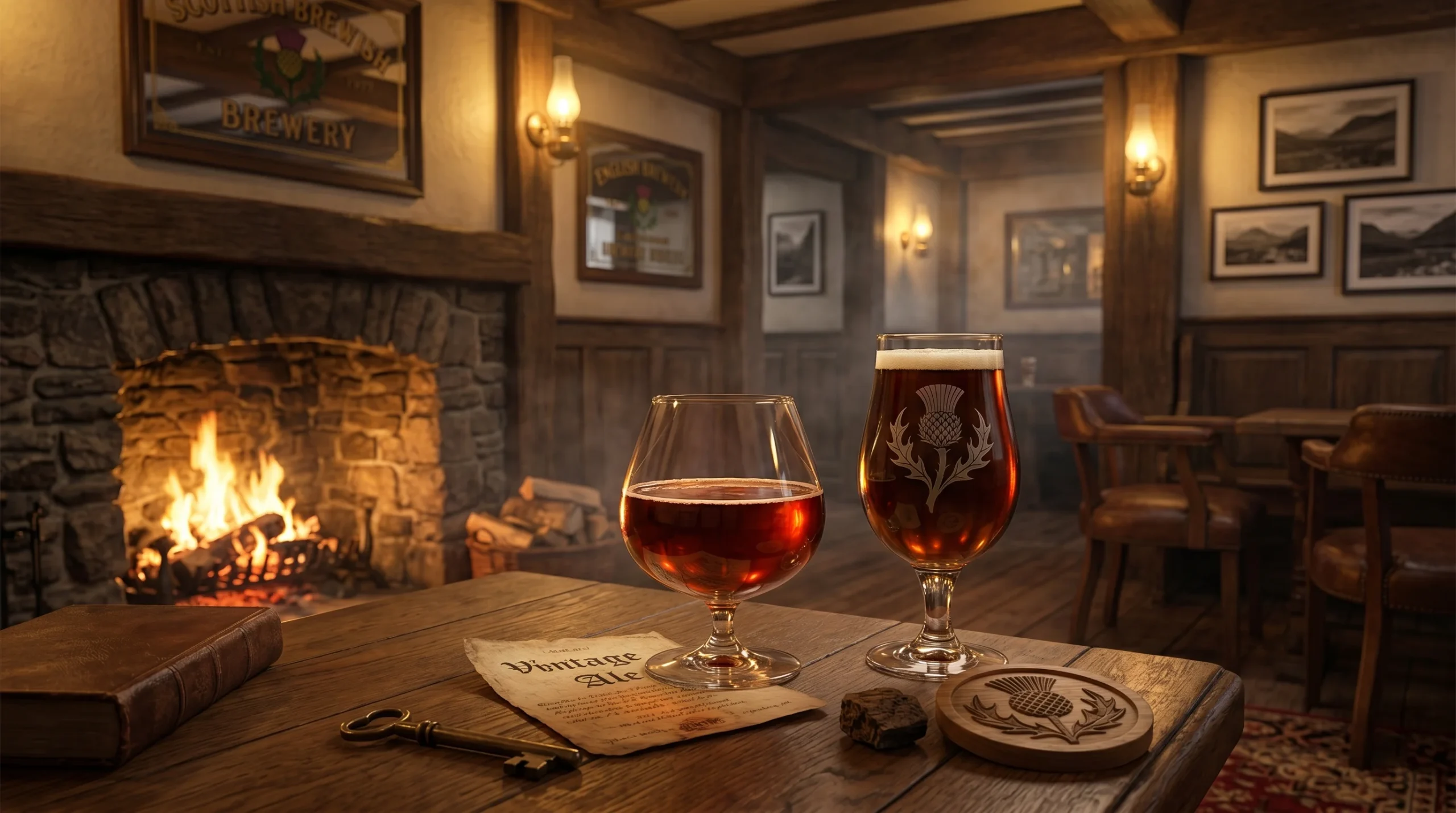
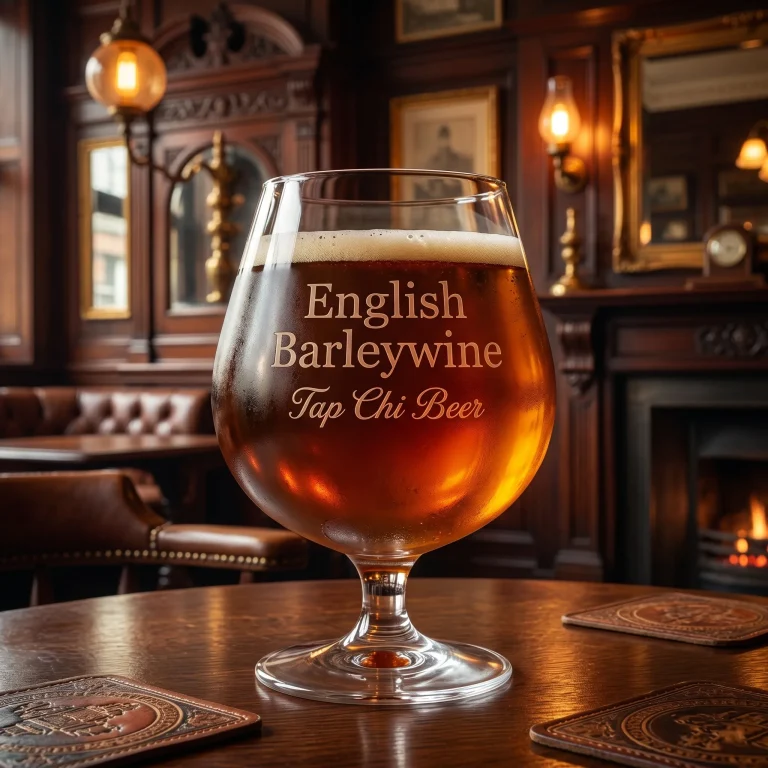
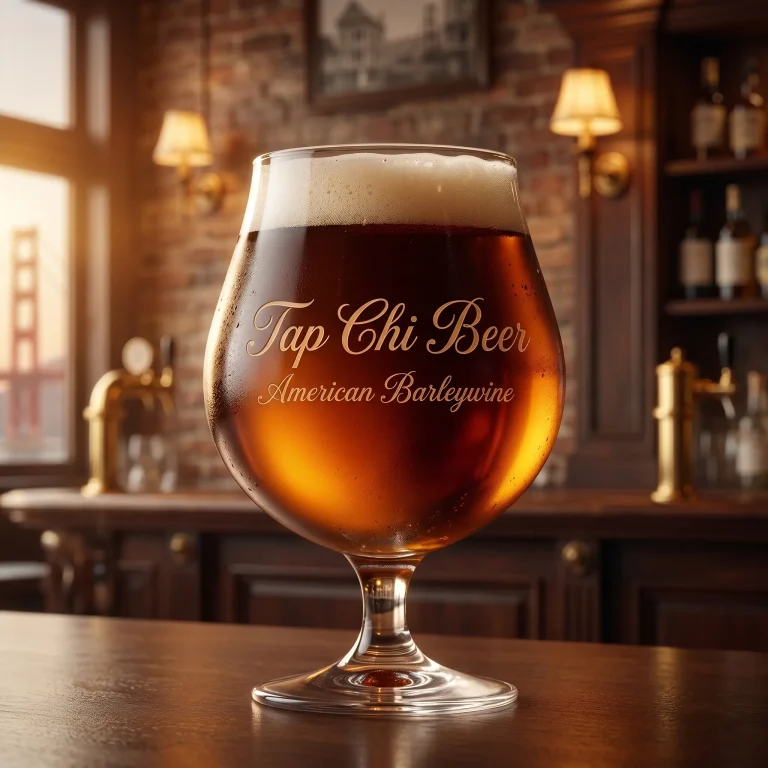
The name “Barleywine” says exactly what the style is: a beer with the strength and complexity of wine. It is still beer, brewed from malt, hops, yeast, and water, but in alcohol and character it sits closer to port than to ordinary beer.
A classic English Barleywine:
- Color: amber-brown to dark mahogany
- Aroma: big malt (caramel, toffee, bread crust), dried fruit (raisin, fig, plum), a hint of vanilla, and warming alcohol
- Flavor: clear malt sweetness, a very full body, moderate hops (English noble hops such as East Kent Goldings and Fuggles), and a warm, boozy finish
- Body: full to very full, smooth and rich
- ABV: 8–12%
English Barleywine carries a tradition of aging. Unlike most beer, it is designed to be drunk after 1–5 years, or longer. In the bottle the malt softens, the alcohol integrates, and new flavors take shape, much as they do in a wine cellar.
Classic examples:
- Fuller’s Vintage Ale (England): a new edition every year, with the vintage on the bottle. Ages well for 10–20 years.
- Thomas Hardy’s Ale (England): one of the legendary Barleywines, released continuously since 1968 and able to age for decades.
- J.W. Lees Harvest Ale (England): a classic vintage Barleywine, released every year since 1986.
American Barleywine: The American Take
In the 1970s and ’80s, American craft brewers took Barleywine their own way. Where English Barleywine balances malt and hops, American Barleywine pushes the hops hard, with citrus, pine, and resin from American varieties (Cascade, Centennial, Chinook, Citra).
The core differences:
| Feature | English Barleywine | American Barleywine |
|---|---|---|
| Hop character | Earthy, floral, moderate | Citrus, pine, intense |
| Bitterness | Medium (40–60 IBU) | High (60–100 IBU) |
| Balance | Malt-forward | Hop-balanced or hop-forward |
| Aging | Ages well for 5–20 years | Drink fresh (within 1–3 years) |
Classic examples:
- Sierra Nevada Bigfoot (1983): the Barleywine that redefined the American style. Released every year, and cellared by many collectors.
- Anchor Old Foghorn (1975): the first commercial American Barleywine after Prohibition, and the style’s pioneer.
- Stone Old Guardian: a hoppier American Barleywine, intensely citrusy.
Wee Heavy (Scotch Ale): The Highlands’ Heavyweight
In Scots, “wee heavy” means “small but heavy”: a small bottle (usually 33 cl) holding a strong beer. The original name is Scotch Ale, but Wee Heavy has become the more common term in modern craft beer.
Key characteristics:
- Color: reddish brown to dark brown
- Aroma: intense malt (caramel, toffee, butterscotch), a hint of smoke from the Scottish peated-malt tradition, and dried fruit
- Flavor: very sweet and malty, very full-bodied, low in hop bitterness, as rich as a meal
- Body: full to very full, smooth and creamy
- ABV: 6.5–10%
Where Barleywine balances malt and hops, Wee Heavy focuses on malt alone and has almost no hop presence. The tradition grew out of necessity: hops are hard to grow in Scotland’s cold climate, so Scottish brewers relied entirely on malt.
Some Wee Heavies carry a hint of smoke from malt kilned over peat, an old Highland technique. The effect recalls single malt Scotch whisky and brings to mind the cold, misty Highlands.
Classic examples:
- Belhaven Wee Heavy: a traditional Scotch Ale, brewed continuously since 1719, and the benchmark.
- Founders Dirty Bastard (US): an American-style Wee Heavy with distinct smoke.
- Orkney Skull Splitter: a Wee Heavy from the Orkney Islands in the far north of Scotland, 8.5% ABV.
Old Ale: England’s Traditional Aged Beer
Finally, a niche style that deserves attention: Old Ale, an English strong beer traditionally aged in wooden casks for months or years before bottling, much as wine is.
Old Ale differs from Barleywine in its oxidized character (sherry, port, tawny), a vinous, winelike edge, and sometimes Brett (Brettanomyces), which adds funk. It is the most complex of the English strong beers, and the hardest to find.
Examples: Theakston’s Old Peculier (England), Greene King Old Speckled Hen, and North Coast Old Stock Ale (US).
The English and Scottish Philosophy
The English and Scottish school fits into three short lines: “Malt is king. Hops are secondary. Alcohol is the natural result.”
That sets it against the American philosophy (“hops are king”) and the German one (“control is king”). The British prize traditional robustness: beer brewed for manual laborers, for cold weather, and for hearty meals. No fuss and no experiments, only malt, malt, and more malt.
IVThe Modern American School, Plus a Look at Belgium
Over the past 40 years, American craft beer has redefined strong beer. Before, strong beer was a niche, traditional corner of brewing. After the American craft revolution it became a fast-growing, inventive category, with hundreds of new styles, new techniques, and a culture of “extreme brewing” all its own.
Imperial Everything: A New Philosophy
By the 1990s, American craft brewers were applying the word “Imperial” to every style. The philosophy: if style X is good at normal strength, see what happens when it is brewed strong.
The main imperial styles:
Russian Imperial Stout: covered in detail in our feature on dark beers. American versions push the ABV to 10–15%, with layered dark malt, chocolate, coffee, and dark fruit.
American Imperial Stout: the American variation on Imperial Stout, usually hoppier, at similarly high strength.
Imperial IPA (Double IPA): covered in detail in our feature on hoppy beers. A stronger IPA at 7.5–10% ABV, with assertive hop character.
Imperial Porter: a stronger English Porter, with deeper chocolate and coffee.
Imperial Red Ale: a stronger American Red/Amber Ale, malt-forward with American hops.
American Strong Ale: The Strong Catch-All
This is the style for beers that are “not Imperial Stout, not Barleywine, but strong American ale.” American Strong Ale is a catch-all for high-ABV American ales that fit no traditional category.
Key characteristics:
- 6.3–9.5% ABV
- American hops (Cascade, Centennial, Citra), usually prominent
- Anywhere from malt-forward to hop-forward
- Medium-full body
- Color: golden amber to brown
Examples: Stone Arrogant Bastard Ale, Dogfish Head Burton Baton, and Founders Backwoods Bastard.
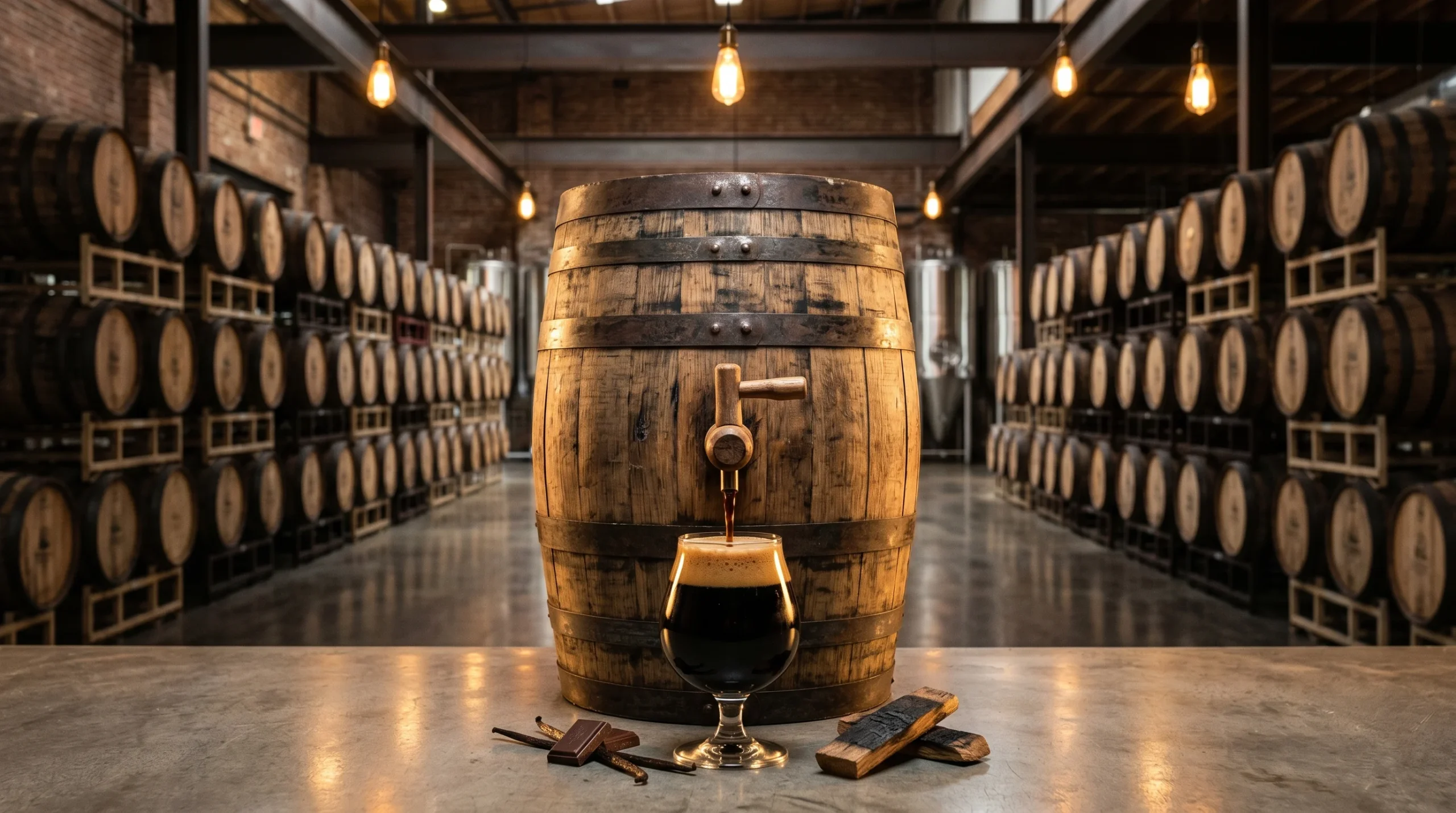
Barrel-Aged: The Peak of Modern Strong Beer
Last comes the most sought-after category in modern craft beer: barrel-aged strong ales. These are strong beers (usually Imperial Stout, Barleywine, or Old Ale) aged in used whiskey or bourbon barrels for anywhere from 6 months to 3 years.
The pioneer was Goose Island Bourbon County Brand Stout (BCBS), first released in Chicago in 1992: an Imperial Stout (14–15% ABV) aged in used Kentucky bourbon barrels. The wood adds vanilla, oak, bourbon, coconut, and deep chocolate, flavors no other method can produce.
By the 2010s, barrel-aged beer had become a category of its own. Breweries that specialize in it (Side Project in Missouri, The Bruery in California, Founders in Michigan, Cycle Brewing in Florida) have built cult followings, with fans lining up from 4 or 5 a.m. on release day for the rare versions.
Variations:
- Bourbon barrel-aged: vanilla, oak, and bourbon (the most common)
- Whiskey barrel-aged: similar to bourbon, with peaty smoke when Scotch whisky barrels are used
- Rum barrel-aged: rum sweetness and a hint of tropical fruit
- Wine barrel-aged: port, sherry, and tannin
- Tequila barrel-aged: agave and citrus
- Maple syrup barrel-aged: maple sweetness
Some barrel-aged stouts command startling prices. Limited variants of Goose Island BCBS can cost $30–$80 for a 33 cl bottle, and some collector bottles reach $500–$2,000 on the secondary market.
The Belgian School, in Brief
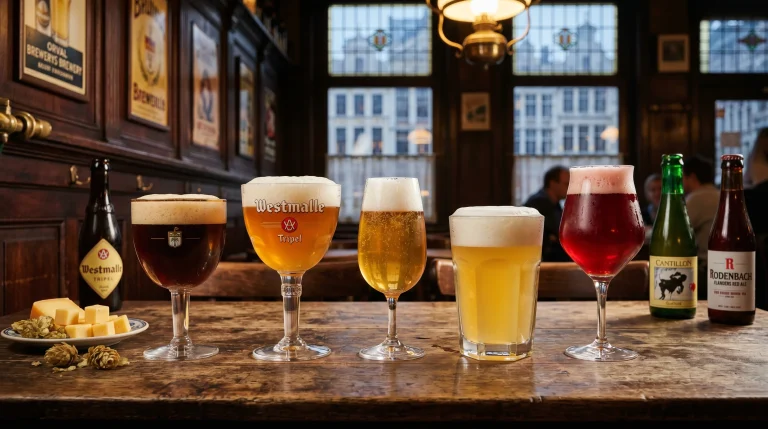
Belgium has a rich strong-beer tradition of its own, covered in detail in our feature on Belgian beer. In brief:
Belgian Quadrupel (Quad): the strongest of the Belgian Trappist styles, at 10–14.2% ABV, with dried fruit, caramel, and port. Examples include Westvleteren 12, Rochefort 10, and Chimay Bleue.
Belgian Pale Strong Ale (Belgian Golden Strong): Belgium’s strongest golden style. Duvel is the benchmark: bright gold, light-bodied, high in alcohol (8–10%), with a thick, distinctive head.
Belgian Dark Strong Ale: a variation on the Quadrupel, with a character particular to each brewery.
Belgian Tripel: not “very strong,” but still a strong beer (7.5–9.5%). Westmalle Tripel is the benchmark.
The Belgian philosophy differs from the German, British, and American ones in that it celebrates yeast character. Belgian brewers see their yeast, with its intricate fruity esters and spice, as the key to the Belgian strong character. The body may be lighter than in German or British beers, but the character is more complex.
VStrong Beer in Vietnam
Strong beer has a fairly short history in Vietnam. Most of it has caught on only since 2015, with the growth of craft beer and specialty bottle shops. Thanks to links with major markets (Singapore, Hong Kong, Japan), though, a surprising range of strong styles has made its way into the country.
Strong Beers Worth Trying in Vietnam
Entry level (7–9% ABV, approachable):
1. Westmalle Tripel (Belgian Tripel, Belgium): the benchmark Tripel, at 9.5% ABV. Amber-gold, with a broad range of fruit aromas and a medium body full of character. A good way into strong beer.
2. Duvel (Belgian Pale Strong Ale, Belgium): 8.5% ABV. The “golden devil” looks light but is strong. Drink it slowly.
3. Chimay Red (Première) (Belgian Dubbel, Belgium): 7% ABV. An entry-level Trappist beer, with dried fruit and caramel.
4. Paulaner Salvator (Doppelbock, Germany): 7.9% ABV. The original 17th-century Doppelbock.
Intermediate (9–12% ABV):
5. Chimay Bleue (Grande Réserve) (Quadrupel, Belgium): 9% ABV. A classic Trappist Quadrupel, full-flavored and complex.
6. Rochefort 10 (Quadrupel, Belgium): 11.3% ABV. One of the most highly rated beers in the world, with concentrated port, chocolate, and dark fruit.
7. Ayinger Celebrator (Doppelbock, Germany): 6.7% ABV. Many beer judges place it first among the world’s Doppelbocks; look for the goat on the bottle.
8. Sierra Nevada Bigfoot (American Barleywine, US): 9.6% ABV. A pioneering American Barleywine, with big hops over a heavy malt base.
Advanced (11% ABV and up, rare and expensive):
9. Schneider Aventinus Eisbock (Eisbock, Germany): 12% ABV. An Eisbock concentrated from a Weizenbock, complex to the point of overwhelming.
10. Westvleteren 12 (Quadrupel, Belgium): 10.2% ABV. The hardest beer in the world to buy, covered in detail in our feature on Belgian beer.
Bonus: barrel-aged stouts. Goose Island Bourbon County Brand Stout, Founders KBS, Cycle Brewing Hazelnut Stout. These are very rare in Vietnam. Most arrive as personal imports, bottles bought in the US by Vietnamese travelers and carried home.
Pairing Strong Beer with Vietnamese Food
Strong beer is not really mealtime beer; most of it is too complex and too strong to carry through a long dinner. A few combinations are worth trying, though:
- Bò kho (Vietnamese spiced beef stew) with Doppelbock (Paulaner Salvator): the Doppelbock’s caramel malt plays off the slow-braised, heavily spiced beef
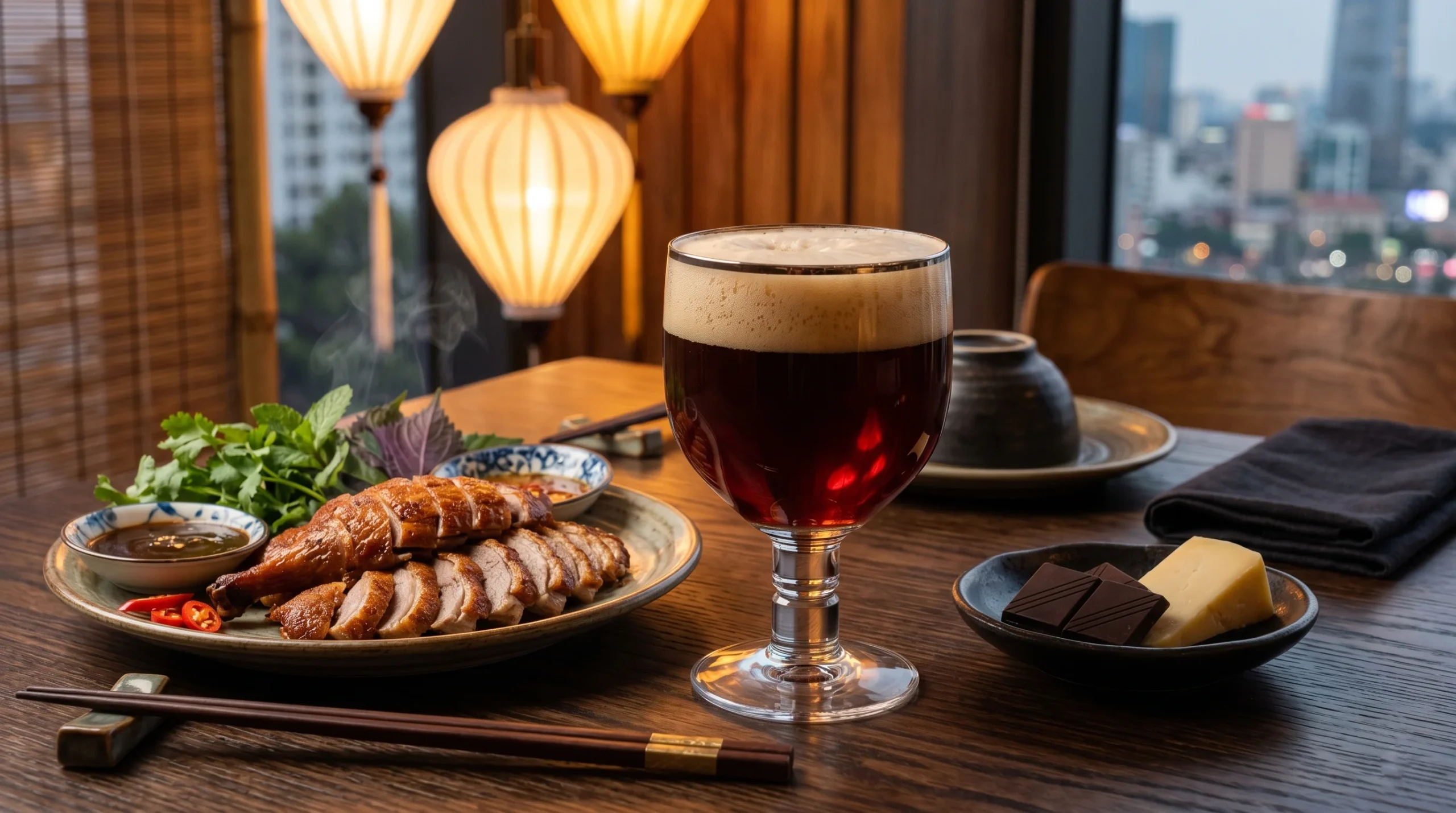
- Peking duck with Belgian Quadrupel (Chimay Bleue): the Quad’s dried fruit and chocolate match the fatty duck and the hoisin sauce
- Chè đậu đỏ (Vietnamese sweet red bean dessert) with Imperial Stout: deep chocolate and coffee against the sweet red beans
- Barbecued meat with American Barleywine (Sierra Nevada Bigfoot): the big hops cut the fat, and the malt matches the barbecue sauce
- Blue cheese with Belgian Quadrupel or Rochefort 10: a classic for dessert
- Dark chocolate (70% and up) with barrel-aged stout: dessert pairing at its height
One important note: strong beer should be served at room temperature, 15–18 °C (59–64 °F), not cold like ordinary beer. Too much chill shuts the flavors down; as the beer warms, more of it comes through. Red wine works the same way, and nobody serves it cold.
A 6-Month Strong Beer Itinerary
Months 1–2: Belgian basics. Westmalle Tripel (Tripel) and Chimay Red (Dubbel), to get to know Belgian yeast character and layered malt.
Month 3: German Doppelbock. Paulaner Salvator and Ayinger Celebrator, to taste the German malt-forward philosophy.
Month 4: Quadrupel. Chimay Bleue and Rochefort 10 (if you can find it), the high point of Belgian Trappist brewing.
Month 5: Barleywine. Sierra Nevada Bigfoot (American) and, if you can find it, Fuller’s Vintage Ale (English), to compare the two schools.
Month 6: Extreme. Schneider Aventinus Eisbock (Eisbock) and, given the chance, a barrel-aged stout: strong beer at its most intense.
A Philosophical Question: When Is Strong Too Strong?
After working through a range of strong styles, a question tends to surface: at what point does high ABV become showing off rather than art?
The plain truth is that not every high-ABV beer is good. Some are brewed only to flaunt their alcohol: simple character, poor balance, nothing but hot alcohol burning on the tongue. That is bad strong beer.
Good strong beer is different. Its high ABV follows naturally from a philosophy rather than being the goal. A good Doppelbock is strong because the monks needed enough “liquid bread.” A Russian Imperial Stout is strong because it had to survive the Baltic winter. An Eisbock is strong because freezing concentrates it. In each case the alcohol serves a purpose beyond display.
When judging a strong beer, ask: “If this beer were 5% ABV, would it still be good?” If the answer is yes, with the character still complex and the balance still sound, it is genuine strong beer. If the answer is no, if only the high alcohol makes it seem good, it is a fake.
Every serious beer drinker applies this test, and it is how to tell strong beer made with art from strong beer made for show.
VIConclusion: Strength Is Not the Point
All of it comes down to one message: strong beer is about philosophy far more than about ABV.
The past 5 sections covered four schools with four opposing philosophies:
Four Philosophies, One Story
The German school: “Strong beer must be controlled.”
The 17th-century Paulaner monks brewed Doppelbock for a specific purpose: to keep themselves alive through 40 days of fasting. In the 19th century, Bavarian brewers made Eisbock through careful freezing. Both followed the same principle, that high ABV is a result of the philosophy, not its aim. German strong beer is always tightly controlled and malt-forward, with its alcohol hidden. It never shows off.
The English and Scottish school: “Strong beer must be robust.”
English brewers of the 18th century made Barleywine to survive the 6-month voyage to India. Scottish brewers of the 19th century made Wee Heavy against the Highland cold. Both followed a philosophy of traditional robustness: big malt, full flavor, no fussy experiments. These are beers for manual laborers, harsh weather, and meat-heavy meals.
The Belgian school: “Strong beer must have yeast character.”
Belgium’s Trappist monasteries developed the Belgian Quadrupel (Quad) and the Belgian Pale Strong Ale (Duvel) over centuries. Their philosophy celebrates Belgian yeast, strains that throw an intricate mix of fruity esters and spice. The beers can be lighter in body than German or English ones while running deeper in character. In 2016, UNESCO recognized this tradition as part of the Intangible Cultural Heritage of Humanity.
The modern American school: “Strong beer must be pushed to the limit.”
American craft brewers of the 21st century have experimented with every style: imperial everything, barrel-aged everything, 20%-plus everything. Their philosophy is that there are no limits. If style X is good at normal strength, try it stronger. If higher alcohol makes for interesting character, go higher still. If a bourbon barrel adds character, try cognac, rum, and tequila barrels. This spirit of innovation has redefined modern beer.
The Larger Lesson
German control, English robustness, Belgian character, and American limit-pushing are four different approaches to the same goal: strong beer of real worth. All four make sense, and all four have produced classics.
Strong beer also says something about art and creativity in general: there is no single right way, and many roads lead to the top. The Paulaner monks got there through strict control, the Highland brewers through traditional robustness, the Trappist monasteries through yeast character, and American craft brewers through extreme experiment. Each path is valid, and each has its worth.
When Is Strength an Art?
Back to the question raised in section 6: when does high ABV become art?
When the alcohol serves a larger purpose: preservation, religion, climate, privilege, or a philosophy of innovation. When there is enough depth of character to justify the strength. When the balance is good enough that you forget how strong the beer is. When every sip turns up something new.
High ABV turns into showing off when it exists only for display, with no character behind it, no philosophy, and no balance. That is fake strong beer, and an experienced drinker will spot it on the first sip.
A Last Word
The next time you pick up a bottle at 8% ABV or more, take a second to ask:
What was this beer brewed for? To sustain monks through Lent? To survive a 6-month voyage? To ward off the Highland cold? To celebrate Belgian yeast? To push a style to its limit?
The answer will shape how you drink it.
Strong beer is for slow drinking, for exploring depth, and for honoring tradition or innovation, not for getting drunk. A bottle of Doppelbock can take 60 minutes. A bottle of Westvleteren 12 can take 90. A barrel-aged stout can take 2 hours. Here, slowness is the philosophy.
So drink slowly, and pay attention to the malt, the alcohol, and everything layered between them. What is in the glass took centuries of tradition or years of experiment to make, and that is the art of high ABV.
Mentioned in this article
-
Beer O L O G Y
Belgian Beer: Intangible Cultural Heritage of Humanity -
Beer O L O G Y
The World of Bitter Beer Begins with IPA -
Beer O L O G Y
Dark Beer Is Not One Style -
Beer O L O G Y
Wheat Beer: The Flavor of the Grain


and 11 more linked in the text
Originally published in Vietnamese on Tạp Chí Beer.