Belgian Beer: Intangible Cultural Heritage of Humanity
In 2016, UNESCO recognized Belgian beer culture as Intangible Cultural Heritage of Humanity. Here is its 1,000-year history, traced through Trappist ales, Lambic, and Saison.
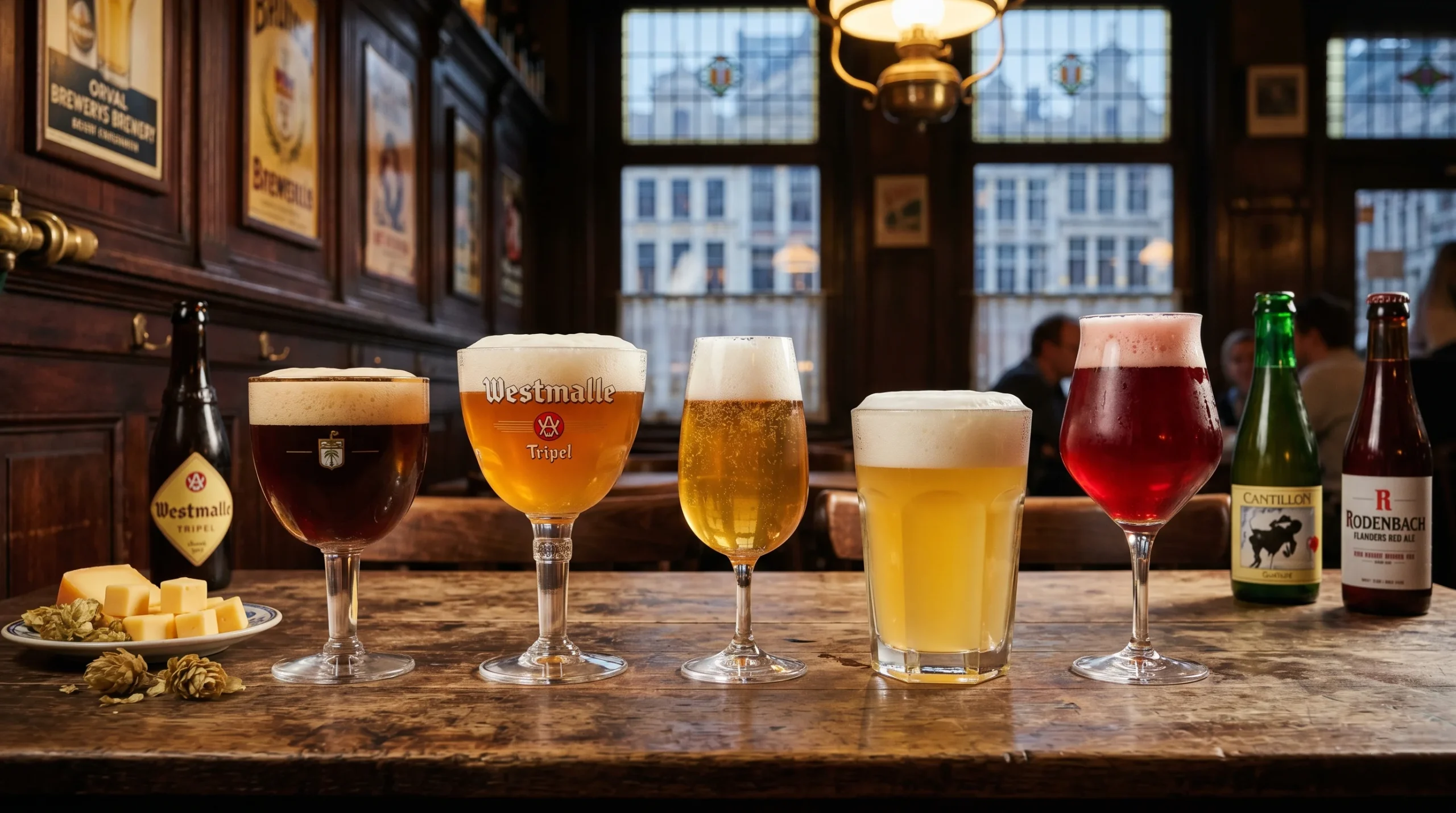
The decision came on November 30, 2016, at a meeting in Addis Ababa, Ethiopia.
UNESCO’s Intergovernmental Committee for the Safeguarding of the Intangible Cultural Heritage, made up of representatives of 183 countries, formally inscribed “Beer Culture in Belgium” as Intangible Cultural Heritage of Humanity.
The inscription was a statement from the international community: in Belgium, beer is heritage rather than a consumer product, on the same footing as Iranian pita baking, Cuban rumba, and the traditional festivals of Japan and Greece.
A small Western European country of just 11 million people, about a third the size of Vietnam, was now recognized by the whole world as the capital of beer culture.
Why Belgium?
There are many answers, and all of them start from one plain fact: in Belgium, beer is part of the national identity.
The average Belgian drinks 74 liters of beer a year, close to a glass a day. The country produces nearly 1,500 different beers, more than any other country in the world. At one point Belgium had more than 200,000 cafés, roughly one for every five houses. As late as the mid-20th century, low-alcohol “table beer” (about 1–2% ABV) was among the drinks served to pupils and students in Belgian schools and universities, on equal terms with tea and coffee.
Beer runs through every part of Belgian life. It is in the Trappist abbeys, where Cistercian monks have brewed for centuries to support their communities, and in the traditional brown cafés, where generations have sat and talked over a glass. It is in home kitchens, where it goes into the cooking and into beer-washed cheeses, and in the beer festivals held somewhere in the country every week. Above all, it is in the Belgian sense of time: some traditional sour beers spend up to 3 years in oak, a degree of patience few other countries share.
UNESCO’s 2016 decision looked past the quality of the beer to a way of life: brewing knowledge that a community has kept and developed for more than 1,000 years, until it became inseparable from the culture itself.
About This Article
What follows is a tour of that heritage and of the specific beer styles it produced.
The piece has two parts. The first covers culture and history: 1,000 years of Belgian beer, the Trappist abbeys, pub culture, the brewing families, and the reasons behind UNESCO’s decision. It is a story about people, about patience, and about how a small country turned brewing into an art.
The second covers Belgium’s 5 signature style families: Trappist Ales, the Lambic Family, Flanders Sours, Saison & Farmhouse, and Witbier & Belgian Specialty. This is the heritage in a form you can taste, each glass a piece of cultural history in concentrated form.
A final section turns to Vietnam: how drinkers here can reach this heritage and, more important, what Vietnam can learn from the way Belgium turned a drink into a culture.
It is written for anyone who has had Westmalle, Chimay, Orval, or Cantillon and wants to understand them better; for anyone who has never tried a Belgian beer and wonders why they are so highly regarded; and for anyone who has simply wondered, “A UNESCO heritage listing for… beer?”
The answer comes into focus over the next 9,000 words.
I1,000 Years of History, from the Middle Ages to Today
To see why Belgian beer earned UNESCO recognition, you have to start a long way back. Its history does not begin with the Industrial Revolution in the 19th century, or with the craft beer movement of the 20th. It begins in the Middle Ages, before Belgium existed, when this land was still called “Lower Lotharingia” and lay within the Carolingian Empire.
That is a thousand years of people living alongside microbes and wooden barrels, and of recipes handed from one generation to the next. No other country has that depth.
The Middle Ages: Beer Instead of Water
In the 10th–12th centuries, clean water was a luxury. Rivers and wells were often contaminated with bacteria, and a drink of water could kill you. Beer became the safest drink for ordinary people: boiling killed the bacteria, and the modest alcohol held back harmful microbes.
Everyone drank beer, women, children, and the elderly alike. Low-alcohol “table beer” (1–2% ABV) took the place of water at everyday meals, and children carried beer to school in a flask. This was a matter of survival, not of drunkenness.
In the monasteries, beer became part of religious life. Cistercian and Benedictine monks, and later the Trappists, raised brewing to the level of an art, making beer to drink and to sell to local people, which helped keep their communities going.
The 13th–15th Centuries: The Hop Revolution
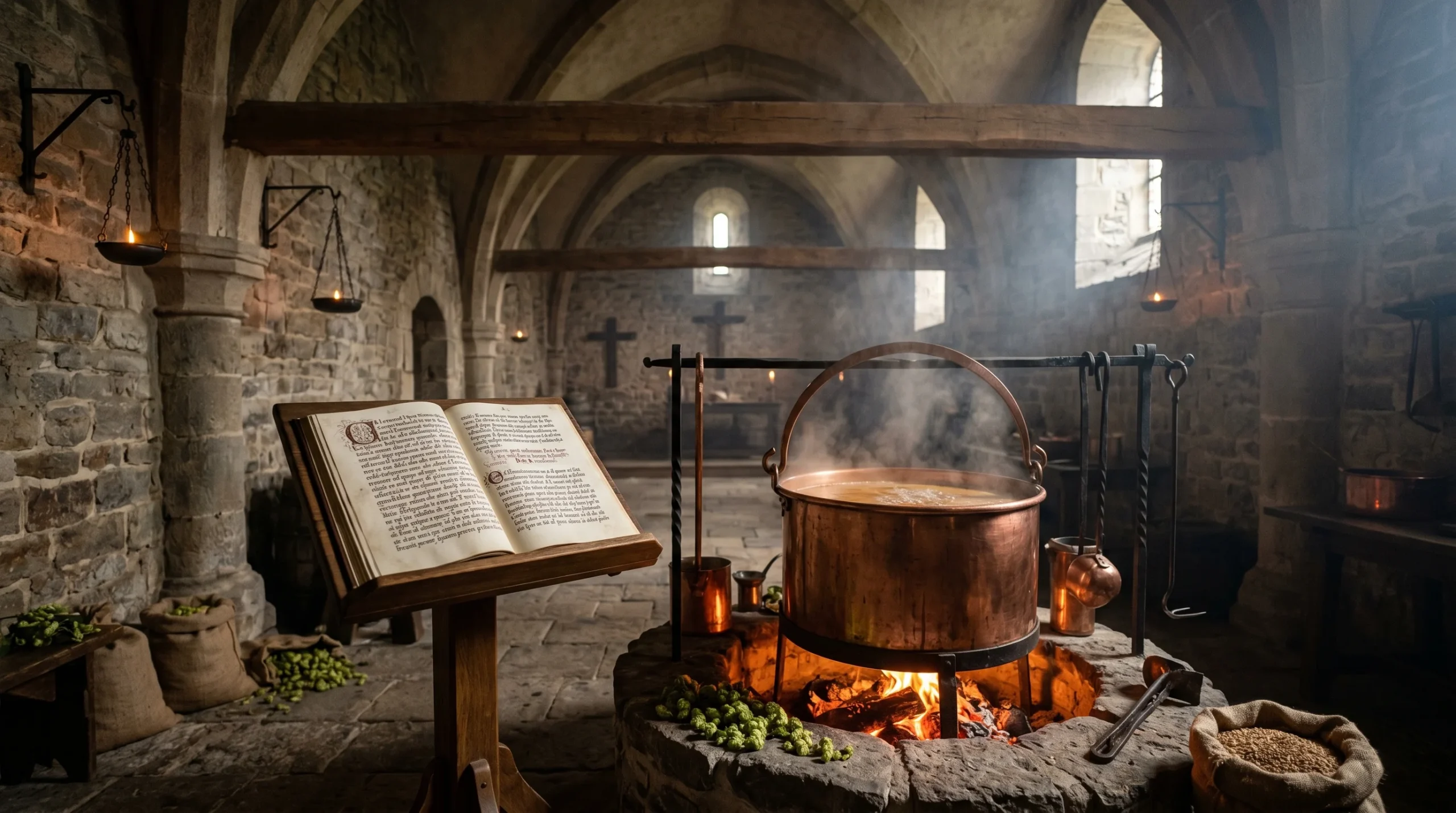
Before the 13th century, European beer was brewed with gruit, a mix of herbs and spices such as mugwort, rosemary, and thyme. Gruit gave a light bitterness and only limited protection against spoilage.
Around the 13th century, brewing with hops reached Flanders from Germany. Besides bitterness, hops have natural antibacterial properties, so hopped beer keeps far longer. The shift from gruit to hops took nearly 200 years, but by the 15th century hops had entirely replaced gruit in Belgian beer.
This is also when regional styles began to take shape. The Pajottenland, near Brussels, developed a tradition of spontaneous fermentation with wild yeast, the origin of Belgian Lambic. West Flanders developed oak-aged beers with a complex sour character, the forerunners of Flanders Red Ale. Wallonia, in the south, developed light, low-alcohol farmhouse beers for summer field hands, which became Belgian Saison.
The 19th Century: Industrialization and the Pressure of Pilsner
In 1842, in Plzeň (Bohemia, now the Czech Republic), the brewer Josef Groll created an entirely new kind of beer: Pilsner. Clear gold, light, clean, and refreshing, it conquered Europe within a few decades.
Belgian beer, mostly rich, hazy, complex ales, suddenly looked old-fashioned next to modern Pilsner. Hundreds of Belgian breweries closed. The number of styles fell sharply, and some classic styles all but disappeared.
Yet many Belgian breweries refused to give up their traditions. They kept brewing Lambic, Trappist ales, and Saison the old way, for cultural rather than economic reasons, since Pilsner plainly sold better. This was their knowledge and their inheritance.
That refusal, repeated at hundreds of small breweries across Belgium through the 19th century, saved Belgian beer from extinction. When UNESCO gave its recognition in 2016, it was in effect honoring a choice made by 19th-century Belgian brewers who would not abandon tradition to follow a trend.
Two World Wars and Heavy Losses
The 20th century opened with two disasters for Belgian beer. World War I (1914–1918) devastated northwestern Belgium, the region with the most breweries. The German army seized most of the copper brewing equipment, since copper was needed for munitions. More than 1,500 Belgian breweries closed for good during the 4 years of war.
By the time rebuilding began, many classic styles were gone. Local yeast strains that had been kept alive for generations vanished when their breweries shut. Family recipes died with the older brewers who were lost in the war.
World War II (1939–1945) repeated the damage. A few breweries came through both wars, among them Cantillon (Brussels, founded 1900), Rodenbach (Roeselare, founded 1821), and Chimay (founded 1862), and they became rare islands of heritage.
The 1960s–80s: Revival
After World War II, the Belgian beer industry had to rebuild almost from nothing. Through the 1950s and ’60s, most Belgian breweries made only Pilsner and a few basic Belgian ales. Lambic nearly died: only a handful of breweries still made it, and most of them sweetened it with syrup to make it easier to sell.
The revival began with an Englishman, not a Belgian. Michael Jackson, the influential beer writer rather than the singer, published “World Guide to Beer” in 1977 and devoted a large part of it to Belgium. For the first time, the wider world learned that a small country in Western Europe was still brewing Lambic, Trappist ales, and Flanders Red by traditional methods.
Jackson did what the Belgians had not managed to do for themselves: he turned Belgian beer into a discovery for the rest of the world. Foreign visitors began arriving in Brussels, Bruges, and Roeselare to try Lambic, Westvleteren, and Rodenbach, and shops devoted to Belgian bottles opened in New York, Tokyo, and London.
International demand gave Belgian brewers a reason to take pride in their own heritage. Lambic was revived, the Trappist ales gained stature, and classic styles were rediscovered.
The 21st Century: Craft Beer and Globalization
When the American craft beer movement took off in the 1990s and 2000s, brewers around the world began looking to Belgium for ideas. Every self-respecting craft brewery had to make a Belgian Tripel, a Belgian IPA, and an experimental Saison. Belgian beer became a school of brewing rather than one country’s tradition.
By the 2010s, Belgian beer was a benchmark as well as a heritage. When UNESCO made its decision in 2016, it was formalizing something the global beer community had long known: Belgium is where most of what is interesting in modern craft beer began.
Trappist Dubbel and Tripel are the roots of thousands of Belgian-style ales around the world. Lambic is the ancestor of the entire modern sour movement, from the revived Berliner Weisse to the brightly colored Smoothie Sour Ales all over Instagram (see Sour Beer: From Lambic to Sour IPA). Saison has become one of the most experimental styles in modern craft beer.
A thousand years is how long a small country has spent turning water, malt, hops, and microbes into an art, and that depth is what UNESCO recognized.
IIThe Trappist Abbeys: Where Prayer Meets Brewing
Of everything that makes up Belgium’s beer heritage, nothing stands apart like the Trappist tradition.
It is a way of brewing that no other country can copy, not because the technique is difficult but because of one essential condition: a community of Trappist monks living and working inside an abbey. You can buy the equipment, learn the recipes, and imitate the style, but you cannot become a Trappist monk overnight.
Every bottle of Westvleteren 12 comes from a community of Cistercian monks who have lived together at the Abbey of Sint-Sixtus since 1831, nearly 200 years. Every bottle of Orval carries the tradition of an abbey founded in 1132, nearly 900 years ago. What ends up in the glass is a way of life, bottled.
Who Are the Trappists?
The Trappists are a branch of the Cistercian order of the Roman Catholic Church. In 1664, Armand Jean le Bouthillier de Rancé, abbot of La Trappe in France, decided the Cistercians had grown too lax and lost their original austerity. He introduced the “Strict Observance,” a tighter rule of silence, labor, fasting, and prayer. The monks who followed it became known as “Trappists,” after the abbey of La Trappe.
Trappists live by the Rule of Saint Benedict, a monastic rule dating from the 6th century. One of its central phrases is “Ora et Labora”: pray and work. A Trappist monk gives most of the day to those two things, prayer and manual labor. The labor might be farming, baking, cheesemaking, or printing, and at many Belgian abbeys it is brewing.
The work is not meant to make money. It is part of monastic life, the way monks provide for themselves without depending on outsiders and a way of keeping spiritual discipline through physical work. To a Trappist monk, beer is not a commercial product but the by-product of the life they have chosen.
“Authentic Trappist Product”: A Logo That Means Something
By the 1980s and ’90s, the commercial beer industry had started trading on the Trappist name. Hundreds of commercial breweries brewed “Trappist-style” beer and advertised it as “Trappist,” though they had no connection with any abbey.
In 1997, the Trappist abbeys responded. They founded the International Trappist Association (ITA) and registered the “Authentic Trappist Product” (ATP) logo. Only beers that meet 3 strict criteria may carry it:
1. The beer must be brewed within the walls of the abbey. Not near the abbey, not in association with it, but inside it: the brewery must stand within the monastic grounds.
2. The beer must be brewed by monks or under their direct supervision. Hired staff may help with day-to-day operations, but the monks make the decisions and oversee the work.
3. Profits must not serve commercial ends. After the costs of running the abbey and supporting the monks, whatever remains goes to charity or to the needs of the local community. There are no shareholders, no investors, and no “growth targets.”

The ATP logo is a small hexagon printed on the label, a firm statement of a philosophy at odds with the rest of the world’s beer industry.
Belgium’s 6 Trappist Abbeys
There are currently about 10 ATP-recognized Trappist breweries in the world, and 6 of them are in Belgium, more than in any other country. That is why the world links “Trappist” with Belgium, even though there are technically Trappist breweries in the Netherlands, Austria, Italy, England, and the United States.
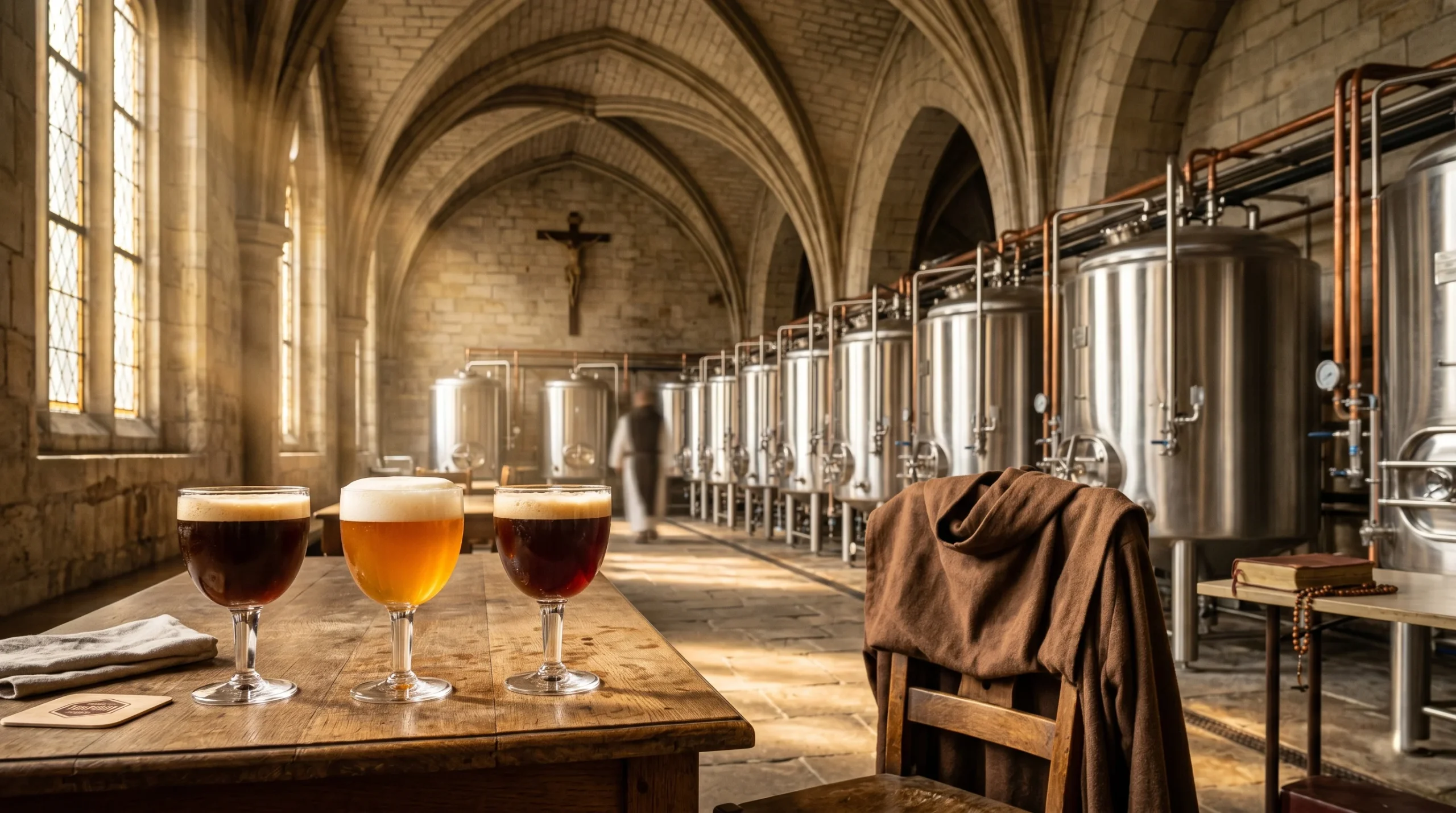
Westvleteren (Sint-Sixtus Abbey, founded 1831) is perhaps the most celebrated Trappist of all. The abbey brews only enough to support its community, with no expansion and no exports. Westvleteren 12 (a Quadrupel) regularly ranks among the top 5 beers in the world. To buy it, you must reserve by phone, you may take home only a limited amount, and you must collect it at the abbey in person. The monks have turned down every proposal to raise production or sell through modern distribution. “We are not a business,” the monks say. “We are a community of prayer.”
Chimay (Scourmont Abbey, founded 1862) is the best-known Trappist internationally. It makes 4 main beers: Dorée (served only at the abbey), Rouge (a Belgian Dubbel), Tripel (Cinq Cents), and Bleue (a Belgian Dark Strong Ale). Chimay is one of the few Trappists distributed widely around the world, and for most newcomers it is the first Trappist they taste.
Orval (Orval Abbey, restored in 1931 on the site of an abbey dating from 1132) is the most singular Trappist. The abbey makes a single commercial beer, Orval, a Belgian Pale Ale that is dry-hopped and given a dose of Brettanomyces. As a result, Orval keeps evolving in the bottle: drunk fresh (3–6 months), it is a completely different beer from one aged 1–3 years. Among connoisseurs, it is the favorite Trappist.
Rochefort (Abbey of Saint-Remy, founded 1230) is the third-oldest abbey in Belgium. It brews 3 beers: Rochefort 6 (a Belgian Dubbel), 8 (a lighter Belgian Dark Strong Ale), and 10 (a fuller Belgian Dark Strong Ale). Rochefort 10 is often counted among the most complex beers ever brewed, with notes of dried fruit, chocolate, port, and vanilla.
Westmalle (Westmalle Abbey, founded 1794) is the abbey that “defined” the two most important Trappist styles. In 1856, Westmalle created the Belgian Dubbel, a style now copied by thousands of breweries worldwide. In 1934, it created the Belgian Tripel, which redefined what a drinkable strong beer could be. Every brewery that makes a Dubbel or a Tripel today is working from Westmalle’s original template.
Achel (Sint-Benedictus Abdij, founded 1844) was the smallest of the Belgian Trappists. In 2021, its last two monks moved from Achel to Westmalle, and Achel lost its ATP certification because no monks lived at the abbey anymore. In 2023, the abbey was sold to a private owner, formally ending 177 years of Trappist tradition. It is a reminder that Trappist heritage is not permanent: it lasts only as long as a monastic community does.
Trappist vs. Abbey Beer: An Important Distinction
This is the point that causes the most confusion for anyone exploring Belgian beer.
Trappist beer is brewed by Trappist monks in a Trappist abbey, under the 3 ATP criteria above. Only 10 breweries in the world qualify, and 6 of them are in Belgium.
Abbey beer (Abdijbier / Bière d’Abbaye) is brewed in the Trappist manner but not inside an abbey. It may come from:
- A commercial brewery named after a former abbey (for example, Leffe, once a real abbey and now a brand owned by AB InBev)
- A brewery under contract to an abbey that does not brew for itself (for example, Maredsous, brewed by Duvel Moortgat for the Abbey of Maredsous)
- A brewery using the word “abbey” with no tie to any abbey at all (for example, Affligem)
Abbey beers can be excellent: Leffe Blonde, St-Bernardus 12, and Tripel Karmeliet are all high-quality beers. But they are not Trappist. The distinction matters for cultural reasons. Trappist beer is monastic heritage; abbey beer is a commercial product inspired by it.
When UNESCO gave its recognition in 2016, it counted both Trappist and abbey beer as part of Belgian culture, since both reflect the long relationship between religion and beer in Belgian history.
Beer as a Way of Life
There is a small story about Westvleteren. Some years ago, an American company offered to buy the rights to produce Westvleteren 12 in the United States, in a million-dollar deal. The monks said no.
Asked why, one monk answered: “We do not brew beer to sell it. We brew beer to keep the abbey going. If we produced more, we would become a business. And we do not want to be a business.”
This is the philosophy UNESCO recognized. Not the quality of the beer, not the range of styles, but a way of life in which brewing serves community, faith, and tradition instead of profit.
In a world that measures everything by GDP and growth rates, the Trappists do not fit, and perhaps that is exactly why theirs is the most precious part of the heritage.
IIIPub & Café Culture: Beer as Daily Life
The Trappists are the spiritual core of Belgian beer; the café is where its traditions are lived every day.
In Belgium, “café” does not mean what it means in France or Vietnam. A Belgian café is where you go for beer, not coffee. In the early 20th century, Belgium had more than 200,000 cafés, roughly one for every five houses. Every village had at least one, and every neighborhood had several. They were less a “service industry” than part of the country’s social architecture.
Café numbers have fallen in the 21st century; by 2005 only about 19,300 remained. But the culture survives. Every village still has at least one café, and every weekend there are still family meals that stretch across the whole afternoon at the local one. This is where UNESCO found its “living heritage”: in the small-town café, not in a museum.
The Brown Café
The “Brown Café” (Bruine Kroeg in Dutch) belongs to Flanders and the Netherlands. It is a traditional bar with dark wood interiors: tables, chairs, bar, and floor are all oak, darkened by decades of tobacco smoke, beer vapor, and warm lamplight.
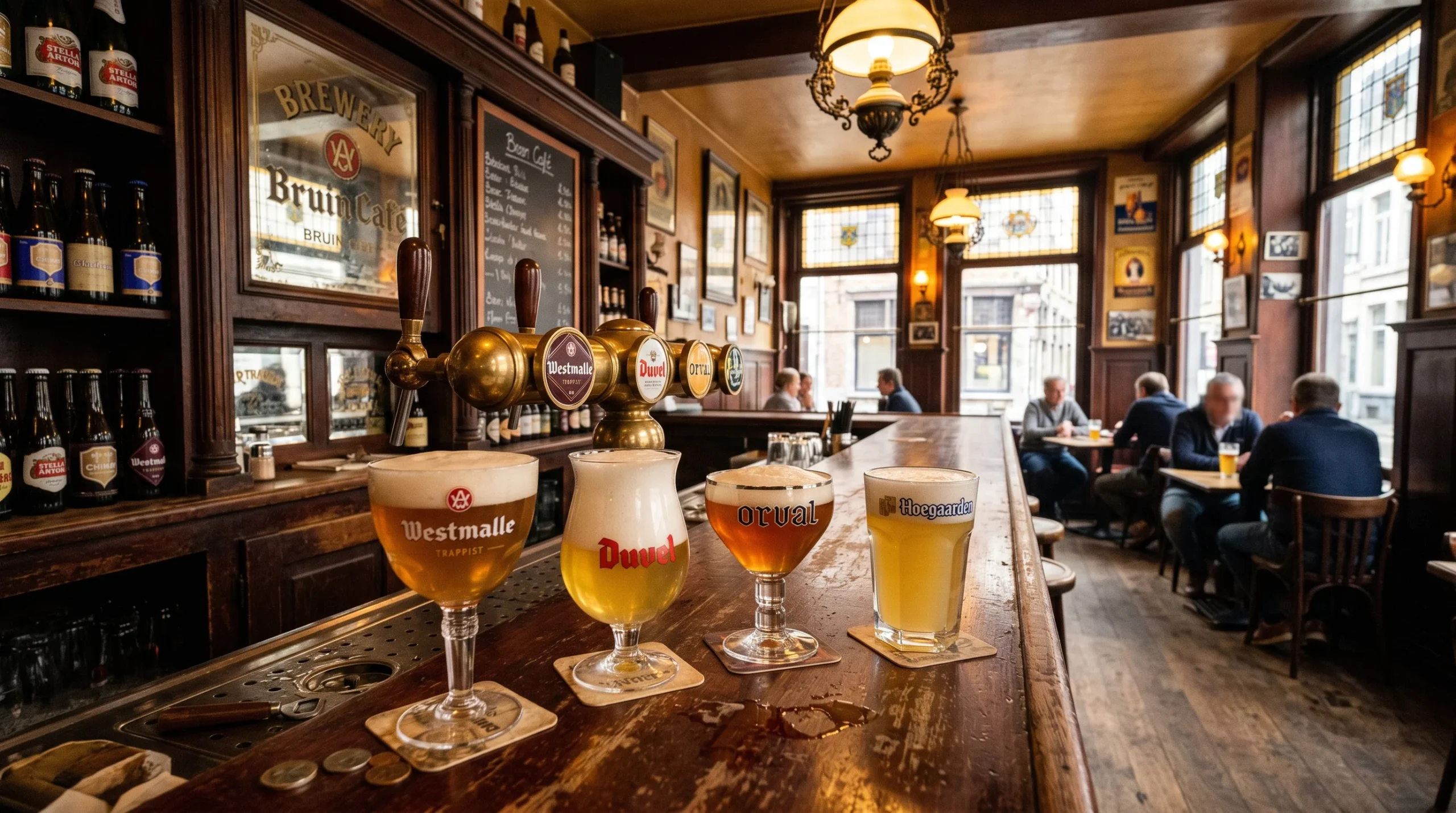
There is no TV, no loud music, no glossy printed menu. There is a chalkboard listing the beers, and there are people drinking slowly, talking, reading the paper. A typical brown café may stay at the same address for 100, 150, sometimes 200 years, usually family-run and handed down from one generation to the next.
In a brown café, Belgians do not hurry. A Westmalle Tripel can last 45 minutes, and a dinner with beer can run 3 hours. This is slowness as a philosophy: slow not out of laziness, but out of a wish to taste everything fully.
Glassware Culture: A Glass for Every Beer
This may be the most distinctive feature of Belgian beer culture, and the one that most surprises foreigners on their first visit to a Belgian café.
In Belgium, every beer has its own glass. Not simply a “big glass” and a “small glass,” but a glass designed for that particular style of beer, often with the brewery’s logo etched on the side.
- Westmalle Tripel is served in a stemmed chalice, designed to hold the head and lift the aroma
- Orval goes into an egg-shaped goblet that preserves the lively sparkle of its Brett re-fermentation
- Duvel goes into a short-stemmed tulip glass, designed to build a 2–3 cm head when poured correctly
- Kwak comes in a glass that cannot stand on its own, a round-bottomed, test-tube-like vessel served in Kwak’s signature wooden holder
- Lambic and Gueuze are poured into small stemmed glasses that hold their carbonation and complex aromas
- Witbier (Hoegaarden) gets its signature hexagonal glass, designed in 1957 by master brewer Pierre Celis
A café that serves Westmalle Tripel in a Duvel glass, or Orval in a Hoegaarden glass, is considered unprofessional, and customers may ask for the right glass. Many good cafés stock hundreds of different glasses, sometimes covering an entire wall behind the bar.
This is not fussiness. It is respect for the style. Each glass has been designed and tested to show off the aroma and flavor of its beer. Drinking Westmalle from an ordinary beer glass shortchanges it, much as drinking wine from a ceramic mug would.
Beer Menus as Thick as Books
A typical Belgian café lists 30–50 beers. That is only the baseline. Belgium’s “beer destinations” carry far more.
The best-known bar in the world for sheer number of beers is Delirium Café in Brussels, which holds the Guinness World Record for the longest beer menu on the planet, with more than 2,000 beers from around the world, hundreds of them Belgian. The menu is bound as a hardcover book as thick as a dictionary, and each beer is listed with its style, ABV, brewery, and a recommended pairing.
At Delirium Café, nobody orders in a hurry. You spend 20–30 minutes reading the menu and asking the bartender, perhaps trying a few samples before deciding. This is beer as discovery: every visit is a chance to find a new beer.
Beer at the Table: Pairing as Culture
In Belgium, beer is not confined to the café. It sits on the family table every day, especially at weekend dinners.
Beer pairing in Belgium is as developed as wine pairing in France. Every dish has its “right” beer: Trappist Dubbel with roast meats, Witbier with seafood, Gueuze with goat cheese, Saison with salads. Upscale restaurants in Brussels and Bruges employ “beer sommeliers,” beer-pairing specialists who play the role a wine sommelier does.
Beer also goes into the cooking. Carbonnade flamande, the traditional Flemish beef stew, is braised in Belgian Dubbel. Lapin à la Gueuze is rabbit stewed in Gueuze. Beer-washed cheese is a traditional Belgian product: the cheese is washed with beer as it ripens, which gives the rind its characteristic flavor.
This is not fine dining. It is the ordinary family meal: parents and grandparents around the table, each with a beer matched to the dish, talking for 2–3 hours. Children watch, learn, and join in gradually once they are old enough. That is how the heritage is handed down: through meals rather than books.
Festivals and Community
Every week, somewhere in Belgium, there is at least one beer festival. Some of the larger ones:
- Belgian Beer Weekend (Brussels, early September): held on the Grand Place in Brussels, with more than 50 Belgian breweries and tens of thousands of visitors from around the world.
- Tour de Geuze (Pajottenland, every 2 years): an open-doors weekend at all the Lambic breweries of the Pajottenland. Cantillon, Boon, Drie Fonteinen, and Hanssens all welcome the public.
- Zwanze Day (yearly, organized by Cantillon): the one day each year when Cantillon releases “Zwanze,” an experimental Lambic, poured simultaneously in Brussels and in dozens of cities around the world.
Beyond the festivals, Belgium has a network of brotherhoods, the beer guilds known as Bierorde. Each region has its own, which organizes events, educates the public, and defends local brewing traditions. Joining one signals real devotion to the heritage, a commitment rather than a hobby.
The Zythologist
Belgium was the first country with an official profession called the zythologist, a beer specialist. Like a sommelier for wine, a zythologist is formally trained at universities and specialist schools, sits exams for certification, and works in fine restaurants, at breweries, or as an independent consultant.
UNESCO specifically mentioned zythologists in its 2016 recognition, as evidence that brewing in Belgium had been professionalized to the level of an art.
The profession does not yet officially exist in Vietnam. There are serious beer enthusiasts and people who write about beer, but no official certification and no recognized profession. When Vietnam gets there, it will be a sign that Vietnamese beer culture has come of age.
IVBrewing Families: Tradition Across Generations
In Belgium, a brewery is family property as much as a business, handed from grandfather to father to son, sometimes across 5, 6, or 7 generations.
This was one of the points UNESCO stressed in its 2016 recognition: “knowledge passed down through families and breweries over centuries.” Not through textbooks or courses, but through word of mouth and shared work: a father working beside his son in the brewery, a grandfather teaching his grandson how to choose malt, how to taste wort, how to read the signals of the microbes.
Every family brewery in Belgium is a living library. When an elderly brewer dies, the loss is more than one person: a store of knowledge built up over decades can vanish with them if it has not been properly passed on.
Cantillon: One Family, One Style
In the world of Lambic, no name commands more reverence than Cantillon.
The brewery was founded in 1900 by Paul Cantillon in the Anderlecht district of Brussels. Today, more than 120 years and 4 generations later, it is still run by the family. Jean Van Roy, Paul Cantillon’s great-grandson, is the current master brewer.
What sets Cantillon apart is its refusal to modernize. The brewery still works with its original equipment from 1900: the same coolship (koelschip), the same old oak barrels, the same copper piping. Visitors find a brewery that looks exactly as Paul Cantillon built it at the start of the 20th century.
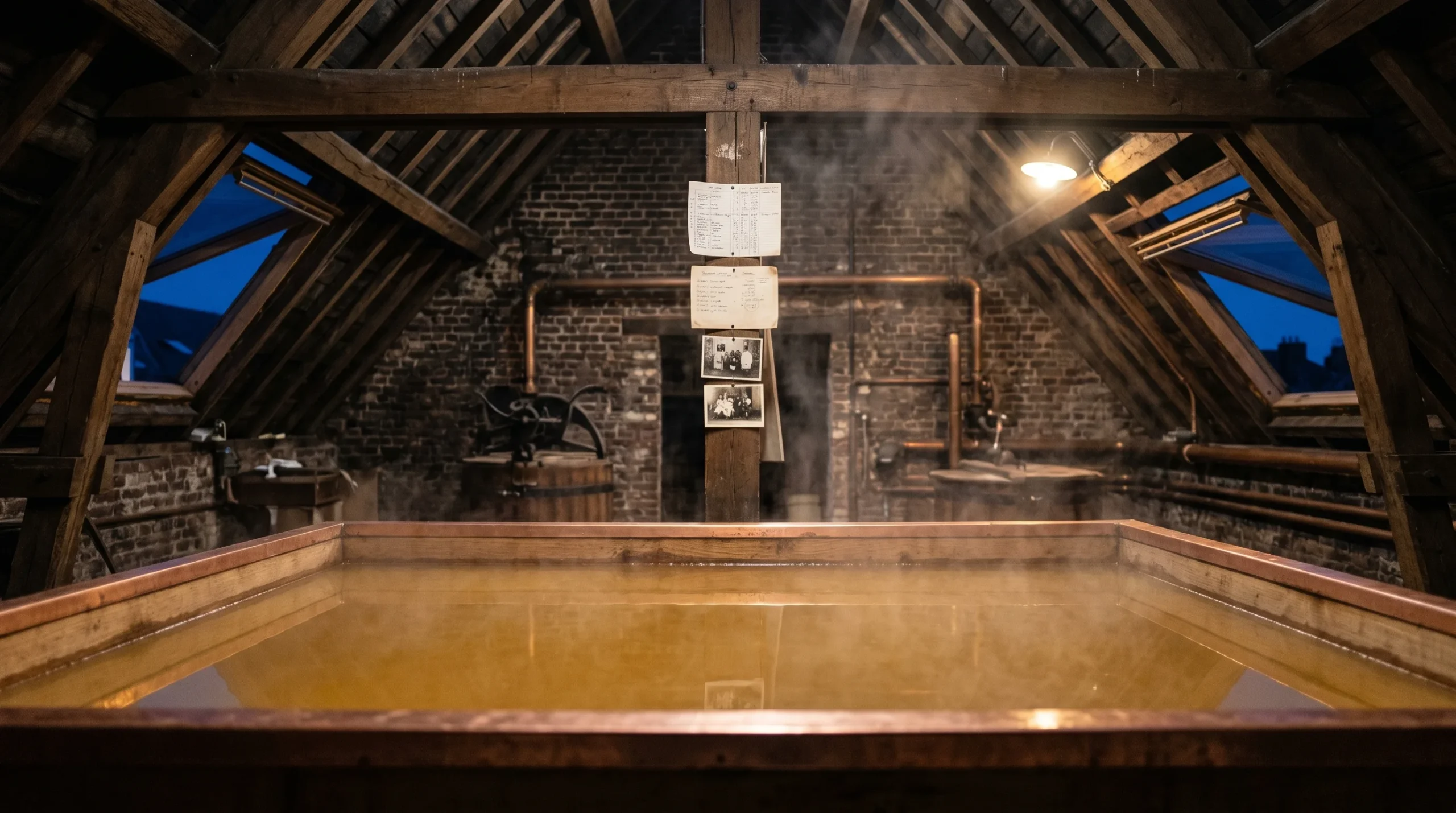
“I don’t change the equipment,” Jean Van Roy says, “because the natural microbes have ‘settled’ in these barrels over more than 100 years. If I replaced them with new ones, I would lose the very character that makes Cantillon.”
The philosophy is “I am not brewing beer. I am preserving it.” The brewery is a responsibility, not a possession. Each generation is only a temporary caretaker of the heritage, which it then hands on to the next.
Rodenbach: 200 Years of One Tradition
In West Flanders, the Rodenbach family defined a style: Flanders Red Ale. The brewery was founded in 1821 by the brothers Pedro and Alexander Rodenbach. After 200 years and many generations, Rodenbach is still known for its giant oak foeders, some of them more than 150 years old.
Each vat is numbered and has its history recorded. Each also has its own microbial population: over decades, Lactobacillus and Brettanomyces have “settled” in the wood and produced a character no one can reproduce. Some vats give a stronger character, some a gentler one, and Rodenbach’s master blender chooses among them to blend the final beer.
In the decades after World War II, Rodenbach came close to bankruptcy more than once. Pilsner was taking over the market, and Flanders Red was seen as “strange” and “old-fashioned.” But the family refused to change the recipe. They preferred to sell the brewery to the Palm Breweries group (1998) rather than abandon tradition. Palm, and later Swinkels Family Brewers, kept Rodenbach brewing exactly as it had for 200 years. It is a fortunate case: an acquisition that did not destroy the heritage.
Liefmans: The Woman Who Saved a Style
Another notable family story comes from Liefmans, a brewery that has made Flanders Oud Bruin since 1679, nearly 350 years. By the 1970s, Liefmans was close to bankruptcy.
Rose Blancquaert-Merckx, who had married the son of Liefmans’ owner, decided to save the brewery. She learned the trade from the old master brewer, took over the family recipes, and devoted most of her life to preserving the traditional Oud Bruin.
Through decades of financial trouble, Rose never changed the recipe. She handed over management several times, to Riva (1991) and to Duvel Moortgat (2008), but always on the condition that the original recipe stay intact. As a result, Liefmans Goudenband (an Oud Bruin) is still brewed today the way Rose directed in the 1970s and ’80s.
Rose Blancquaert-Merckx died in 2008. She left behind a brewery that is still alive and a distinctive Belgian sour style preserved for future generations.
Boon: Lambic’s Master Blender
Frank Boon was not born into a brewing family. He was an engineer who loved Lambic, and in 1975 he bought the small Vandersticken brewery in Lembeek (Pajottenland), whose owner was about to retire with no successor. Frank renamed it “Boon” and took on a task few would attempt: reviving Lambic at a time when Lambic was dying.
In the 1970s and ’80s, Lambic barely sold. Most of it was sweetened with syrup to make it easier to drink, and the traditional sharp, sour, funky character had all but vanished. Frank Boon refused to follow the trend. He made Lambic and Gueuze the traditional way, sour and funky, with no syrup, and accepted low sales for 20 years.
Today, nearly 50 years on, Frank Boon is regarded as the most important master blender in modern Lambic. Together with Cantillon and 3 Fonteinen, Boon saved Lambic from extinction, and specialist Lambic bottle shops around the world now count Boon among the brands they cannot do without.
The brewery is now run by Karel Boon, Frank’s son, who carries the tradition forward. It is a story of persistence: 50 years in one style of beer, without compromise.
Carry On or Sell?
Not every brewing family gets a happy ending. In recent years, many Belgian family breweries have faced a hard question: does the next generation want to carry on?
Traditional Belgian brewing is hard work. It demands deep knowledge and a great deal of manual labor, and it earns thin profits compared with other industries. Many brewers’ children choose other careers and become doctors, engineers, or lawyers. Without a successor, a family brewery usually has three options:
- Sell to a large group (AB InBev, Heineken, Carlsberg), which often means the recipe is changed to cut costs
- Sell to another brewery with the same philosophy (Duvel Moortgat, Palm/Swinkels), which may preserve the tradition but loses the “family” element
- Close, and lose the heritage entirely
This is the biggest challenge facing Belgium’s beer heritage in the 21st century. UNESCO recognition may raise awareness, but it cannot solve the succession problem. Every year, some Belgian family breweries still close or change hands, and each time a piece of the heritage may disappear.
That is why every bottle of Cantillon, Rodenbach, or Boon you open today is a piece of history being kept alive. Not for business, not for profit, but because some people still believe that beer in Belgium deserves to be made the way their forebears made it.
VWhy UNESCO Recognized Belgian Beer: A Closer Look
After 5 sections on culture and history, it may already be clear why UNESCO decided as it did in 2016. Still, it is worth being precise: what criteria does UNESCO apply, and how does Belgian beer meet them?
What Is “Intangible Cultural Heritage”?
UNESCO keeps several kinds of heritage list. The best known covers World Heritage Sites, physical heritage such as Ha Long Bay, the former imperial capital of Hue, and Hoi An Ancient Town (Vietnam has 8 sites on this list).
UNESCO also keeps a different list, Intangible Cultural Heritage of Humanity. It is reserved for cultural practices: not places or objects, but the ways people live and work.
Vietnam has a number of intangible elements recognized by UNESCO as well: the Quan Họ folk songs of Bac Ninh, Ca Trù singing, Nhã Nhạc court music of Hue, the worship of the Mother Goddesses of the Three Realms, and the Đờn Ca Tài Tử music of southern Vietnam. All of them are cultural practices, not monuments.
Belgian beer sits on this list alongside practices such as Cuban rumba, the Iranian and Turkish art of pita baking, and Japanese sake-making (recognized only in 2024).
UNESCO’s 5 Criteria
Under UNESCO’s 2003 Convention for the Safeguarding of the Intangible Cultural Heritage, a practice must meet 5 basic criteria to be recognized:
1. It is passed down from generation to generation
How Belgian beer meets it: 1,000 years of tradition, from medieval monasteries to today’s family breweries. Brewing knowledge passes through brewing families, through the Trappist communities, and through formally trained zythologists. No other country has such a long, unbroken chain of beer tradition.
2. It is created and re-created by communities
How Belgian beer meets it: 1,500 beer styles brewed by more than 150 breweries, by many communities rather than a single corporation. Each region has its own styles (Pajottenland for Lambic, West Flanders for Flanders Red, Wallonia for Saison). Each brewery is a small community, and each café is a place where the culture is practiced.
3. It provides a sense of identity and continuity
How Belgian beer meets it: beer is so much a part of Belgian identity that many Belgians put it this way: “When I speak French, I am Walloon. When I speak Dutch, I am Flemish. But when I drink beer, I am Belgian.” Beer connects Belgium’s two language communities, which are often at odds.
4. It is compatible with human rights and mutual respect
How Belgian beer meets it: Belgian beer culture includes organizations that promote “responsible beer consumption” and discourage excess. Trappist monks give their beer profits to charity, and brewing families share their knowledge with the community.
5. It sustains cultural diversity
How Belgian beer meets it: in a world dominated by commercial beer (Pilsner and industrial lager), Belgium stands for diversity of style. Its 1,500 different beers show that cultural diversity can hold out against the pressure of globalization.
Comparison with Other Heritage Listings
To see where Belgian beer stands on the UNESCO list, compare it with similar listings:
Traditional Mexican Cuisine (2010): the whole of traditional cooking in Mexico (corn, beans, chiles, tortillas, mole). It was the first food or culinary tradition UNESCO recognized.
Mediterranean Diet (2013): the food culture of the Mediterranean (Italy, Spain, Greece, Morocco, Croatia, Cyprus, and Portugal).
Pizza Napoletana (2017): the art of making pizza the traditional way in Naples.
French Gastronomic Meal (2010): French dining culture, the multi-course meal with wine.
Belgian Beer Culture (2016): the beer culture of Belgium.
If France was recognized for how it eats, Belgium was recognized for how it drinks. Both stand for a philosophy of slow living that treats food and drink as an art.
The Road to Inscription, 2014–2016
Getting onto the UNESCO list is not simple. For Belgium, the process began in 2014.
Norbert Heukemes, a civil servant from Belgium’s German-speaking East Cantons, led the project. With Sven Gatz (a Brussels politician and beer enthusiast) and representatives of Belgium’s three language communities (Flemish, French, and German), he spent more than 2 years preparing the nomination file.
The file had to demonstrate:
- That beer is a living cultural practice, not merely a product
- That Belgian communities are committed to safeguarding it
- That there is a concrete plan for passing it on to future generations
- That the communities involved (Flemish, Walloon, and German-speaking) agree
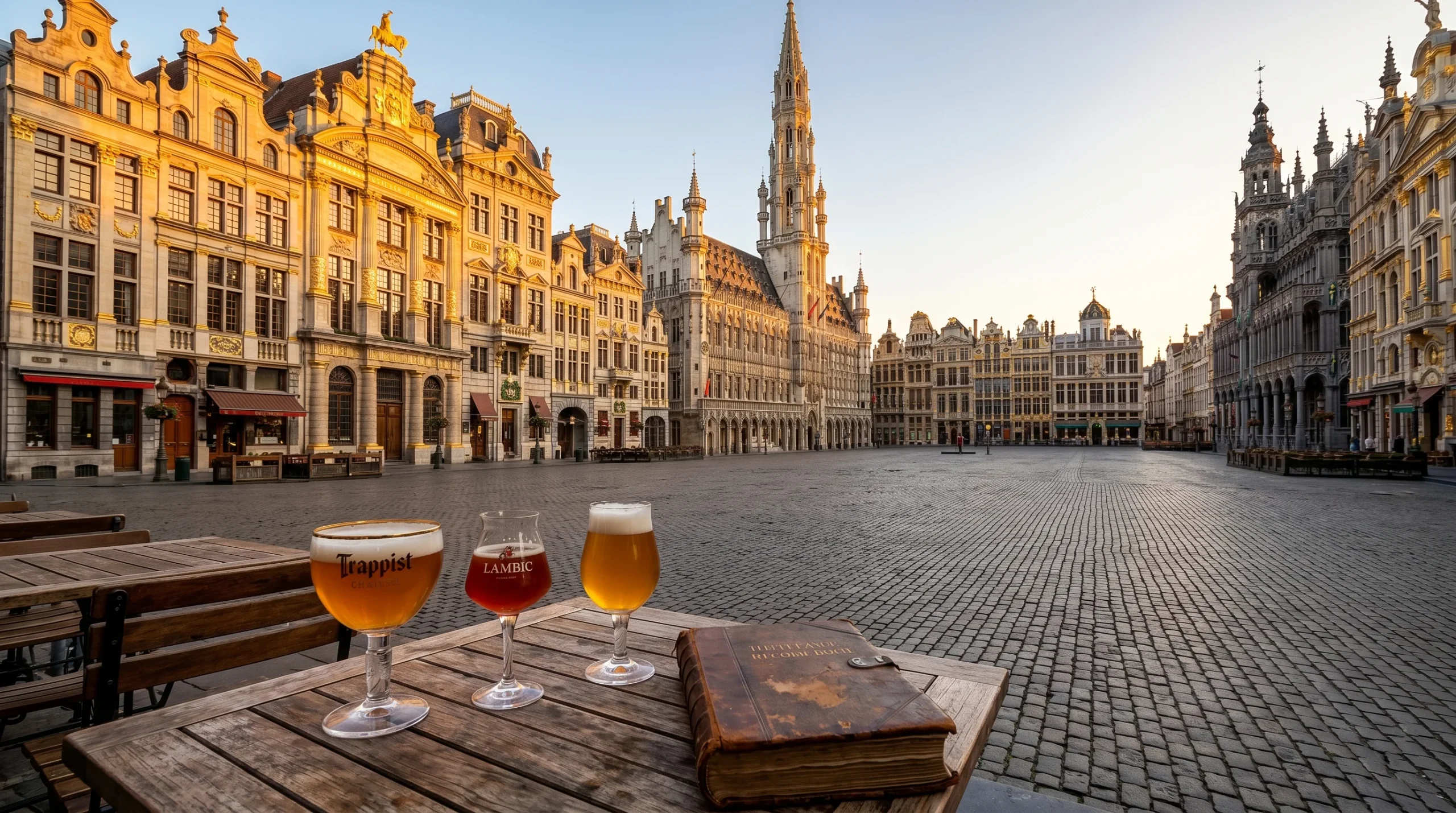
On November 30, 2016, in Addis Ababa (Ethiopia), the UNESCO committee of 183 countries voted, and the decision passed. Sven Gatz received the news by text message from Norbert Heukemes in Ethiopia. Within hours, the international press had gathered on the Grand Place in Brussels for “the celebratory photo” at the Brewers House.
What It Means for the Global Beer Community
The 2016 recognition was not only a Belgian event. It mattered to beer communities everywhere, because it made something official: beer can be cultural heritage, on a par with wine, cuisine, and traditional musical instruments.
Since Belgium, other countries have moved to protect their own drinking cultures:
- Georgia (2013): the ancient qvevri winemaking method
- Spain (2024): the cider culture of Asturias
- Japan (2024): traditional sake-making with koji mold
- Czech Republic (2025): beer and brewing culture (recognized nationally, with a UNESCO nomination under way)
Belgium led the way. Since then, other countries have looked at their own drinking cultures and realized that this, too, is heritage worth protecting.
Perhaps one day Vietnam will nominate a drinking culture of its own: traditional phin-filter coffee, perhaps, or rượu cần (jar-fermented rice wine) from the Central Highlands, or nước mắm (Vietnamese fish sauce) from Phu Quoc. If it does, Belgium will be the first precedent to point to, the proof that beer can be heritage and that a drink can carry a whole culture.
VIBelgium’s 5 Style Families: An Overview
After 6 sections on culture and history, the article turns to the part you can taste: Belgium’s specific beer styles. This is where 1,000 years of heritage meet the glass on the table.
Belgium makes nearly 1,500 beers, but they fall into 5 main style families. Each has its own brewing philosophy, its own home region, and its own independent history.
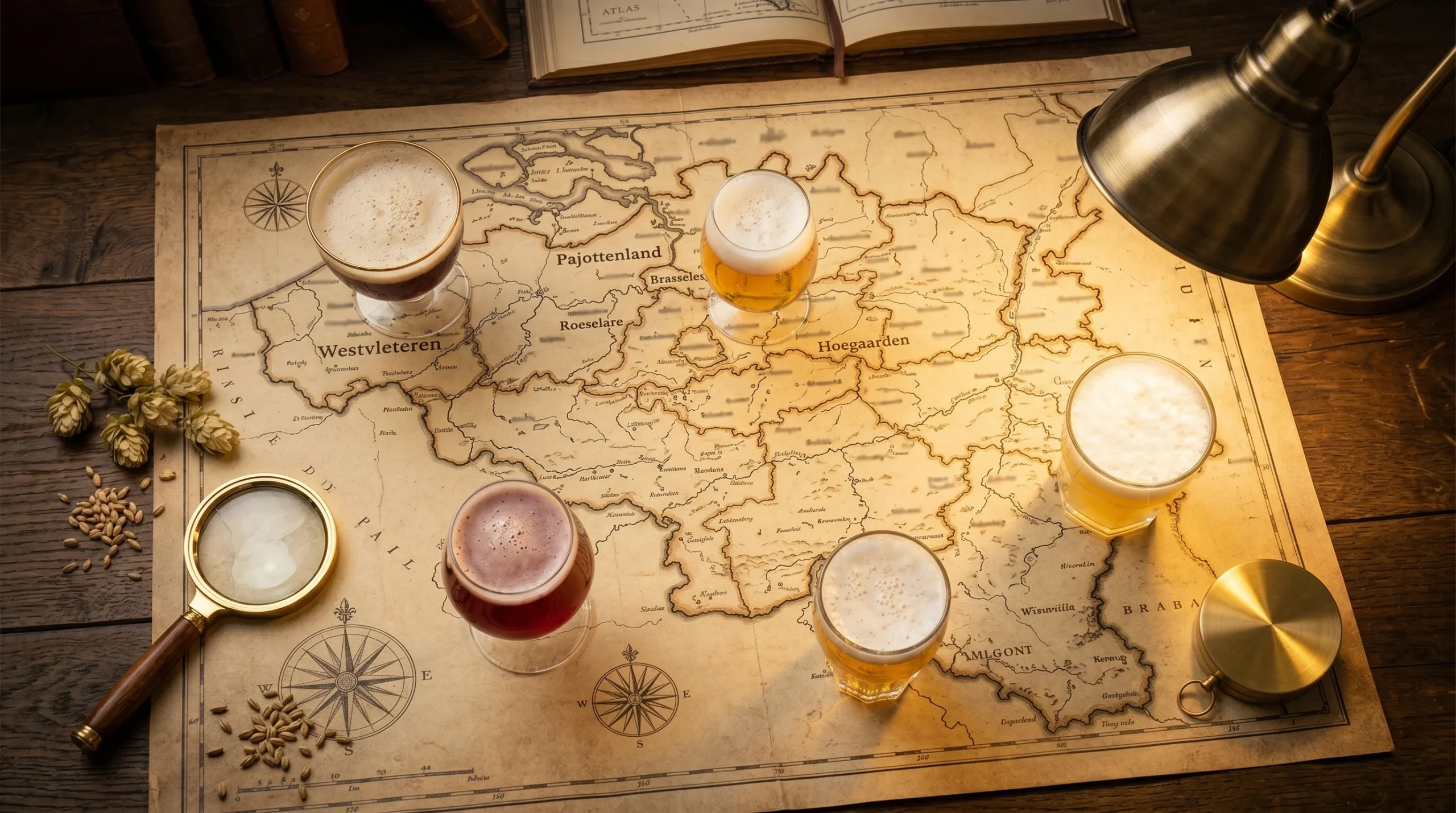
The 5 Families
1. Trappist Ales: the beers of the Cistercian monks, brewed inside abbeys under the ATP rules. The family includes Belgian Single (Patersbier), Belgian Dubbel, Belgian Tripel, and Belgian Dark Strong Ale (Quadrupel). Hallmarks: bottle conditioning, complex Belgian yeast, and candi sugar that raises the ABV while keeping the body light.
2. Lambic Family: spontaneously fermented sour beers from the Pajottenland. The family includes Belgian Lambic, Belgian Gueuze, Belgian Fruit Lambic, and Belgian Faro. Hallmarks: wild microbes from the air, 1–3 years in wooden barrels, and a sharp, sour, funky character. (Covered in detail in Sour Beer: From Lambic to Sour IPA.)
3. Flanders Sours: “wine-like” sour beers from West Flanders. The family includes Flanders Red Ale and Flanders Oud Bruin. Hallmarks: long aging in oak and a character of sourness, chocolate, and dark fruit, closer to Burgundy wine than to ordinary beer.
4. Saison & Farmhouse: farmhouse beers from Wallonia (southern Belgium) and the French border country. The family includes Belgian Saison, French Bière de Garde, and Belgian Grisette. Hallmarks: Belgian yeast that throws fruity and spicy esters, a very dry finish, an ABV that ranges from light to strong, and an origin as a drink for field hands.
5. Belgian Specialty: Belgian styles outside the 4 families above. The group includes Witbier (spiced wheat beer), Belgian Pale Ale, Belgian Blonde Ale, and Belgian Pale Strong Ale, also called Belgian Golden Strong Ale (Duvel). Hallmark: a spirit of free experimentation. Unbound by rigid local traditions, Belgian brewers invent new styles here.
Some Belgian styles are covered in more depth in other articles:
- Lambic Family + Flanders Sours: the microbes, the history, and each substyle, in Sour Beer
- Belgian IPA: the Belgian-American hybrid, in Bitter Beer
- Belgian Dark Ale: in the Dark Ales group of Dark Beer
VIITrappist Ales: The Monks’ Beers
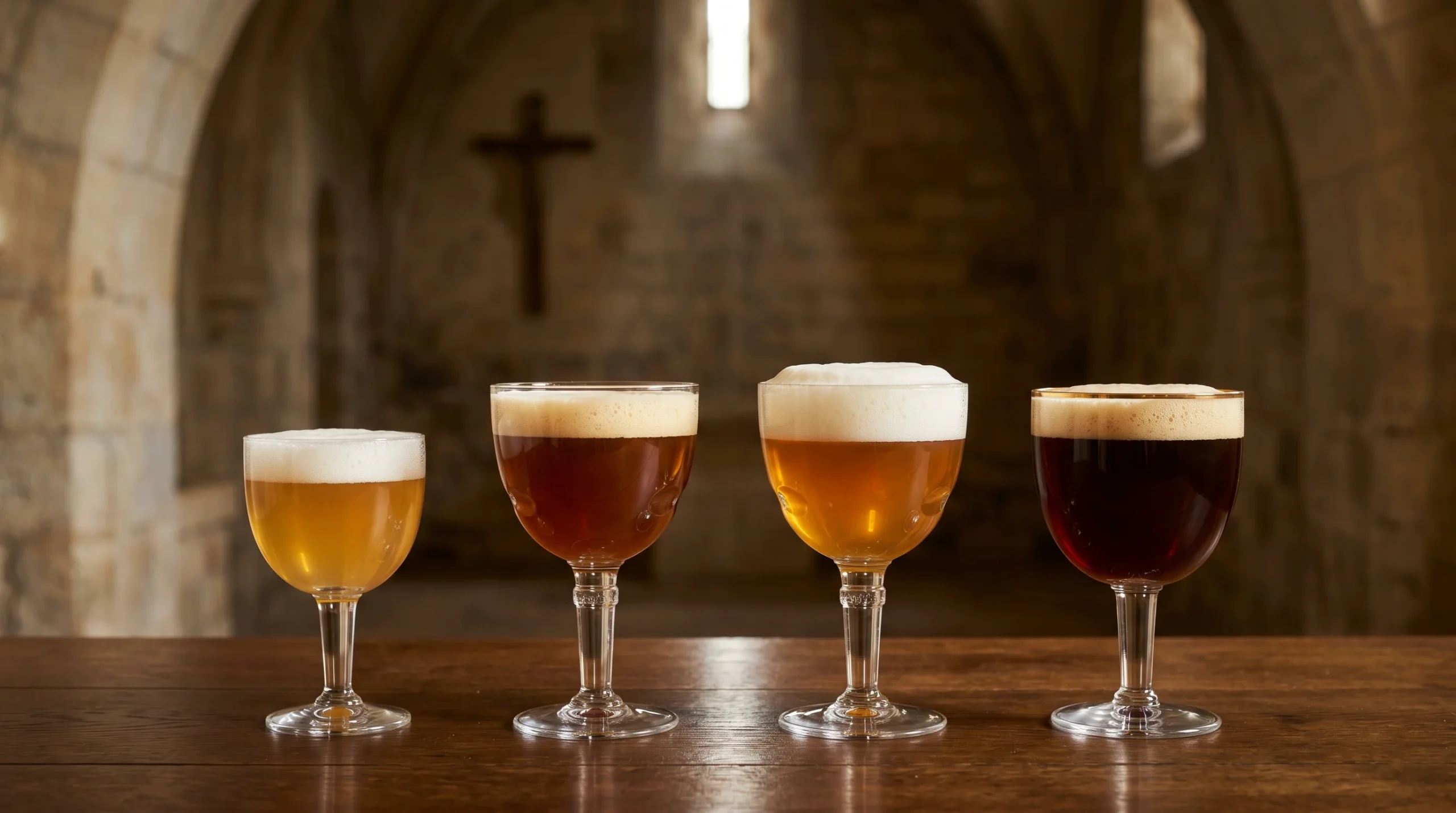
Trappist Ales are a family rather than a single style. It has 4 main members, in order of rising strength: Belgian Single (Patersbier), Belgian Dubbel, Belgian Tripel, and Belgian Dark Strong Ale (Quadrupel).
The sequence “Single, Double, Triple, Quadruple” is no accident. In the old Trappist tradition, abbeys brewed several strengths from the same basic recipe, changing only the amount of malt. Each strength had its own designation:
- Enkel (Single): the monks’ everyday beer, the lowest in alcohol and never sold commercially
- Dubbel (Double): a richer version for honored guests and for sale
- Tripel (Triple): a strong, golden-amber beer for special occasions
- Quadrupel (Quad): the strongest and richest, for major feast days
The Westmalle brewery developed this numbering in the 19th century, and it has become the global standard for Belgian-style ales.
Belgian Single (Patersbier): The Monks’ Own Beer
In Dutch, “Patersbier” means “the monks’ beer”: the beer the monks drink every day at the abbey.
It is the least known of the Trappist styles, because most of it is never sold. Trappist monks traditionally drink Patersbier with their meals. It is low enough in alcohol not to interfere with work and prayer, and light enough in flavor not to overwhelm the plain food of the abbey.
A few Patersbiers do reach the market: Westvleteren Blond (low ABV), Achel Blond (before 2021), and Chimay Dorée (Chimay Gold). All are versions of the “table beer” the monks drink every day, released commercially in limited quantities.
Character: pale gold, light body, gentle Belgian yeast notes (banana esters, a little spice), and a dry finish. It is understated enough that it has no need to impress; it is built to be drunk several times a day without tiring the palate.
Belgian Dubbel: The Defining Style
In 1856, the Westmalle brewery created Westmalle Dubbel, a richer version of the traditional Patersbier. It is deep brown from lightly roasted malt, with dried fruit (raisin, prune, fig), a little chocolate, and caramelized candi sugar. Its ABV is higher than a Patersbier’s but still moderate.
Westmalle Dubbel became the global benchmark. Thousands of breweries have copied it: Chimay Red, La Trappe Dubbel, Rochefort 6, St-Bernardus 8, and many versions from the United States, Japan, and Australia.
A “true” Dubbel relies on Belgian yeast for complex esters (fruit and light spice), adds Belgian candi sugar (caramelized sucrose) to raise the ABV without adding body, and is bottle-conditioned for natural carbonation. It is no ordinary strong brown ale: its complexity comes from malt, yeast, and carbonation working together.
Ideal pairings: roast duck, braised meats, hard cheeses (Gouda, Parmesan), and dark chocolate.
Belgian Tripel: Strength Without Weight
Also at Westmalle, in 1934, the brewmaster Hendrik Verlinden created Westmalle Tripel, and with it redefined what a drinkable strong beer could be.
The idea behind a Tripel is strength without heaviness. Most high-ABV beers have a thick body and an obvious alcohol taste, which makes them hard to drink in quantity. A Tripel uses clever technique to keep the body light while the alcohol stays high. The secret lies in:
- Pilsner malt (pale), which avoids the heavy body of Munich or caramel malt
- Belgian candi sugar, which ferments out completely and leaves no body behind
- Belgian Trappist yeast, highly attenuative, which ferments the beer dry and produces fruity esters instead of sweetness
- European noble hops such as Saaz, Hallertau, and Styrian Goldings, for floral, grassy aromas and moderate bitterness
The result is a bright golden amber beer with aromas of tropical fruit and spice (clove, white pepper, citrus), a medium body, high ABV with the alcohol well hidden, and a dry finish.
Westmalle Tripel remains the benchmark. Other excellent Tripels: La Trappe Tripel, Chimay Cinq Cents (a Tripel), Tripel Karmeliet (Bosteels, brewed with added wheat and oats), and St-Bernardus Tripel.
Ideal pairings: roast chicken, grilled seafood, soft cheeses, and salads with cold cuts. A Tripel is just as good with no food at all, alongside a long conversation.
Belgian Dark Strong Ale (Quadrupel): The Top of the Ladder
If the Dubbel is rich and the Tripel is strong, what is a Quadrupel?
The Belgian Quadrupel (Quad) combines the strength of a Tripel with the richness of a Dubbel. Its color runs from deep brown to mahogany. The aroma is full of dried fruit (raisin, fig, dark cherry, plum), with caramel and port, sometimes vanilla and chocolate. The ABV is very high. The body is medium-full, but the high attenuation of Belgian yeast keeps it from turning heavy.
This is the style of Westvleteren 12, Rochefort 10, St-Bernardus Abt 12, and La Trappe Quadrupel, beers that regularly rank among the top 50 in the world on RateBeer and BeerAdvocate.
Above all there is Westvleteren 12, the hardest beer in the world to buy: sold only at the Abbey of Sint-Sixtus, rationed per customer, never advertised, never officially exported. Many drinkers still rank it first among all the world’s beers. That is a big claim, and a hard one to dispute after tasting it.
A Quad is not a beer to rush. A 33 cl bottle can last 45–60 minutes, and as it warms it opens up and reveals new layers of flavor. This is a beer for a special evening, not for every day.
Ideal pairings: blue cheeses (Roquefort, Stilton), dark chocolate desserts, or simply a good book on a Saturday night.
Trappist Ales in Vietnam
Trappist ales are among the most popular Belgian beers in Vietnam, thanks to the clear ATP label, the appealing story, and their dependable quality.
The Trappists easiest to find in Ho Chi Minh City and Hanoi:
- Chimay (Red, Tripel, Bleue): the most common and most widely distributed, and the natural place to start.
- Westmalle (Dubbel, Tripel): the benchmark for both styles, and essential.
- Orval: the most unusual, with Brett. Newcomers may be caught off guard by its character.
- Rochefort (6, 8, 10): harder to find, but worth buying when you see it.
- La Trappe (from the Netherlands rather than Belgium, but still an ATP Trappist): easy to find and reasonably priced.
Westvleteren 12 is almost never available in Vietnam through official channels, since the abbey does not export. If you do see it for sale, be wary about authenticity and price.
Advice for newcomers: start with Chimay Red (a Dubbel) or Westmalle Tripel. Then move up to Rochefort 10 or Chimay Bleue (Quadrupel). Finally, if you get the chance, try Orval, the most individual of the Trappists and unlike anything else.
VIIILambic & Flanders: Belgium’s Sour Beers
Belgium’s two most important sour families, the Lambic Family and the Flanders Sours, are covered style by style in Sour Beer: From Lambic to Sour IPA. This section takes a different angle: the part Belgian geography played in creating them.
It is no coincidence that the world’s two most important sour traditions both come from Belgium. There is a specific reason, rooted in geography and microbiology.
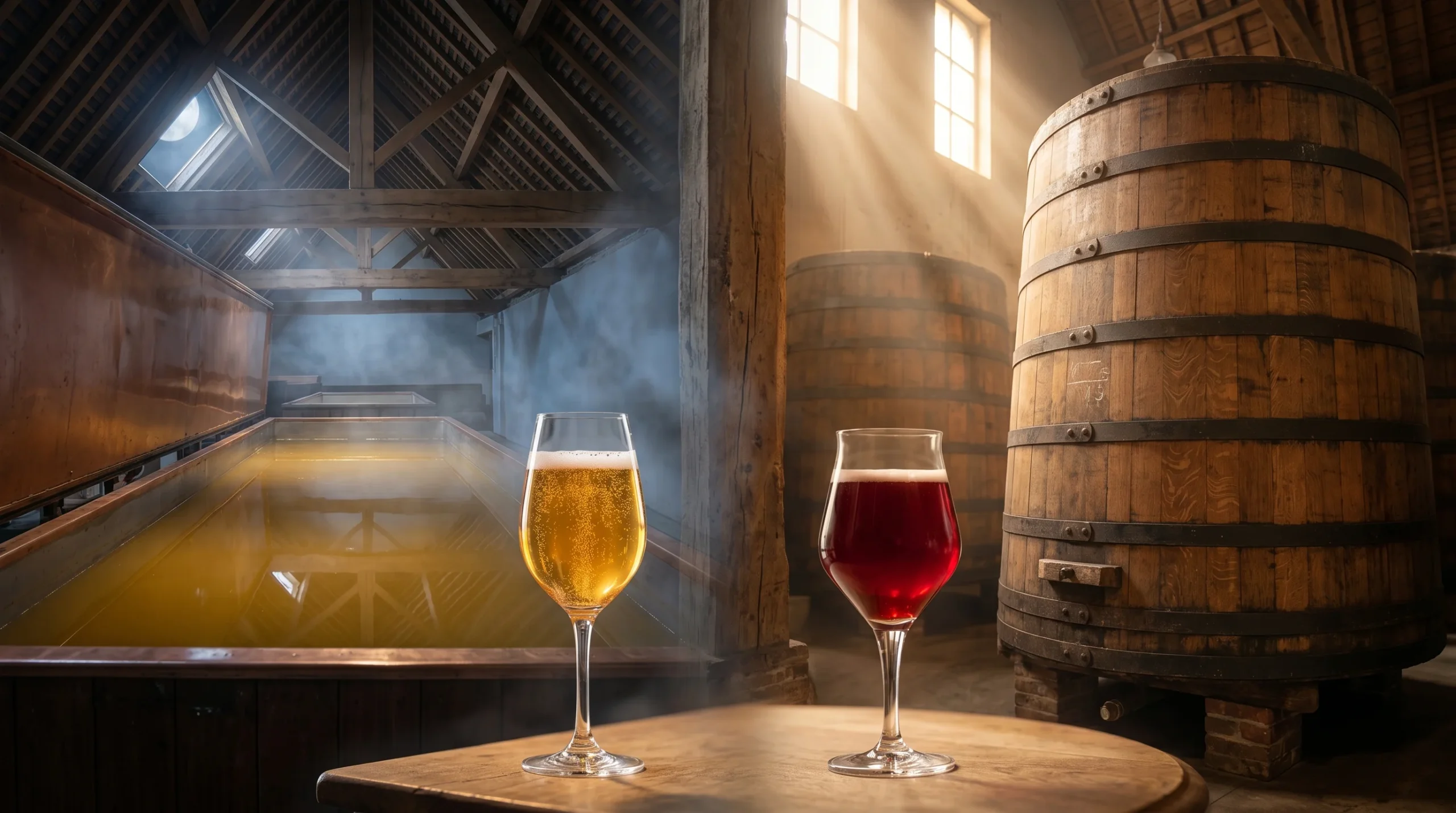
The Pajottenland: Home of Wild Microbes
The Pajottenland is a small farming region west of Brussels, about 25 by 30 km. On a map it is so small that many Belgians do not know its name. In the beer world, though, it is one of the most hallowed places of all.
It is the only place in the world where “true” Lambic can be brewed. The reason is the wild microbes in its air: Brettanomyces bruxellensis, Brettanomyces lambicus, and characteristic species of Lactobacillus and Pediococcus, a mix that cannot be reproduced elsewhere. Brewers outside the Pajottenland can buy lab cultures of the same species, but they cannot recreate the diverse microbial balance the region has naturally.
What makes the Pajottenland’s conditions special:
- A mild climate, neither too cold nor too hot, which keeps microbes active all year
- High humidity, with the Senne river running through the area and creating a damp microclimate
- A farming tradition of barley and hops, so the microbes in the soil and air have adapted to brewing ingredients over centuries
- Accumulated history: more than 500 years of Lambic brewing have “settled” microbes into the breweries, the storehouses, and the brick walls
The EU has formally recognized this. Lambic is a Traditional Specialty Guaranteed (TSG), a form of legal protection similar to that of “Champagne”: it can be produced only in a specific geographic area.
The largest Lambic breweries today: Cantillon (Brussels, at the heart of the Pajottenland), 3 Fonteinen (Beersel), Boon (Lembeek, the village that gave “Lambic” its name), Lindemans (Vlezenbeek), and a few smaller breweries.
West Flanders: The Oak Vat Tradition
West Flanders lies about 100 km west of the Pajottenland, near the French border. The climate is different, the microbes are different, and so is the sour beer.
Where the Pajottenland practices fully spontaneous fermentation (Lambic), West Flanders developed a tradition of long aging in oak. Brewers begin with a controlled Saccharomyces yeast, then let the beer “develop” in wooden vats where Lactobacillus and Brettanomyces have settled into the wood.
Why did the tradition take hold in West Flanders? Two factors:
1. A warmer climate than the Pajottenland. Before refrigeration, West Flanders brewers had to find a way to keep beer through warm weather. Oak vats holding microbes adapted to warm conditions were the answer.
2. A woodworking tradition. West Flanders has long built large wooden vats (foeders) for wine and beer. The Rodenbach brewery developed a system of giant foeders, some holding 6,000–15,000 liters, standing 5 m tall, and more than 100 years old.
Rodenbach’s foeder halls are known as the “cathedral of beer.” Visitors to Roeselare can tour them and see dozens of giant wooden vats lined up in vaulted halls like a church.
Each vat has its own microbial character. The master blender, the most important position in the brewery, chooses among them to blend the final beer. It is a kind of applied microbiology that cannot be fully taught from books; it is learned over many years at the side of an older master blender.
The most important Flanders sour breweries: Rodenbach (founded 1821, Roeselare), Verhaeghe (Duchesse de Bourgogne, in Vichte), Liefmans (founded 1679, Oudenaarde), and Petrus (Bavik, in Bavikhove).
Belgium’s Role in Modern Sour Beer
Without Belgium, there would be no modern sour beer movement.
Every modern craft brewery making a Wild Ale, Sour Ale, Brett Beer, or Fruited Sour Ale is following a Belgian-inspired playbook. Russian River in California, Jester King in Texas, Side Project in Missouri, and Hill Farmstead in Vermont all cite Cantillon, Rodenbach, and 3 Fonteinen as inspiration.
At the start of the 21st century, sour beer was a small niche, mostly the province of traditional Belgian breweries. By 2020, it had become one of the fastest-growing styles in craft beer worldwide. Belgium led the way through 500 years of refusing to give up its traditions, not through marketing.
When UNESCO gave its recognition in 2016, it was also acknowledging this contribution. Belgium did not keep its heritage to itself; it shared it with the world by inspiring brewers on every continent.
IXSaison & Farmhouse: The Farmers’ Beers
If Trappist ales are the beers of monks and Lambic is the beer of a landscape, Saison is the beer of working hands.
The style was born on the farms of Wallonia (southern Belgium) and along the French border, where beer was part of the working day rather than a festive drink. Every farm had a small brewery. Every summer, field hands were given Saison: a low-ABV, refreshing beer that quenched thirst without leaving them drunk while they swung a sickle.
The Saison story is about functional beer, beer with a specific job to do rather than a luxury. That is the basic difference between Saison and the other Belgian styles. Trappist ales were born in abbeys and Lambic in wooden barrels; Saison was born among fields of barley and wheat, in the long summer days of Wallonia.
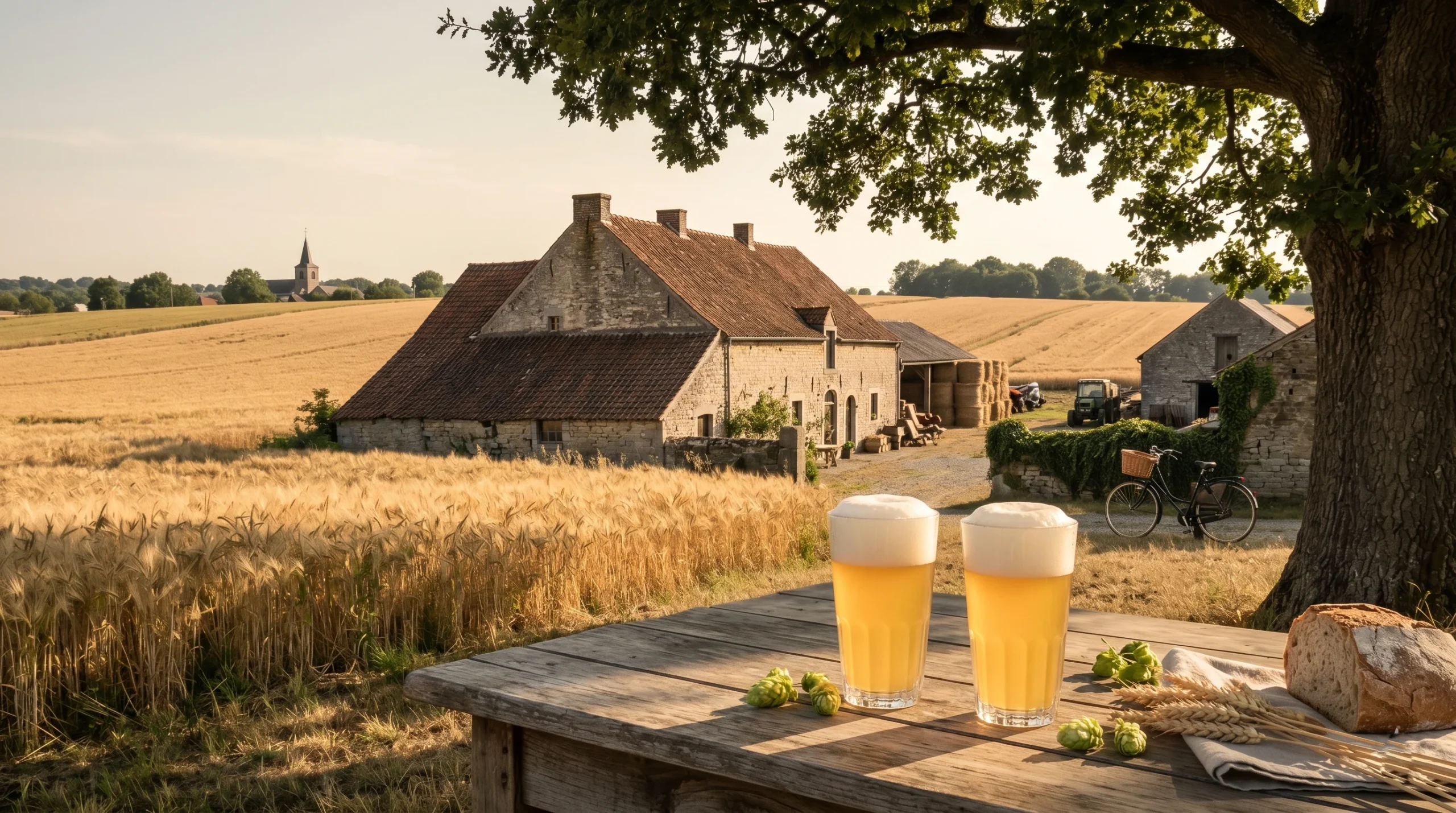
Saison Literally Means “Season”
In French, “saison” means “season.” The name is no accident: Saison is the beer of one particular season.
In the 18th and 19th centuries, before refrigeration, brewing in summer was impossible, because warm temperatures led to infected yeast and spoiled beer. Belgian farm brewers made one large batch in winter or early spring, enough to last until the end of summer. The beer had to be:
- Able to keep for months, without spoiling in storerooms that had no cooling
- Moderate in alcohol: not too low, since alcohol helps preservation, and not too high, since the field hands had a full day’s work ahead
- Refreshing, and drinkable in the summer heat
- Dry, with no residual sweetness to attract bacteria
The answer was a particular Belgian yeast, Saison yeast (Saccharomyces cerevisiae var. diastaticus), capable of very high attenuation (eating nearly all the sugar and leaving a very dry beer) and of producing complex esters (tropical fruit, spice, sometimes a touch of funk).
The classic Saison is pale gold to amber, with aromas of citrus, black pepper, and meadow flowers, a light to medium body, a bone-dry finish, and possibly a little Brett if it has been aged a long time.
Saison Dupont: The Living Benchmark
In the world of Saison, one name stands apart: Brasserie Dupont in Tourpes, Wallonia. The brewery was founded on a farm in 1844, and it still stands on exactly the same site today.
Saison Dupont, the brewery’s signature beer, is regarded as the gold standard of Saison. When craft brewers around the world want to learn Saison, they go to Dupont. When the BJCP (Beer Judge Certification Program) defined the style, it used Dupont as its reference.
What sets it apart is that Saison Dupont is still brewed on the family farm, to a recipe unchanged since the mid-20th century. The Dupont yeast, kept going in the brewery for decades, is one of the most famous Saison yeasts in the world. Many craft breweries have bought or copied it, but Dupont’s original still cannot be fully replicated.
Bière de Garde: The Border Country’s Beer “for Keeping”
Just across the border south of Wallonia lies the French region of Nord-Pas-de-Calais, where the Saison tradition turned into a related style: Bière de Garde.
In French, “Bière de Garde” means “beer for keeping.” It follows much the same philosophy as Saison (brewed in winter, drunk all year), but its character is somewhat different:
- More malt-forward than Saison, with clearer biscuit and caramel notes
- Higher in alcohol, usually 6–8.5% ABV, enough to keep longer
- Lighter on hops, with no strong bitterness
- Sometimes aged in wooden casks, occasionally with an earthy or cellar-like character
Bière de Garde nearly disappeared in the mid-20th century but was revived in the 1980s and ’90s by Brasserie Castelain (Saint-Amand-les-Eaux) and Brasserie Duyck (Jenlain). Today it is a niche but respected style, the standard-bearer of a farmhouse brewing tradition shared by France and Belgium.
Belgian Grisette: The Miners’ Beer
The least known of the farmhouse styles is Grisette, the beer of Wallonia’s miners in the 19th century.
Industrial Wallonia had many coal mines. Miners worked long hours underground and came up parched. Local breweries made Grisette for them to drink after their shifts: a lighter version of Saison, lower in alcohol and lighter in body, sometimes with wheat malt for a smoother texture.
When Wallonia’s mining industry declined in the mid-20th century, Grisette nearly vanished. In recent years, some Belgian breweries and American craft breweries have revived it as heritage, for its cultural value rather than any market demand.
The Revival in Modern Craft Beer
Saison has a remarkable story in modern craft beer. By the 1970s and ’80s, Dupont and a few other Wallonian breweries were nearly the only ones still making it. The style was considered old-fashioned and was little known.
Then, in the early 2000s, American craft brewers, notably Brasserie Saint Somewhere, The Bruery, Hill Farmstead, and Jester King, “discovered” Saison and fell for it. They realized that Saison yeast is one of the most versatile yeasts in the world. It can ferment at very high temperatures, 35 °C (95 °F), where most other yeasts tolerate only 20–25 °C (68–77 °F). It produces complex esters, it attenuates thoroughly, and it does not “break” when brewers experiment.
That is why Saison became the “sandbox” of modern craft beer. Brewers add fruit, herbs, spices, and hops, age it in barrels, blend it with Brett, and Saison keeps its basic character. A modern craft brewery may have 5–10 different Saisons on its menu.
Belgium supplied the inspiration, and the world ran with it. Saison today is one of the most experimental styles in craft beer anywhere, but its roots are still in Wallonia, in the low-alcohol beers that family farms brewed for their field hands.
XBelgian Specialty: Belgium’s Range
The four families covered so far all have clear geographic or cultural roots: Trappist (the abbeys), Lambic (the Pajottenland), Flanders Sour (West Flanders), and Saison (Wallonia). The fifth, Belgian Specialty, is different: it is not tied to any region or rigid tradition.
This is where Belgian brewers invent. It is where styles that “don’t fit anywhere” are welcome, and it is home to some of the most famous Belgian beers in the world.
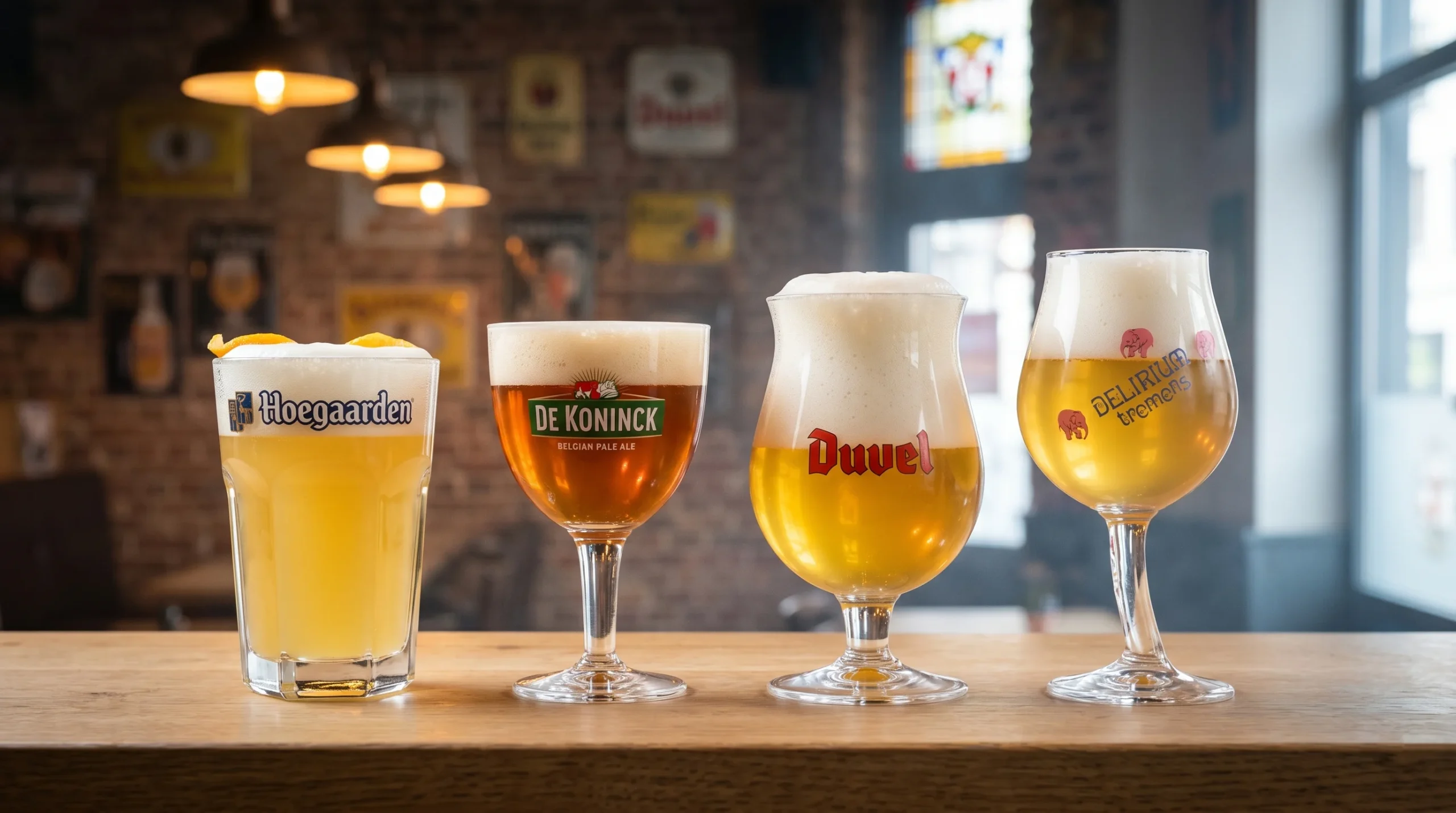
Witbier: Belgian Wheat Beer
Witbier (Dutch for “white beer”) is the only Belgian style that uses unmalted wheat as its main ingredient.
Unlike German Hefeweizen, which is also a wheat beer, Witbier adds coriander and dried orange peel, two spices that give it its signature character. A Witbier smells of fresh citrus and lightly peppery coriander, with banana esters from the yeast and a hint of vanilla. The body is light, and the beer has a characteristic pale, cloudy look.
Its story is worth telling. The style died out completely in the mid-20th century. The last Witbier brewery, Tomsin in Hoegaarden, closed in 1957, and a 600-year-old style all but vanished from history.
In 1966, a man named Pierre Celis, not a professional brewer but a milkman in Hoegaarden, decided to bring Witbier back. He learned from old brewers who still remembered the recipe, experimented for years, and opened his own brewery. In 1980, Hoegaarden Witbier was launched, and it became one of the great successes of modern Belgian brewing.
Today Hoegaarden (now owned by AB InBev) is the most popular Witbier in the world. Craft breweries in Belgium and elsewhere make Witbier too: Blanche de Bruxelles, Allagash White (United States), Hitachino Nest White Ale (Japan). Every Witbier poured today owes a debt to Pierre Celis, who saved a 600-year-old style from extinction.
Belgian Pale Ale: Quiet Balance
Belgian Pale Ale is the most “modest” style in the Specialty group, neither as powerful as a Tripel nor as complex as a Saison. But it is Belgium’s most balanced style, and it captures the Belgian idea of an everyday beer.
Character: golden amber, gentle noble hops (Saaz, Styrian Goldings), light fruity esters from Belgian yeast, biscuit malt with a touch of caramel, medium body, and moderate ABV.
This is the “all-day Belgian beer,” for lunch, for an evening with friends, for after work. No intensity, no drama, only balance and familiarity.
Classic examples: De Koninck Bolleke (Antwerp, the city’s own beer), Palm Speciale, and Vieux Temps. De Koninck stands out. Served in its signature “bolleke,” a short, round, tulip-like glass, it is so much a part of Antwerp’s identity that locals order “Een bolleke” instead of naming the brewery.
Belgian Blonde Ale
Belgian Blonde Ale is sometimes mistaken for a Belgian Tripel, since both are golden and both use Belgian yeast. But the differences are clear:
- Blonde Ale: lower ABV than a Tripel, a lighter body, softer esters, less “spicy”
- Tripel: higher ABV, a fuller body, more pronounced esters and spice, more hop intensity
Belgian Blonde Ale is the “entry-level” style for newcomers to Belgian beer: a handsome gold, lightly estery, and easy to drink. Examples: Leffe Blonde (not a Trappist, but still a benchmark for the style), Affligem Blonde, and Brugse Zot.
Belgian Golden Strong Ale: Duvel and Its Story
Belgian Golden Strong Ale may be the most “deceptive” of all Belgian styles: bright gold like a Pilsner, light-bodied, refreshing… and very high in alcohol.
The beer that defines the style is Duvel, from the Moortgat brewery. The story goes that in 1923, Moortgat created a strong beer in answer to the popularity of Pilsner. When the brewery’s master brewer tasted the first batch, he exclaimed, “Dit is een echte duivel!” (“This is a real devil!”), because the beer looked light but hid a high ABV. And so the name Duvel (“devil” in old Dutch) was born.
Duvel’s character comes from two fermentations (primary, then secondary in the bottle), long bottle conditioning, Czech and Slovenian noble hops, and a signature Belgian yeast. It throws a thick, creamy white head, so much so that pouring a Duvel “correctly” is a skill in itself: one decisive pour into a tulip glass to raise 2–3 cm of foam.
The Belgian Golden Strong style also includes Delirium Tremens (Huyghe brewery), a high-ABV beer served in a glass decorated with a pink elephant. Delirium tremens is the hallucinatory state brought on by heavy drinking, so the name is a sly joke on the brewery’s part.
This is a “careful, it sneaks up on you” style. The beer tastes light and goes down fast, but its ABV is high enough that you may not notice until it is too late.
Bière de Champagne: Beer Made Like Champagne
A niche style, but a notable one: Bière de Champagne (also called Bière Brut). This Belgian style borrows the French méthode champenoise: a second fermentation in the bottle, followed by remuage (turning the bottles) and disgorgement (removing the sediment), exactly as with Champagne.
The result is a beer with Champagne-like sparkle, complex aromas from aging on the yeast lees, a light body, high ABV, and an extremely dry finish.
Example: DeuS Brut des Flandres (from Bosteels, the brewery behind Tripel Karmeliet). The beer is brewed and matured in Belgium, then shipped to the Champagne region of France to undergo the méthode champenoise there. The process takes 9 months and the price is high; DeuS is a bottle for special celebrations, not an everyday drink.
It is proof of the Belgian brewer’s “no limits” philosophy. If a French technique can lift a beer, why not try it? Belgian beer has always been open to experiment, as long as the result is worth it.
XIBelgian Beer in Vietnam
After more than 10,000 words on heritage and styles, one last question remains, and for readers in Vietnam it matters most: how can we reach this heritage from here?
The good news is that over the past 10 years, the growth of craft beer in Vietnam has brought Belgian beer within reach of local drinkers. Today, in Ho Chi Minh City or Hanoi, you can find most Belgian styles, from the great Trappist ales to the most revered Lambics.
It took pioneers to get here: people who spent years of effort and patience building a Belgian beer culture in Vietnam.
Beer & Barrel: The Pioneer
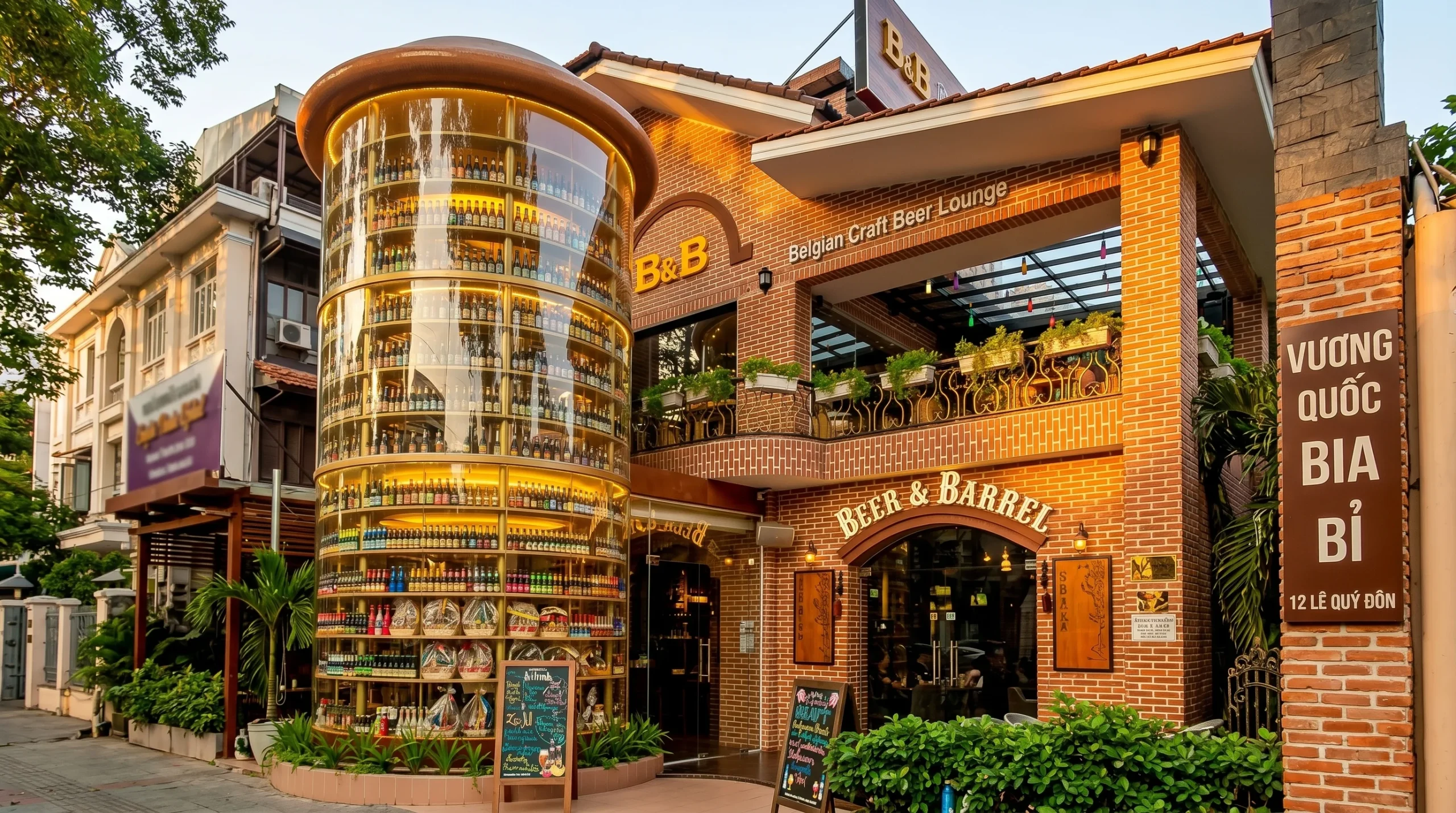
In the story of Belgian beer in Vietnam, one name has to come first: Vương Quốc Bia Bỉ Beer & Barrel, the “Belgian Beer Kingdom.”
Founded in 2014 in District 3 of Ho Chi Minh City, Beer & Barrel was the first Belgian beer restaurant in Vietnam, and the exclusive importer and distributor of more than 100 Belgian beers for the domestic market (according to Foody). Its founder, Nguyễn Thị Tuyết, had fallen for Belgium’s intricate beer culture on a trip there.
After that trip, Tuyết understood something many Vietnamese drinkers in the 2010s had not yet discovered: that beer, which most people drank simply to cool off, could be a drink to savor slowly and think about, the way people approach wine.
In 2014, Beer & Barrel opened at 12 Le Quy Don Street, Ward 6, District 3, in a neighborhood that still bears the strong imprint of Saigon’s French architecture. The interior was done in a vintage European style, with a tower of Belgian bottles on display at the front: a miniature “beer kingdom” in the heart of the city.
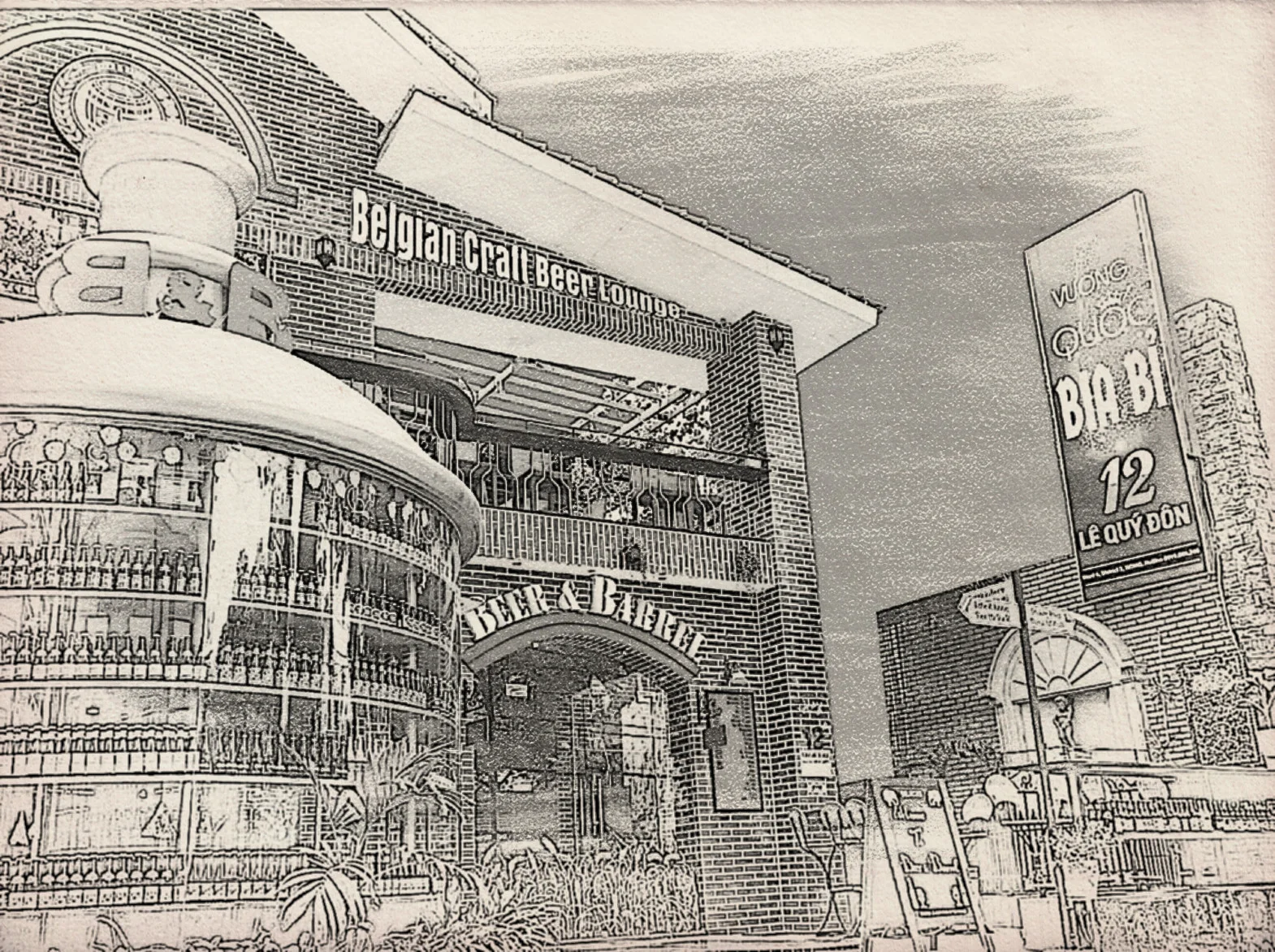
At Beer & Barrel, guests found officially imported Belgian beer and, with it, a proper culture of savoring beer. Every beer was served in its own glass, as in Belgium; the staff knew enough to recommend the right style; and the room encouraged slow drinking over the bottoms-up “dzô 100%” of a Vietnamese toast. Signature beers on the old menu included Floreffe Prima Melior, Gauloise Triple Blonde, Barbar Bok, Blanche de Namur, RedBocQ, and Newton, ranging from Trappist-inspired ales to Witbier and Belgian fruit beer.
Two names deserve a separate mention, because they show most clearly the patience and the standing Beer & Barrel built over nearly a decade in business.
An Exclusive Contract with Rochefort
Of all the Belgian Trappist brands, Rochefort is among the most exacting in choosing distribution partners. The Abbey of Saint-Remy does not sell to whoever asks. It works only with partners who have proved they are serious, understand Trappist culture, and are committed to quality over the long term.
Beer & Barrel achieved what many other importers could not: an exclusive contract to import Rochefort into Vietnam. For an independent restaurant in Saigon, with no large corporation and no global distributor behind it, winning that contract was a sign of the trust the Trappist monks placed in Tuyết and in Beer & Barrel.
For as long as it was open, it was the only place in Vietnam with an official, steady supply of Rochefort 6, Rochefort 8, and Rochefort 10. Rochefort 10, a Belgian Dark Strong Ale that many connoisseurs rank among the 10 best beers in the world, reached Saigon drinkers through the door at 12 Le Quy Don.
Westvleteren 12: The “Sacred” Bottles That Remain
The second story concerns Westvleteren 12, the hardest beer in the world to buy.
As the section on the Trappist abbeys explained, Westvleteren does not sell through ordinary distribution. The Abbey of Sint-Sixtus sells only at its own gate in West Flanders, in strictly limited quantities per customer, after a reservation by phone. There are no exceptions, no VIPs, and no exclusive contracts.
To bring Westvleteren 12 to Vietnam, Tuyết did what only the truly devoted do: she flew to Belgium, went to the abbey itself, lined up with local Belgians, and bought it case by case within the abbey’s quota. It was not a single trip. It took patience, repeated over many trips and many years.
The result was that Beer & Barrel once had Westvleteren 12 on its menu, one of very few places in Southeast Asia at the time that could say so. Each bottle stood for a trip to Sint-Sixtus, less a commercial product than the result of one person’s dedication.
The most striking detail is this: even now, with the restaurant closed, a few bottles of Westvleteren 12 are still being kept. They are a living record of an era, and of a Saigon woman who brought Belgian beer culture to Vietnam with her own hands.
The Door Closes
But the Beer & Barrel story has a sad ending.
The COVID-19 pandemic ended the restaurant’s run. Like many other upscale restaurants in Saigon, Beer & Barrel could not survive the long months of closure, the fall in revenue, and the irreversible shift in how people spent their money. The door at 12 Le Quy Don closed, and part of Saigon’s beer culture closed with it.
Yet for the people who went there (Tạp Chí Beer has heard it in story after story), Beer & Barrel remains bound up with memories nothing can replace.
A first evening with a Westmalle Tripel and a sweetheart, and the discovery that beer could be as elegant as wine. A family celebration dinner, when a grandfather who drank only bia hơi (Vietnamese fresh draft beer) tried Rochefort 10 for the first time and gave one of his rare nods. Get-togethers with university friends, when someone ordered a bottle of Rochefort 8 and everyone shared it sip by sip, as if sharing a secret. Nights alone at the bar with the thick menu, while a patient young woman on the staff explained one beer after another: the start of a love of Belgian beer that lasted for years.
For a lucky few, who were offered Westvleteren 12 on special occasions and heard the story behind each bottle, Beer & Barrel was also where they touched the summit of the beer world. Some later found that experience hard to repeat, even in Belgium, because the setting, the atmosphere, and the guidance they had at Beer & Barrel existed nowhere else.
Many people still grow emotional when Beer & Barrel comes up. Some former customers have kept the signature glasses they bought before it closed, as keepsakes of an era. In Saigon’s beer groups, stories about “the old days at Beer & Barrel” are told and retold, not out of simple nostalgia, but because the place meant more to them than a bar usually does.
Tạp Chí Beer has tracked down some surviving material on the old Beer & Barrel, including a short video of the restaurant’s interior that gives some sense of what the place felt like. For anyone who never went, it may be the only way left to see the care that went into its design and how much of herself the founder put into it.
There is a sad but consoling truth about heritage: it does not have to last forever to matter. Beer & Barrel did what it set out to do. It was the first to bring Belgian beer to Vietnamese drinkers in a serious way, it laid the groundwork for a whole generation of Saigon beer lovers, and it left thousands of memories with the people who walked through the door at 12 Le Quy Don.
When you hold a bottle of Rochefort 10 or Westvleteren 12 today, remember the people who went before so that you could. Beer & Barrel was one of them. Perhaps that is how heritage works: those who open a road rarely travel it to the end, but the road exists because of them.
10 Belgian Beers Worth Trying in Vietnam
A concrete list for anyone starting out with Belgian beer:
1. Hoegaarden (Witbier): the entry point. Hazy orange-gold, with coriander and orange on the nose, and easy to drink. Widely available and inexpensive.
2. Leffe Blonde (Belgian Blonde Ale): an approachable abbey beer. A handsome gold with soft esters, and it goes with any Vietnamese dish.
3. Chimay Red (Belgian Dubbel): the most popular Trappist. Reddish brown, with dried fruit and caramel. Pair it with grilled meats.
4. Westmalle Tripel (Belgian Tripel): the benchmark for the style. Amber gold and complex on the nose, high in alcohol but easy to drink. No list is complete without it.
5. Duvel (Belgian Golden Strong Ale): the beer that hides its strength, light to look at but powerful. Drink it slowly. It is at its best poured properly, under a thick head.
6. Orval (the unconventional Trappist): unlike any other beer. Funky Brett aromas and moderate hop bitterness. A challenge for newcomers, but worth it.
7. Chimay Bleue (Belgian Dark Strong Ale): a classic Quadrupel. Complex and rich, made for a special evening.
8. Rochefort 10 (Belgian Dark Strong Ale): for those who already love Chimay Bleue. More intense, with a port-wine character, and one of the finest beers in the world. Note: Rochefort was once imported into Vietnam exclusively by Beer & Barrel. Since the restaurant closed, it has been much harder to find through official channels.
9. Saison Dupont (Belgian Saison): the benchmark Saison. Pale gold, with citrus and black pepper, and bone-dry. A first taste of the style of Wallonia.
10. Lindemans Kriek (Belgian Fruit Lambic): the gentlest introduction to Lambic. Fresh cherry and a light sourness make it the easiest-drinking beer in the family, and a door into the rest of it.
Bonus: Westvleteren 12 (Belgian Dark Strong Ale): the world’s hardest beer to buy, with no official distribution in Vietnam. Most of the bottles that have reached Vietnam came through Beer & Barrel, from Tuyết’s own trips to the Abbey of Sint-Sixtus. Some are still kept by Beer & Barrel and a few former customers: “heritage within the heritage,” not ordinary drinks.
For those who have worked through the 10 above and want to go further, look for Cantillon Gueuze, Rodenbach Grand Cru, and 3 Fonteinen Oude Geuze, the high points of Belgium’s beer heritage.
Footage from those years: Beer & Barrel’s YouTube channel still holds a video of the great Belgian bottles that reached Saigon through the door at 12 Le Quy Don. It is the only way left to see the range of beers the restaurant brought to Vietnam. Watch it here.
Pairing Belgian Beer with Vietnamese Food
An article this long has no room for detailed pairing, but a few combinations are worth trying:
- Beef phở (Vietnamese rice noodle soup) + Belgian Dubbel (Chimay Red): the Dubbel’s dried fruit echoes the cinnamon and star anise in the phở
- Bún chả (grilled pork with rice noodles, a Hanoi specialty) + Witbier (Hoegaarden): the beer’s coriander and orange sit well with the fresh herbs and the dipping sauce
- Roast duck + Flanders Red Ale (Rodenbach Grand Cru): the acidity cuts the fat, and the wine-like character flatters the meat
- Grilled seafood + Belgian Saison (Saison Dupont): the pronounced dryness and peppery character clean the palate
- Bún bò Huế (spicy beef noodle soup from Hue) + Gose or Berliner Weisse: covered in detail in Sour Beer
- Dark chocolate + Belgian Dark Strong Ale (Westvleteren 12, Rochefort 10): a dessert pairing that is hard to beat
For Belgian IPA with Vietnamese food, see Bitter Beer. For dark Belgian ales (Dubbel, Quad) with Vietnamese food, see the Belgian Dark Ale section of Dark Beer.
A Route for Newcomers
For anyone who has never had a Belgian beer and wants to begin, here is a 6-month route:
Months 1–2, the entry level: Hoegaarden, Leffe Blonde, and Chimay Red, to get to know Witbier, Belgian Blonde Ale, and Dubbel.
Months 3–4, going deeper: Westmalle Tripel, Duvel, and Saison Dupont, to get a feel for the complexity of Belgian yeast.
Month 5, the outliers: Orval and Rodenbach Grand Cru, a first encounter with Brett and Belgian sourness.
Month 6 and beyond, the summit: Chimay Bleue, Rochefort 10 (if you can find it), and Cantillon Gueuze, the climb to Quadrupel and Lambic.
After 6 months you will have a solid grounding in Belgian beer. You will be able to tell Westmalle from Chimay from Rochefort, you will understand why Duvel is not a beer to drink fast, and you will taste the difference between a young Lambic and an old one.
Most important, you will taste 1,000 years of heritage in every glass. You may not get to begin at Beer & Barrel, as many people in Saigon once did. But the approach it pioneered — drink slowly, respect the style, treat tasting as an art — can carry on in the bottle shops and craft beer bars open today. Heritage is not tied to a place. It lies in how we approach it.
What Can Vietnam Learn from Belgium?
The question is an open one. It closes this section and leads into the last.
Vietnam has rich traditions of its own: phin-filter coffee, trà sen (lotus tea), the rượu cần of the Central Highlands, rượu nếp (sticky-rice wine), and nước mắm. Each has its own history, technique, and culture. But unlike Belgium, Vietnam has not yet formalized this heritage to the point of UNESCO recognition.
What did Belgium do to earn it? It:
- Protected its brewing traditions over centuries, and held on to them even when Pilsner took over the market
- Built up a professional framework: zythologists, beer brotherhoods, beer pairing
- Wove beer into cultural life: pub culture, the family, festivals
- Passed knowledge down the generations, through brewing families and master blenders mentoring their successors
- Secured legal protection: TSG status for Lambic, the ATP label for Trappist beer, UNESCO recognition for Belgian beer culture
Vietnam can learn from these steps. It also needs pioneers like Nguyễn Thị Tuyết and Beer & Barrel, people willing to invest in bringing a foreign heritage home and building a culture of appreciation in Vietnam, even when the effort does not always reach its goal. A strong beer culture does not arrive on its own. It needs people willing to go first and to spend years patiently educating the market. Beer & Barrel may be gone, but what it planted (an interest in quality beer, a habit of savoring beer slowly, respect for style) is still growing in Vietnam’s beer community.
Could Vietnamese phin coffee become UNESCO heritage? It could, if Vietnam is willing to invest in it, and if a generation comes to believe that Vietnamese coffee is a culture worth protecting.
Belgium has shown that a small country can win worldwide recognition for its drinking culture. That is not a privilege reserved for large nations. It is the result of commitment to heritage.
XIIConclusion: A Lesson in Heritage
This article began with a question: why does Belgian beer deserve UNESCO recognition?
By now, the answer should be clear.
It is not because Belgian beer is “the best in the world”; Germany, Britain, the United States, and many other countries also brew excellent beer. Nor is it because Belgium has “the most beers”; quantity can be measured, but culture cannot.
Belgium was recognized for something else, something hard to define but obvious once you are in the middle of it: in Belgium, beer is a way of life, not a product.
The Pieces of the Heritage
The past 13,000 words have covered:
- 1,000 years of history, from medieval monasteries to modern craft breweries
- 6 Trappist abbeys, where prayer and brewing are one
- Pub culture: the brown café, a glass for every beer, a menu of more than 2,000 beers
- Brewing families, who have kept traditions alive across 4, 5, even 7 generations
- UNESCO recognition, which made the heritage official on the world stage
- 5 style families: Trappist, Lambic, Flanders Sour, Saison, and Belgian Specialty
- Dozens of storied breweries: Cantillon, Rodenbach, Westmalle, Westvleteren, Chimay, Orval…
Each piece is a story in itself. Together they make up a culture no other country has.
A Thought About Vietnam
While writing this piece, I kept thinking about Vietnam. What can we, in Vietnam, take from Belgium?
Vietnam has rich traditions. Phin-filter coffee, brewed by hand. The trà sen of Hanoi’s West Lake, scented with real lotus. The rượu cần of the Central Highlands, with its communal rituals. Phu Quoc nước mắm, fermented for 12–15 months. Each has historical depth, techniques of its own, and a place in the culture.
But Vietnam faces challenges much like Belgium’s in the 19th century. Globalization is handing the market to “global” products (Starbucks, Heineken, soft drinks). Traditional techniques are gradually giving way to industrial production. Young people sometimes see no value in keeping traditions alive, because tradition does not “scale,” does not deliver “growth,” and offers no “exit.”
Belgium took the opposite path. When Pilsner took over the market in the 19th century, Belgian brewers did not abandon Lambic, Trappist ales, or Saison; they accepted lower sales to keep their traditions. When globalization threatened the country’s beer culture in the 20th and 21st centuries, Belgium sought legal protection: TSG for Lambic, ATP for Trappist beer, UNESCO for its beer culture as a whole.
Vietnam could do the same for phin coffee, rượu cần, and nước mắm, if it is willing to invest in heritage and not only in markets.
The Larger Lesson
Belgian beer teaches another, deeper lesson, one that has nothing to do with business or marketing.
In a world that chases speed — drink fast, eat fast, live fast — Belgium is out of step. A Lambic ages for 3 years. A bottle of Westvleteren 12 is bought only after a reservation by phone. A dinner in a brown café runs 3 hours. A 150-year-old Rodenbach foeder is fermenting beer as you read this line.
Call it a philosophy of slow living. The slowness is not laziness; it comes from knowing that some things need time to be worth anything. Microbes need time to “settle” into wooden barrels. Traditions need time to form. A culture needs time to be recognized.
When UNESCO recognized Belgian beer in 2016, this is what it was really honoring: not the beer, but a nation’s patience. The patience to keep Lambic alive for 500 years when no one else did. The patience to hand family recipes down through 5–7 generations. The patience of Trappist monks who refuse to “scale up,” though they could make millions of dollars.
In a modern culture that prizes speed, patience is a form of rebellion. Belgian beer shows that such a rebellion can survive, and can even be honored.
A Last Word
The next time you hold a bottle of Belgian beer, whether a Hoegaarden at a bar, a Chimay Red from a bottle shop, or a Westmalle Tripel at a special dinner, take a second to remember what is in your hand.
1,000 years of history.
The heritage of a small Western European country that refused to give up its traditions under the pressure of globalization.
The work of monks, brewing families, and master blenders, people who spent their lives preserving the knowledge their ancestors handed down.
A piece of the Intangible Cultural Heritage of Humanity.
Drink it slowly. Savor it. And be grateful to the people who have kept this heritage alive.
And if you ever make it to Belgium, go to Brussels, to Roeselare, to the Pajottenland. Stand in a brown café while the gaslights burn warm. Tour the foeder halls at Rodenbach. With luck, buy a case of Westvleteren 12 straight from the Trappist abbey.
That is when drinking a beer becomes living with a heritage.
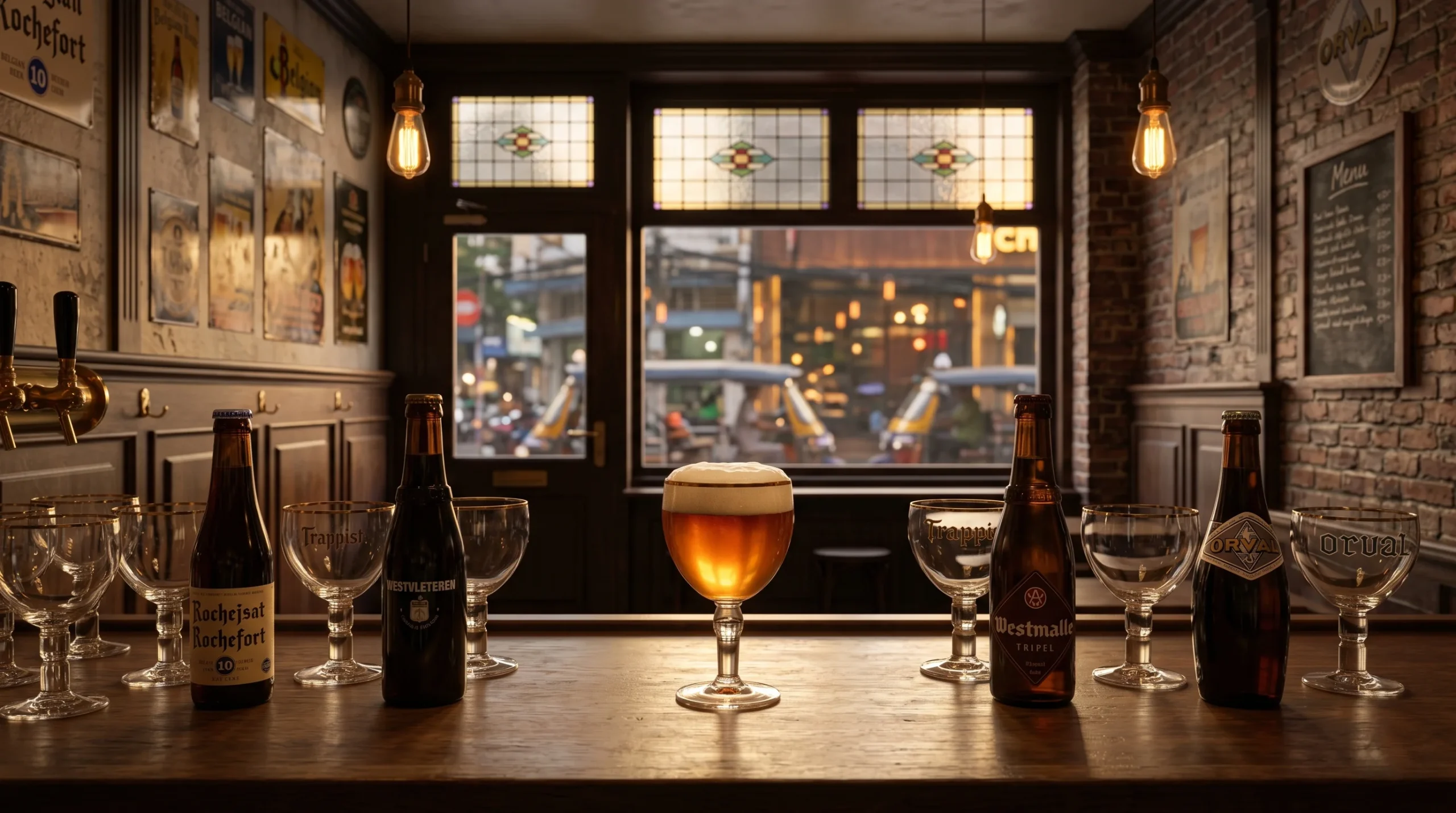
Mentioned in this article
-
Beer O L O G Y
Sour Beer: From Lambic to Sour IPA -
Beer O L O G Y
The World of Bitter Beer Begins with IPA -
Beer O L O G Y
Dark Beer Is Not One Style
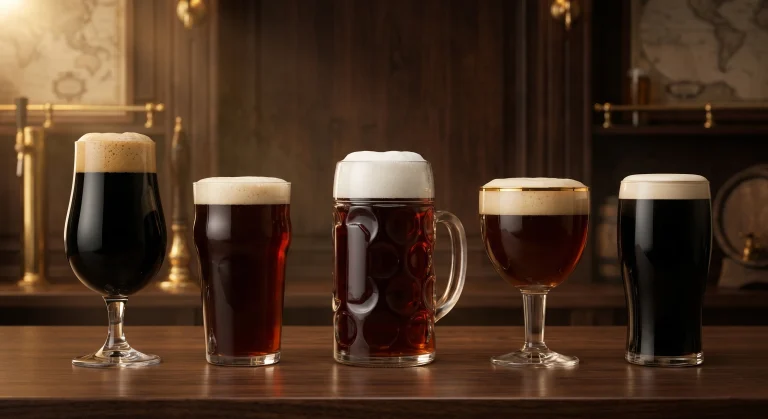
Originally published in Vietnamese on Tạp Chí Beer.