Sour Beer: From Lambic to Sour IPA
A 500-year history of sour beer told through 14 styles, from the classic Lambic of Belgium’s Pajottenland to Smoothie Sour and Sour IPA.
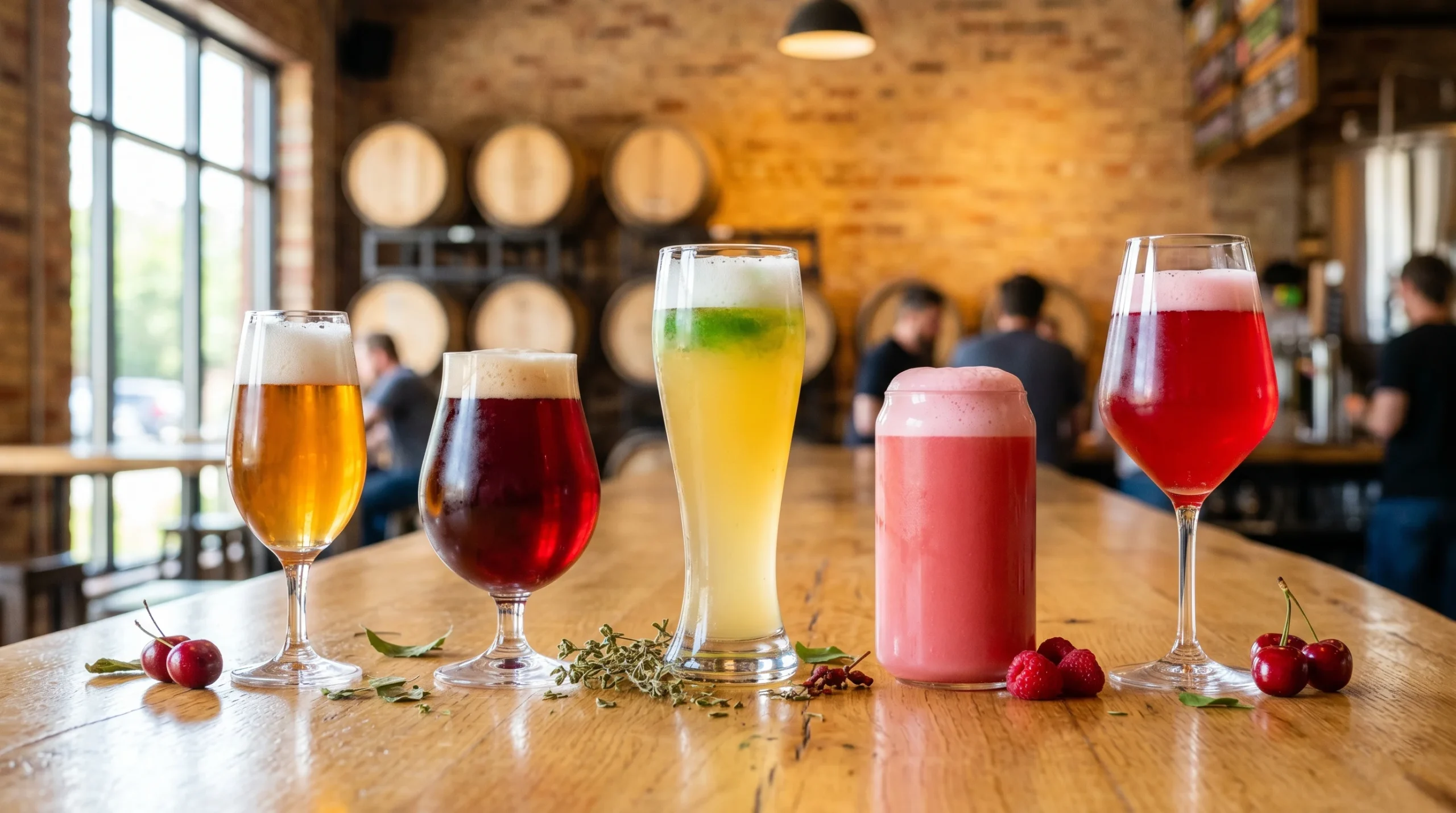
No family of beer styles starts as many arguments as sour beer.
First-timers tend to land at one of two extremes. Some blurt out, “This is amazing. Why is it so strange?” Others wince and wonder whether the beer has gone bad. Few styles split a room so cleanly.
Behind that jolt of acidity lies one of the oldest and most intricate corners of brewing. Before people learned to control yeast, all beer was sour to some degree. Lambic, Belgium’s classic sour style, has been brewed the same way for more than 500 years, and every batch is a conversation between the brewer and the wild microbes drifting through the air.
This guide runs from the wooden barrels of Belgium’s Pajottenland valley in the late 16th century, through the Trappist monasteries that brewed Flanders Red for decades, to the brightly colored cans of American Sour IPA and Smoothie Sour in the 2020s: 14 styles across 500 years.
It is written for the curious who have never tried a sour, for Berliner Weisse fans ready to go further, and for anyone still convinced that sour beer is spoiled beer, in the hope of changing their mind.
IWhat Is Sour Beer?
“Sour beer” is the umbrella term for any style with a distinctly tart taste, from the gentle tang of lemonade to the sharp bite of vinegar.
Most beer is fermented by Saccharomyces yeast alone. Sour beer brings in lactic acid bacteria (Lactobacillus, Pediococcus), wild yeast (Brettanomyces), or both. These microbes produce different acids, lactic acid with its soft tang and acetic acid with its vinegar edge, along with a host of other compounds that together give sour beer its character.
Among serious beer drinkers, sour beer is usually divided into 5 main families:
1. The Lambic family (Belgium). Lambic, Gueuze, Fruit Lambic, and Faro. The most classic of the five: spontaneously fermented by airborne microbes and aged in wood for years.
2. Flanders sours (Belgium). Flanders Red Ale and Flanders Oud Bruin. Sours aged at length in wood, with notes of chocolate and dark fruit.
3. German sours (Germany). Berliner Weisse and Gose. “Quick” sours, light and easy to drink.
4. Modern wild ales. Wild Ale, Brett Beer, and Sour Ale. Modern styles inspired by Belgian tradition but freer in technique.
5. Modern sour variants. Fruited Sour Ale, Smoothie Sour Ale, and Sour IPA. Young, inventive styles that combine sour beer with fruit, cream, or hops.
Each family has its own idea of what sourness is for. Lambic prizes patience, measured in years of aging. German sours prize lightness, the kind of beer you can drink all day. The modern variants prize invention and recognize few limits. The acidity is shared; the paths to it are not.
IIWhy Beer Turns Sour
The short answer: lactic acid bacteria and wild yeast.
The longer answer is a story of microbiology and history that spans thousands of years.
Before Anyone Understood Yeast
For nearly 7,000 years, brewers had no idea what yeast was. They only knew that a cooked barley brew left open to the air would, after a few days, turn into beer on its own. Sometimes the beer was good, sometimes sour, sometimes spoiled, and nobody understood why.
Only in 1857 did Louis Pasteur demonstrate the role of yeast in fermentation. From then on, brewers learned to take charge of the process: selecting pure yeast, controlling temperature, and eliminating “contaminating” bacteria.
A handful of Belgian brewers went the other way. They held on to the old practice, letting the air carry microbes into the wort and letting every yeast and bacterium present take part in fermentation. The result is Lambic, brewed continuously by the same method for more than 500 years.
The Three Microbes Behind the Sourness
In modern sour beer, three main players produce the acidity:
- Lactobacillus. A lactic acid bacterium that produces lactic acid, a soft sourness like yogurt’s. It is the most important bacterium in sour beer, and it is everywhere: in yogurt, kimchi, pickles, and sour beer.
- Pediococcus. Another lactic acid bacterium, producing lactic acid along with a number of more complex compounds. It usually turns up alongside Lactobacillus in long-aged sours.
- Brettanomyces (“Brett”). A wild yeast, not a bacterium. It produces the signature “funky” aromas: leather, horse blanket, tropical fruit, wood. It makes no lactic acid directly, but it does produce acetic acid, with its vinegar sharpness, and a wide range of esters.
Depending on the style, brewers use one, two, or all three. Berliner Weisse relies mainly on Lactobacillus for a light, clean sourness. Lambic uses all three, plus Saccharomyces, and its flavor is correspondingly deep.
Two Schools: Quick Sour vs. Wild Sour
Modern sour brewing divides into two distinct schools:
Quick sour (kettle sour). The brewer adds Lactobacillus to the kettle for 24–48 hours, then boils the wort to kill the bacteria and ferments it normally with yeast. The result is a light, clean, easy-drinking sour. Berliner Weisse, Gose, and most modern Sour Ales follow this school.
Wild sour. Lactobacillus, Pediococcus, and Brettanomyces share a wooden barrel for months or years, acting on one another and producing hundreds of compounds. The result is a deep, funky, many-layered sour. Lambic, Flanders Red, and Wild Ale take this route.
Quick souring is the “industrial” method: fast, controllable, and scalable. Wild souring is the “artisanal” one: slow, never fully under control, with every batch a surprise. Each has its merits, and many modern breweries do both.
IIIThe Lambic Family: The Classic Sours
If sour beer has an ancestor, it is Lambic.
It is the oldest beer style still being made, brewed continuously for more than 500 years in the Pajottenland valley west of Brussels by the same method brewers used in the 16th century. There is no cultured yeast, no precise temperature control, no lab testing. There is only water, malt, aged hops, and the air of Pajottenland, where wild microbes have settled into the brick walls of the breweries over the centuries.
Lambic is not so much made as allowed to happen. That is the basic difference between Lambic and every modern beer style.
History & Origins
Lambic took shape in Pajottenland, a small farming region west of Brussels, no later than the 15th century. The name is thought to come from the village of Lembeek, one of the first places to produce it.
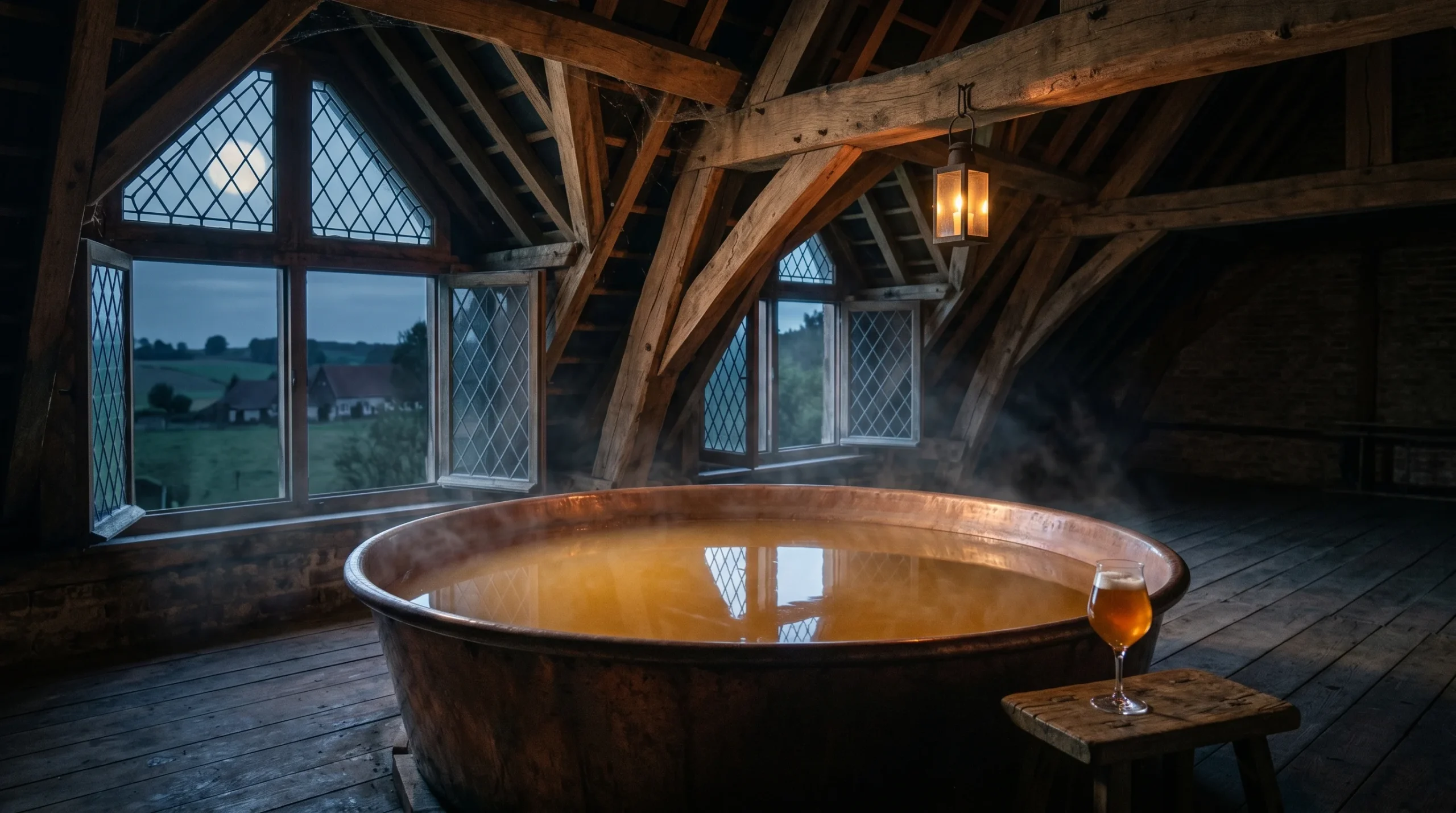
What sets Lambic apart is spontaneous fermentation. After the boil, the brewer pours the wort into a broad, shallow vessel called a koelschip, or coolship, which sits in the brewery attic with the windows open. Overnight, the Pajottenland air drifts in carrying hundreds of kinds of yeast and bacteria: Saccharomyces, Lactobacillus, Pediococcus, Brettanomyces, and many species science has yet to fully identify.
By morning, the wort has caught the microbes particular to Pajottenland. It then goes into old oak barrels, usually former wine barrels, to ferment and age for 1–3 years.
This is why Lambic can only be brewed in Pajottenland. Its wild microbes cannot be reproduced anywhere else. A brewery that wants to make true Lambic has to be in the region, and even then each brewery carries its own microbial signature, shaped by its walls, its barrels, and its accumulated history.
In 1997, the EU recognized Lambic as a Traditional Specialty Guaranteed, giving the traditional method legal protection.
What the Lambic Family Shares
- Color: Deep gold to amber, sometimes ruby red (Fruit Lambic)
- Body: Light, almost completely dry
- Core flavors: Sharp acidity (lactic and acetic), Brett funk (leather, horse blanket), fruit (raisin, green apple), oak, and at times a lively, Champagne-like tartness
- Good for: Drinkers who love complexity and don’t mind unfamiliar flavors
The Lambic Styles
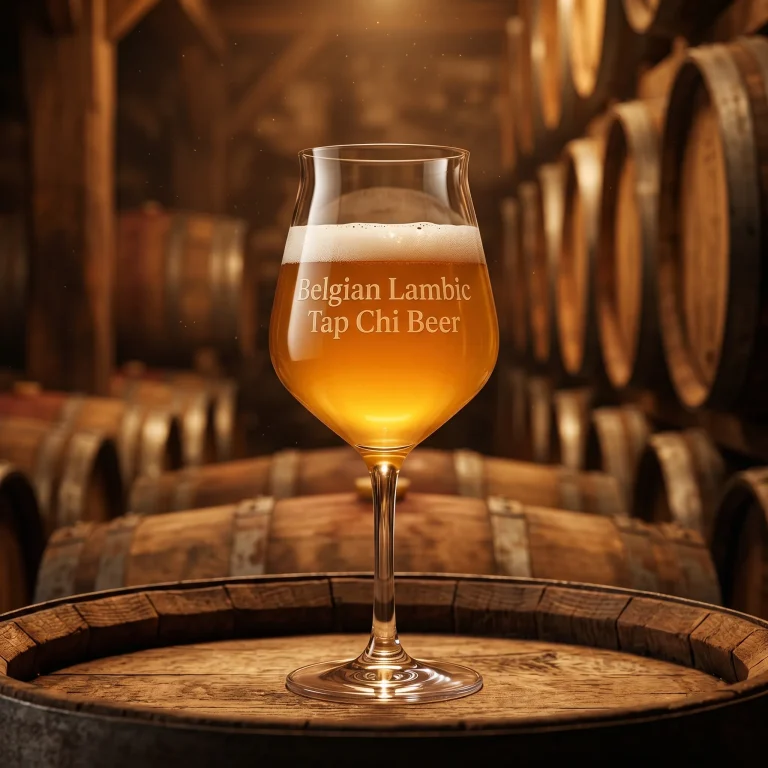
Belgian Lambic is Lambic in its original form, unblended and without fruit. It is usually drunk young, at about a year old, in local bars around Brussels. The sourness is pronounced and funky, with almost no sweetness. This is Lambic at its rawest, and the form least often exported.
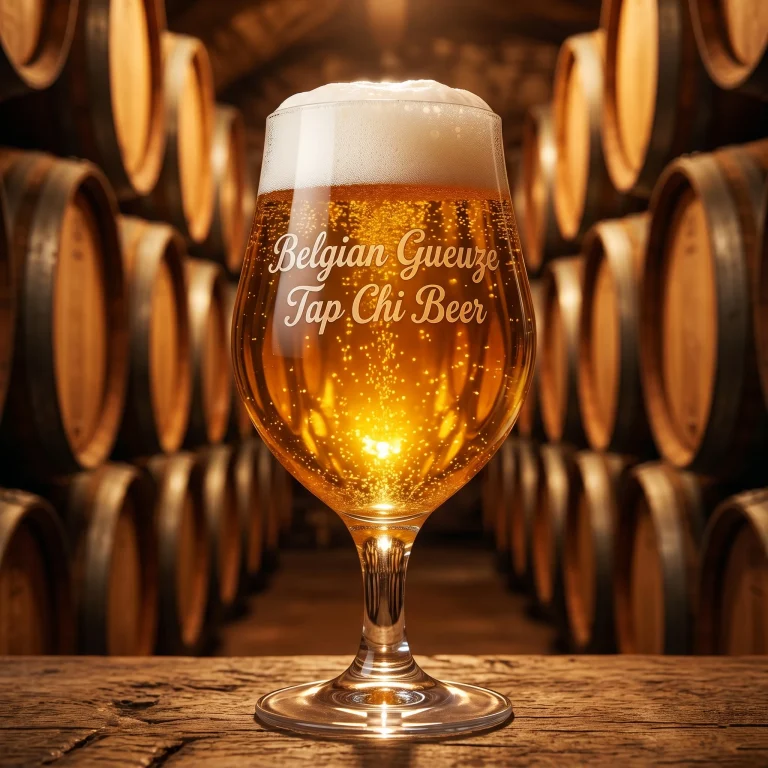
Belgian Gueuze is Lambic blended with care. The brewer, called a blender in this role, mixes young Lambic (1 year) with old Lambic (2–3 years) and bottles it. The young Lambic still holds residual sugar, which produces natural carbonation in the bottle. The result has a Champagne-like sparkle and a layered sourness, with the depth of old Lambic and the freshness of young. It is often called “the Champagne of beer.”
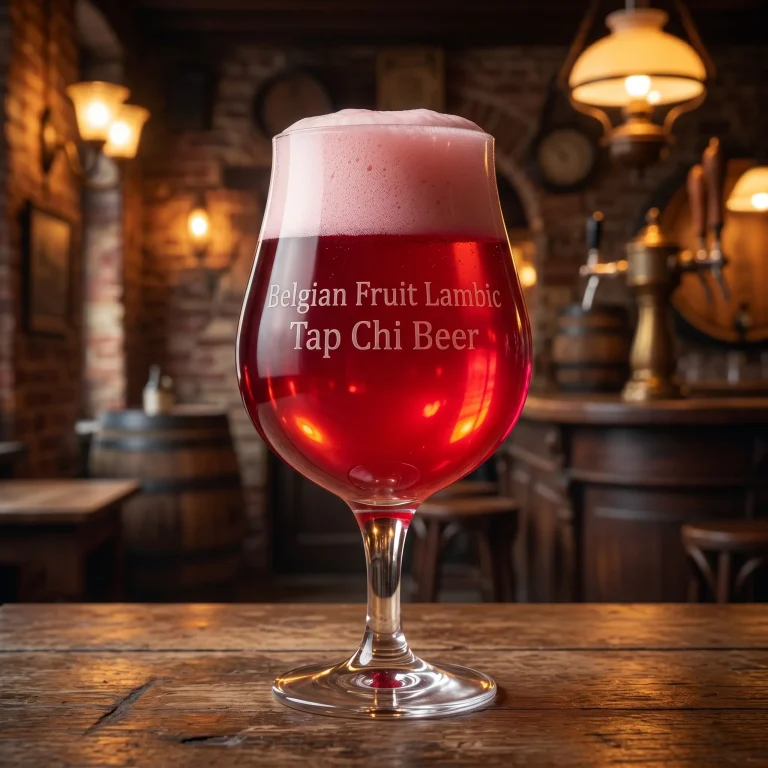
Belgian Fruit Lambic is Lambic aged further on fresh fruit, most often Kriek (cherry) and Framboise (raspberry). The fruit goes into the Lambic barrel for several more months while the microbes eat its sugar, leaving a beer with clear fruit aroma that keeps Lambic’s dryness and acidity. It is the easiest way into Lambic for a newcomer, since the fruit softens the sourness.
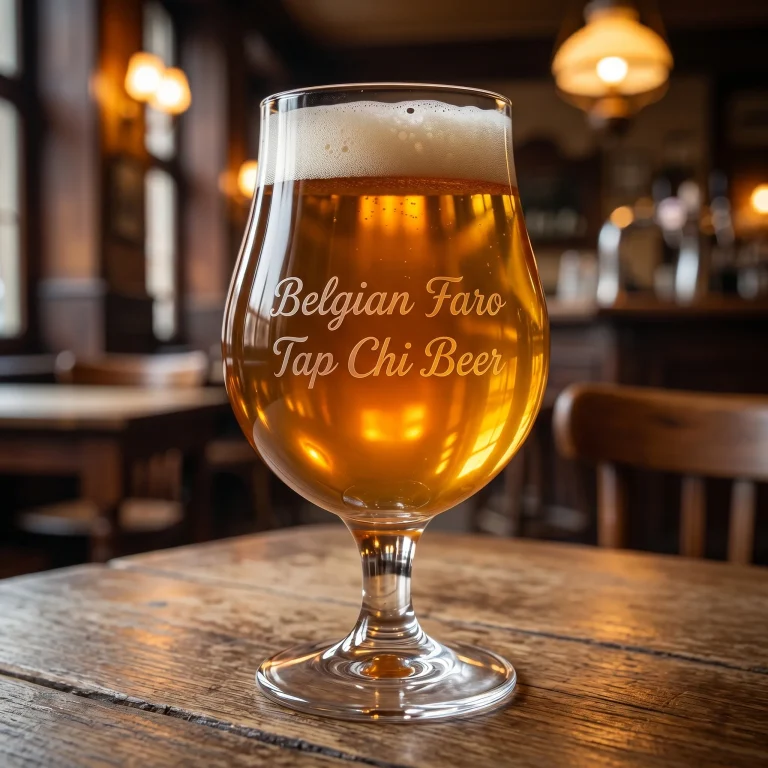
Belgian Faro is Lambic sweetened with candi sugar or syrup. Traditionally a beer “for special occasions,” it tempers the acidity with sweetness, which makes it friendlier to drinkers unused to straight Lambic. It is rare today but still made by a few traditional breweries in Brussels.
Lambic in Vietnam
Lambic is the hardest of these styles to find in Vietnam. Production is limited to a few dozen breweries worldwide, long aging keeps prices high, and demand is specialized, since not everyone takes easily to such intense sourness.
Names worth seeking out when the chance comes: Cantillon (Brussels, often called the “king” of Lambic), 3 Fonteinen (the revered blender), Boon (larger and easier to find), and Lindemans (commercial but widely available, its Framboise especially good for beginners).
If you are new to Lambic, start with a Fruit Lambic (Kriek or Framboise): the fruit tames the sourness and funk, and it drinks far more easily than straight Lambic. Once you are comfortable, try a Gueuze, and the Champagne comparison will make sense.
IVFlanders Sours: The Sour Beers of Western Belgium
Lambic belongs to Pajottenland, west of Brussels. Flanders sours belong to another region, West Flanders, near the French border. The two are only 100 km apart, but their ideas about brewing are entirely different.
Where Lambic relies wholly on spontaneous fermentation, Flanders sours combine traditional fermentation with painstaking blending. They are the most refined of the sour beers: less funky than Lambic, weightier than the German sours, and settled in the middle ground, deep and layered, closer to red wine than to beer.
Belgians have a saying: “Flanders sour is the beer of people who understand beer.” It is not a starting point. It is a style for drinkers who have already come a long way.
History & Origins
Flanders sours developed in West Flanders in the 18th and 19th centuries. The region has a long tradition of aging beer in oak for extended periods, a technique devised to keep beer sound through warm weather before refrigeration existed.
Inside the barrels, the beer meets the microbes living in the wood, Lactobacillus and Brettanomyces above all, and develops a complex sourness over months or years. Unlike Lambic, which ferments entirely on wild microbes, Flanders beers usually begin with a controlled Saccharomyces fermentation before being left to evolve in wood.
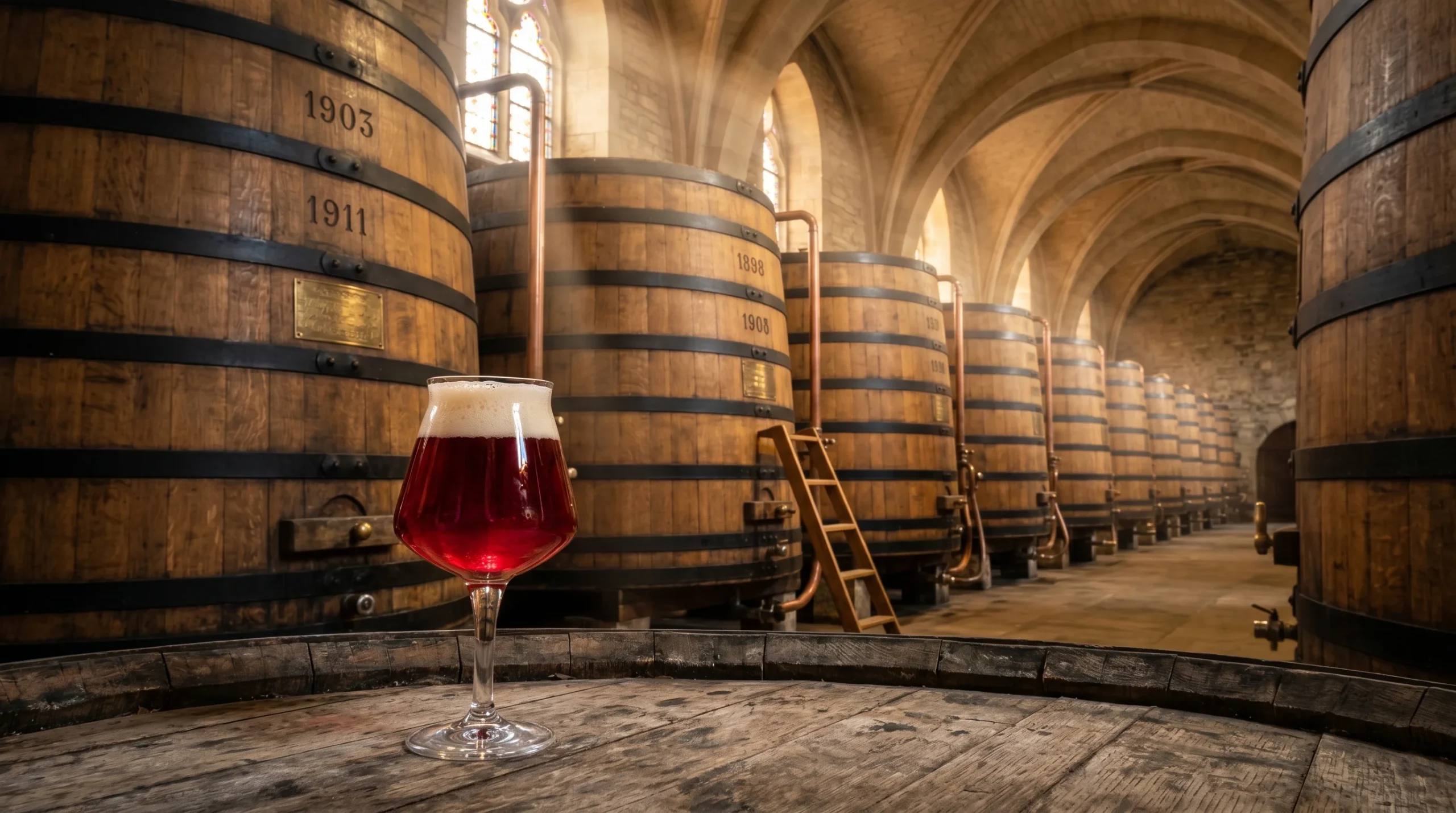
One name is bound up with the style: Rodenbach Brewery, founded in 1821 in Roeselare. Rodenbach defined Flanders Red Ale with its halls of giant wooden vats, some more than 150 years old. Each vat has its own microbes and its own character, and Rodenbach’s master blender chooses among them, blending for balance.
The sour beers of West Flanders are known as “the Burgundy of Belgium” for their deep ruby color, their wine-like flavor, and a complexity close to that of red Burgundy.
What Flanders Sours Share
- Color: Ruby red to deep brown (unlike the gold-to-amber Lambic)
- Body: Medium, smoother than Lambic
- Core flavors: Sharp acidity (lactic and acetic), dried fruit (raisin, cherry, prune), a hint of chocolate, oak, sometimes a balsamic vinegar note, vanilla
- Good for: Red wine lovers who enjoy wine-like complexity
The Flanders Sour Styles
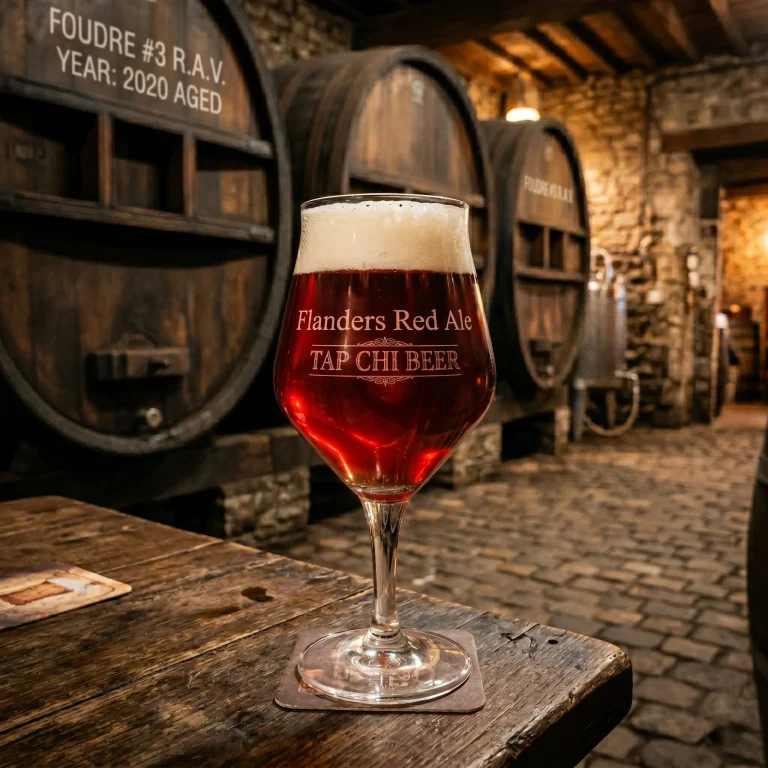
Flanders Red Ale is a ruby-red sour aged 1–2 years in oak. Its aroma has the layers of a red wine: sour cherry, prune, vanilla, a little chocolate, a touch of balsamic. The sourness is strong but held in balance by a malt-forward base and a little fruit sweetness. This is the style that defines “wine-like beer,” and Rodenbach Grand Cru is its benchmark.
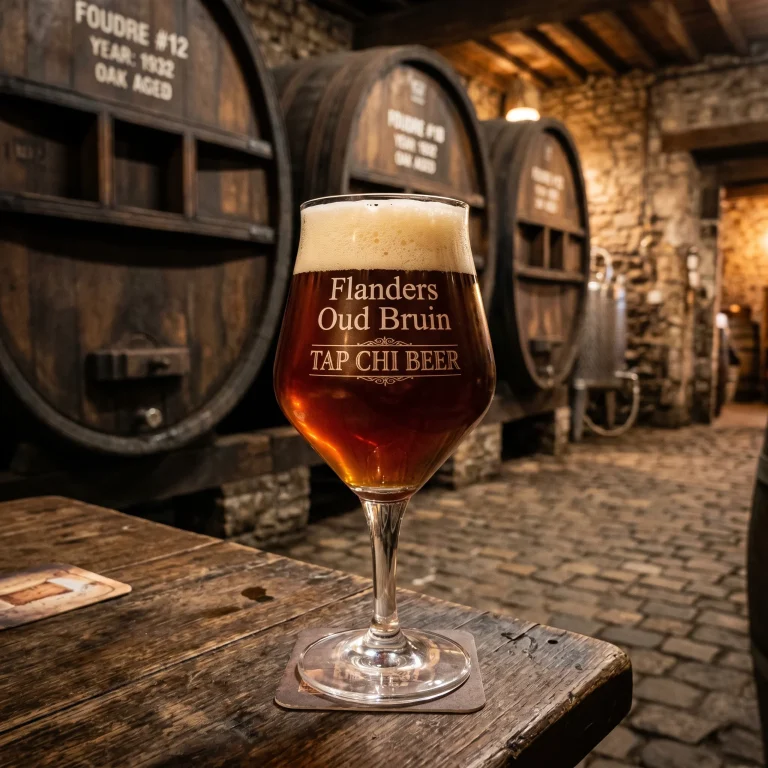
Flanders Oud Bruin takes its name from the Dutch for “old brown.” It is the brown version of the Flanders sour: less acidic than the red and more malt-forward, with deeper chocolate, caramel, and dried fruit and a firmer body. It spends less time in wood, 6–12 months. Liefmans Goudenband is the classic example. With milder acidity and more malt, it is the easier of the two for a newcomer.
Flanders Sours in Vietnam
Flanders sours are uncommon in Vietnam but easier to find than Lambic. The bottles that do reach the country, Rodenbach Grand Cru, Duchesse de Bourgogne, and Liefmans Goudenband, are all classic examples of the style.
Duchesse de Bourgogne in particular, one of the most widely sold Flanders Reds on the Belgian market, makes a good first bottle if you are curious about wine-like beer.
A pairing worth trying: Flanders Red Ale with richly flavored roast meats such as grilled lamb, beefsteak, or roast duck. The beer’s sharp acidity and wine-like depth bridge to meat-forward dishes much the way red Burgundy does.
If you love red wine and want a beer with similar character, a Flanders sour is the first door to knock on.
VGerman Sours: Germany’s Light Sour Beers
Lambic spends years with its wild microbes. The German sours get there in a fraction of the time, and with a lighter touch.
These are the “light” sours: low in alcohol (3–5% ABV), softly tart like yogurt or lemonade, light in body, and easy to drink. Where Lambic needs years of aging, a German sour can be finished in a few weeks. Where Flanders sours are rich and wine-like, German sours are as bright and thirst-quenching as sparkling lemonade.
They are the easiest sours for a beginner to approach, and the ones most at home in hot weather. A cold Berliner Weisse or Gose on a summer afternoon in Saigon can change someone’s mind about sour beer.
History & Origins
German sours have two historic centers: Berlin and Leipzig.
Berliner Weisse appeared in Berlin around the 16th or 17th century. By the 19th century it was the city’s most popular beer, and at one point more than 700 breweries in Berlin were making it. Napoleon called it the “Champagne of the North” after French troops were stationed in Berlin in 1809. By the mid-20th century, though, Pilsner and modern lagers had all but wiped it out, and only a few breweries still made it.
Gose has a history of its own. It was born in the small town of Goslar around the year 1000 and migrated to Leipzig in the 18th century. What sets it apart is the addition of salt and coriander, two ingredients rarely found in German beer, since the Reinheitsgebot (German Beer Purity Law) of 1516 permitted only water, malt, hops, and yeast. Gose was allowed because it was a traditional style that predated the law.
Both styles nearly vanished in the mid-20th century, and the global craft beer movement of the 2010s brought them back. Today independent breweries around the world favor them because they are easy to brew (compared with Lambic), easy to experiment with (fruit, herbs), and easy to sell.
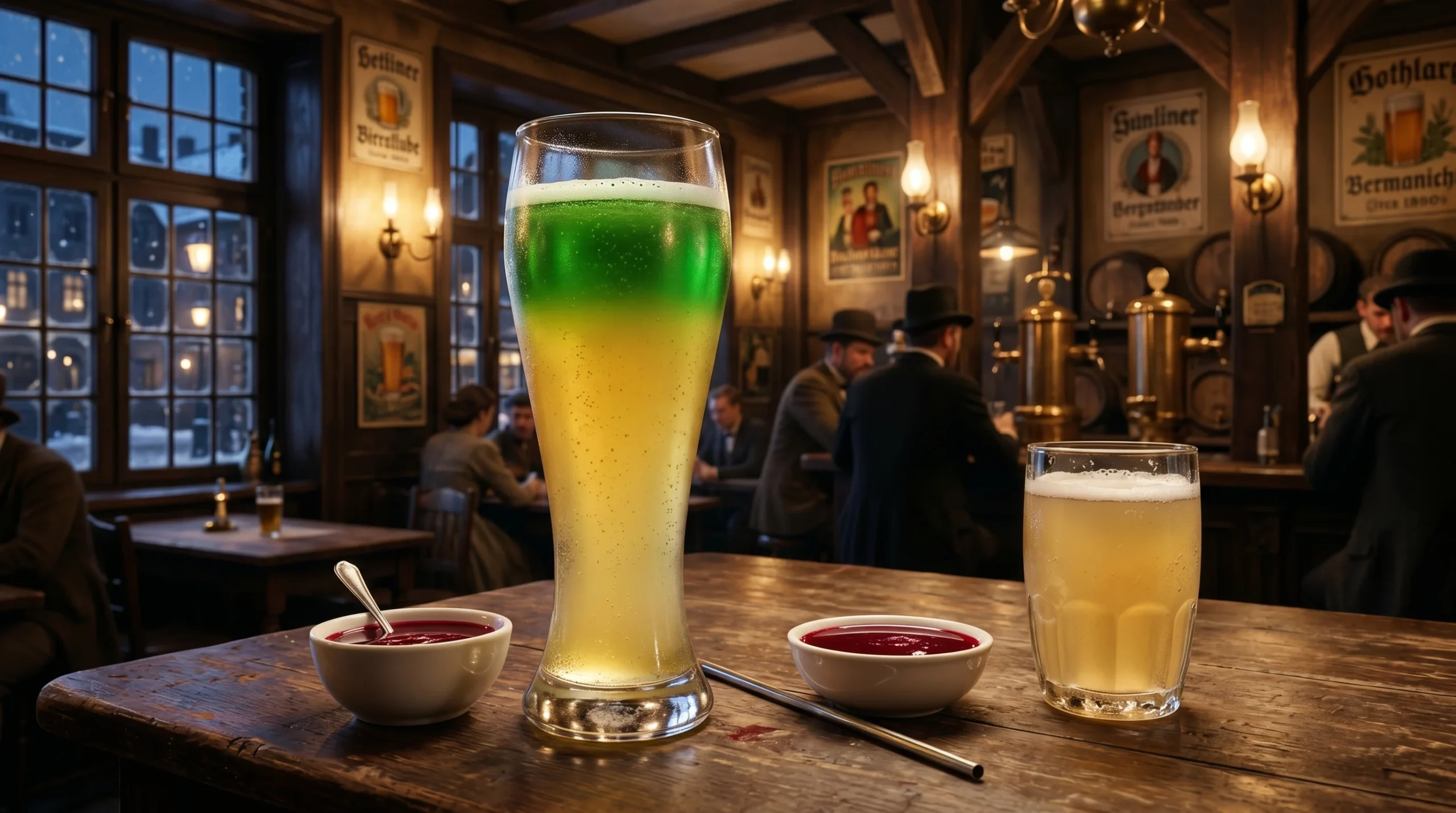
What German Sours Share
- Color: Pale straw to slightly hazy gold
- Body: Light and refreshing
- Core flavors: Gentle, yogurt-like lactic tartness, a dry finish, sometimes salt (Gose); often served with fruit or syrup
- Good for: Newcomers to sour beer, hot climates, and anyone who prefers lower alcohol
The German Sour Styles
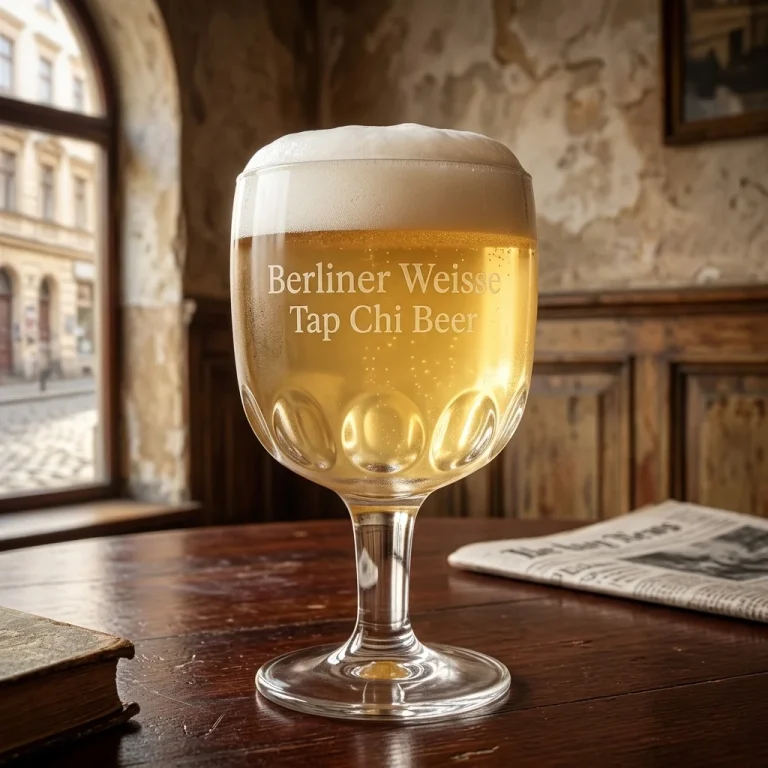
Berliner Weisse is Berlin’s traditional sour: low in alcohol (2.8–3.8% ABV), gently and cleanly tart, and very light in body. It is brewed with more than 50% wheat malt and fermented with Lactobacillus and Brettanomyces. Traditionally it is served with a Schuss, a splash of syrup, usually raspberry or green woodruff, to soften the acidity. For someone who has never had a sour, it may be the easiest one to drink.
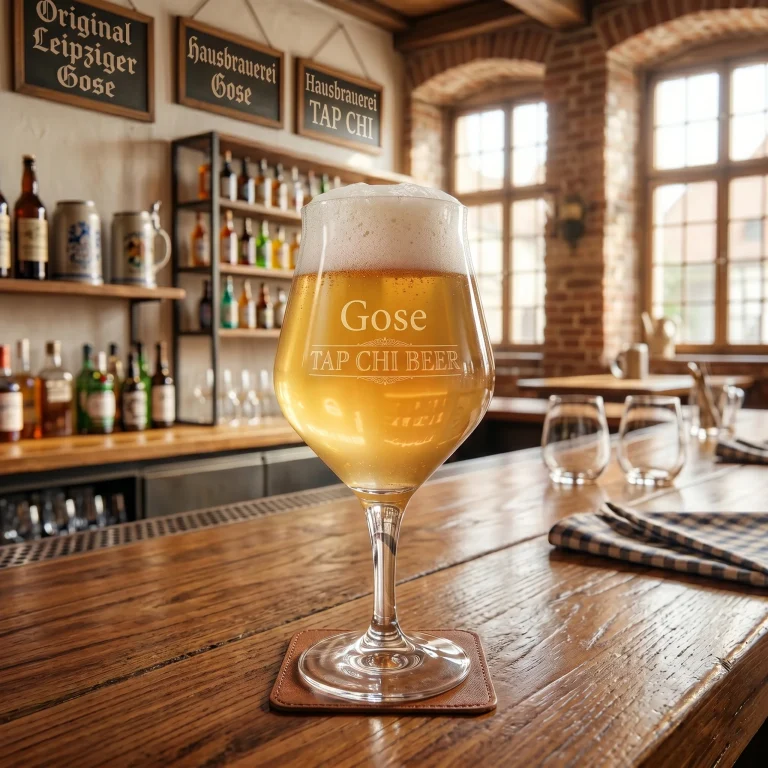
Gose is the Leipzig sour with a twist: sea salt and coriander. Mild tartness, a faint salinity, and the aroma of coriander add up to a character unlike any other beer style. Alcohol is moderate (4.2–4.8% ABV) and the body light. It is a strange style and an appealing one. The first glass usually prompts the question “Why is there salt in my beer?” That surprise is much of its charm.
German Sours in Vietnam
German sours are gradually appearing on Vietnamese craft beer menus, and several local breweries have tried their hand at Berliner Weisse and Gose. Pasteur Street Brewing, Heart of Darkness, and a few others have made versions with Vietnamese fruit such as passion fruit, mango, and pineapple.
The style is a natural fit for Vietnam, for several reasons:
- The heat. German sours are as refreshing as lemonade, ideal for summer.
- Low ABV. Several glasses won’t go to your head, which suits the long sessions of nhậu (the Vietnamese custom of drinking over shared dishes).
- Sour and salty (Gose). Close to the Vietnamese palate, which balances sour, spicy, salty, and sweet.
- Vietnamese fruit. Passion fruit, mango, pineapple, lychee, and guava all pair well with Berliner Weisse and Gose.
If you have never had a sour beer and want to begin, begin here: a Berliner Weisse with passion fruit syrup, or a cold Gose with its faint edge of salt. There is no gentler way into sour beer.
VIModern Wild Ales: A New Generation of Sour Beer
Lambic is the classic. Flanders sours are the tradition. German sours are the heritage. So where does that leave modern sour beer?
A generation of American brewers asked exactly that in the 1990s. They loved the complexity of Lambic but could not brew Lambic outside Pajottenland. They admired Flanders Red but had no interest in making copies. They wanted a line of sour beer of their own, still built on wild yeast and bacteria, but freer in technique and bolder in flavor.
That was the start of the modern wild ale: sour beer unbound by geography yet faithful to the old principle that wild microbes or Brettanomyces, not the brewer, lead the flavor.
History & Origins
Modern wild ales took shape in the United States in the 1990s, led by pioneering breweries such as Russian River (California) and The Lost Abbey. Vinnie Cilurzo of Russian River created a series of Belgian-inspired wild beers, Supplication, Temptation, and Sanctification, that were neither Lambic nor Flanders but a California kind of sour.
By the 2010s the style had spread across the United States and Europe. Breweries such as Jester King (Texas), Side Project (Missouri), and Hill Farmstead (Vermont) pushed it further, from wild ales fermented entirely with microbes from their own farms to hybrids of Lambic and modern wild ale.
The basic difference from the Belgian tradition is control. American brewers can choose their microbes precisely, using lab-grown cultures, and set temperature and timing. They can use foeders (large wooden vats) or oak barrels from American wineries. The result is sour beer that is still handmade but more reproducible than Lambic.
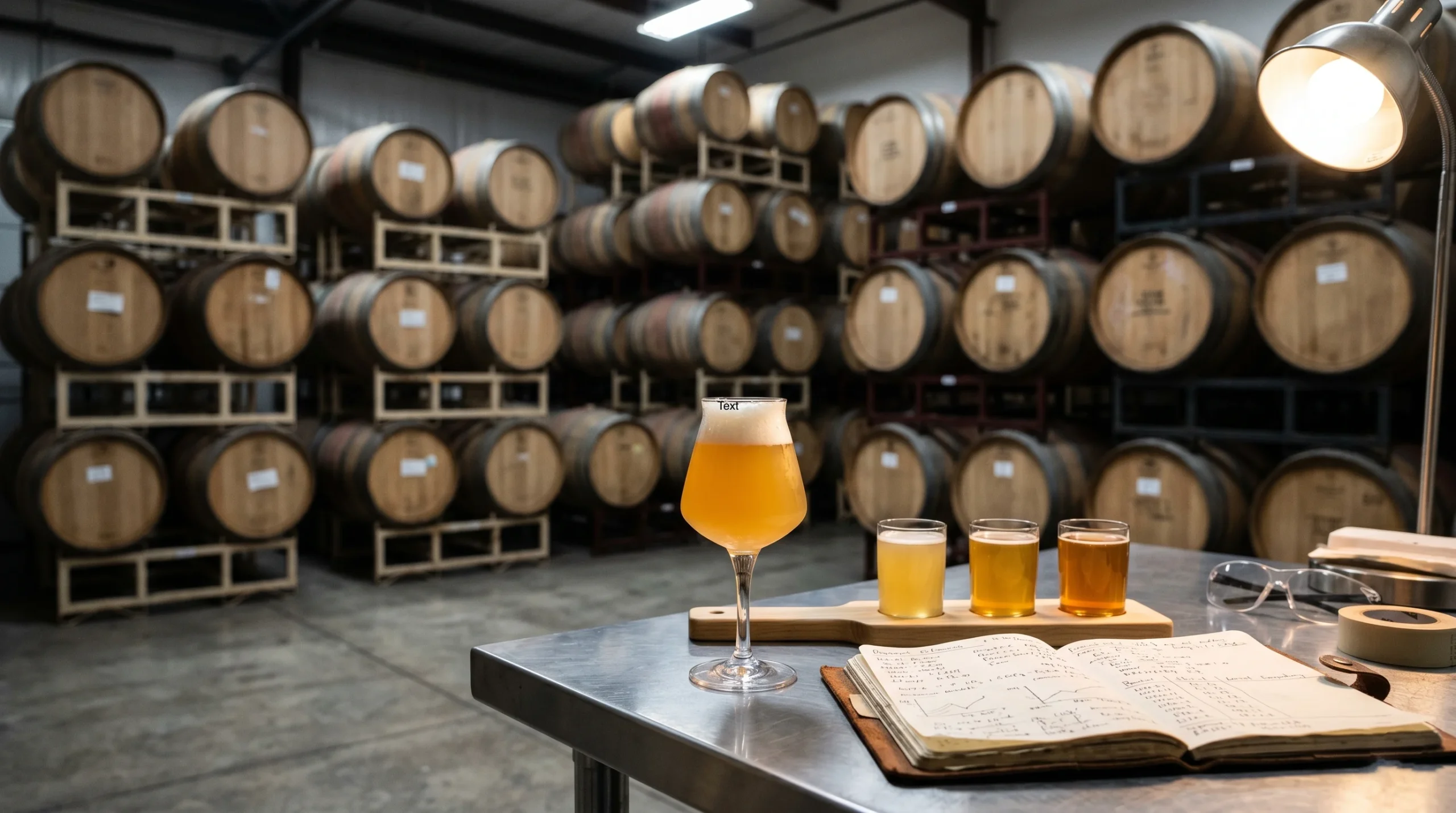
What Modern Wild Ales Share
- Color: Anywhere from pale gold to deep brown
- Body: Light to medium
- Core flavors: Sharp to gentle acidity, Brett funk (leather, horse blanket, tropical fruit), oak, dried fruit
- Good for: Drinkers already at home with sour beer who enjoy invention and variety
The Modern Wild Ale Styles
Wild Ale is the broadest style in the group, covering any beer fermented with wild yeast (usually Brettanomyces), lactic acid bacteria, or both, by a method other than Lambic’s. It may be 100% Brett or a mixed fermentation of Brett, Lacto, Pedio, and Saccharomyces. The character ranges from gently tart and funky to sharply sour and complex. It is the brewer’s sandbox.
Brett Beer is fermented primarily with Brettanomyces rather than Saccharomyces. It need not be sour. Brett makes far less acid than Lactobacillus, but it brings its signature funk: leather, horse blanket, tropical fruit, dried grass and flowers. Lactic bacteria may or may not be involved. It is a specialty for drinkers who love Brett aromas but don’t yet want much acidity.
Sour Ale is a broad term for modern sour beer, usually made by kettle souring (Lactobacillus goes into the kettle for 24–48 hours before the boil). The sourness is clean, mostly lactic acid. It lacks Lambic’s complexity, but it is easy to brew and to scale, and it is the foundation for many modern variants such as Fruited Sour and Smoothie Sour. Many breweries use a Sour Ale as a base, then add fruit or other flavor adjuncts.
Modern Wild Ales in Vietnam
Vietnamese craft brewing is only beginning to explore modern wild ales. A few local breweries have experimented with Brett-fermented beers or Sour Ales, but they remain rare next to IPAs and stouts.
The biggest obstacle to brewing wild ales in Vietnam is cross-contamination. Brett and Lactobacillus are troublesome guests: once they are in a brewery, they can infect ordinary batches and ruin an entire production line. Most Vietnamese breweries do not yet have the facilities to devote to these beers, which need their own equipment and their own space.
Still, some breweries have made a start. If a craft beer menu lists a Wild Ale or a Sour Ale, try it; it is a way to support Vietnamese brewers taking on a demanding style.
Imports are the other route. Bottles from Russian River, Cascade Brewing, Crooked Stave, and other American wild ale specialists do make their way to Vietnam. They cost more than everyday beer, and sour lovers generally find them worth it.
VIIModern Sour Variants: Sour Beer for the Instagram Generation
If Lambic is a 500-year inheritance and the modern wild ale is the technical reinvention of the 1990s, the modern sour variants are the sour beers of the decade we live in.
They are the youngest, most colorful, and most contested sours of all. A peach-pink can of sour beer with vanilla bean and a topping of blended fruit. An orange one made with lactose, crowned with mousse, smelling like a smoothie. A can with the hop aroma of an IPA and a sour taste. This is beer for the Instagram age: photogenic, intriguing, easy to share, and sometimes very good indeed.
Traditionalists argue about them, and many dismiss them as “not beer,” “dessert beer,” or “Instagram beer.” What no one can deny is that these variants have brought sour beer to millions of new drinkers, people who would never try a Lambic but will happily drink a mango and passion fruit Smoothie Sour.
History & Origins
The modern sour variants emerged around 2015–2017, alongside the boom in Hazy IPA. The same generation of brewers, mostly American, started asking why sour beer had to be so serious.
They began to experiment. They added lactose (milk sugar) to Sour Ale for a soft sweetness, as Milkshake IPA had done with hops. They used fruit purée instead of whole fruit for a smoothie-like body and mouthfeel. They added vanilla, marshmallow, and cinnamon to give the beer a dessert character. And they paired aromatic hops with Lactobacillus to create Sour IPA, a paradox on the palate.
The pioneers include The Veil (Virginia), Other Half (New York), Tree House (Massachusetts), WeldWerks (Colorado), and 450 North Brewing (Indiana, known for its Slushy series). Between them, they redefined sour beer for a new generation.
By 2020, modern sour variants were among the fastest-growing styles in craft beer worldwide. The trend reached Southeast Asia, Vietnam included, around 2022.
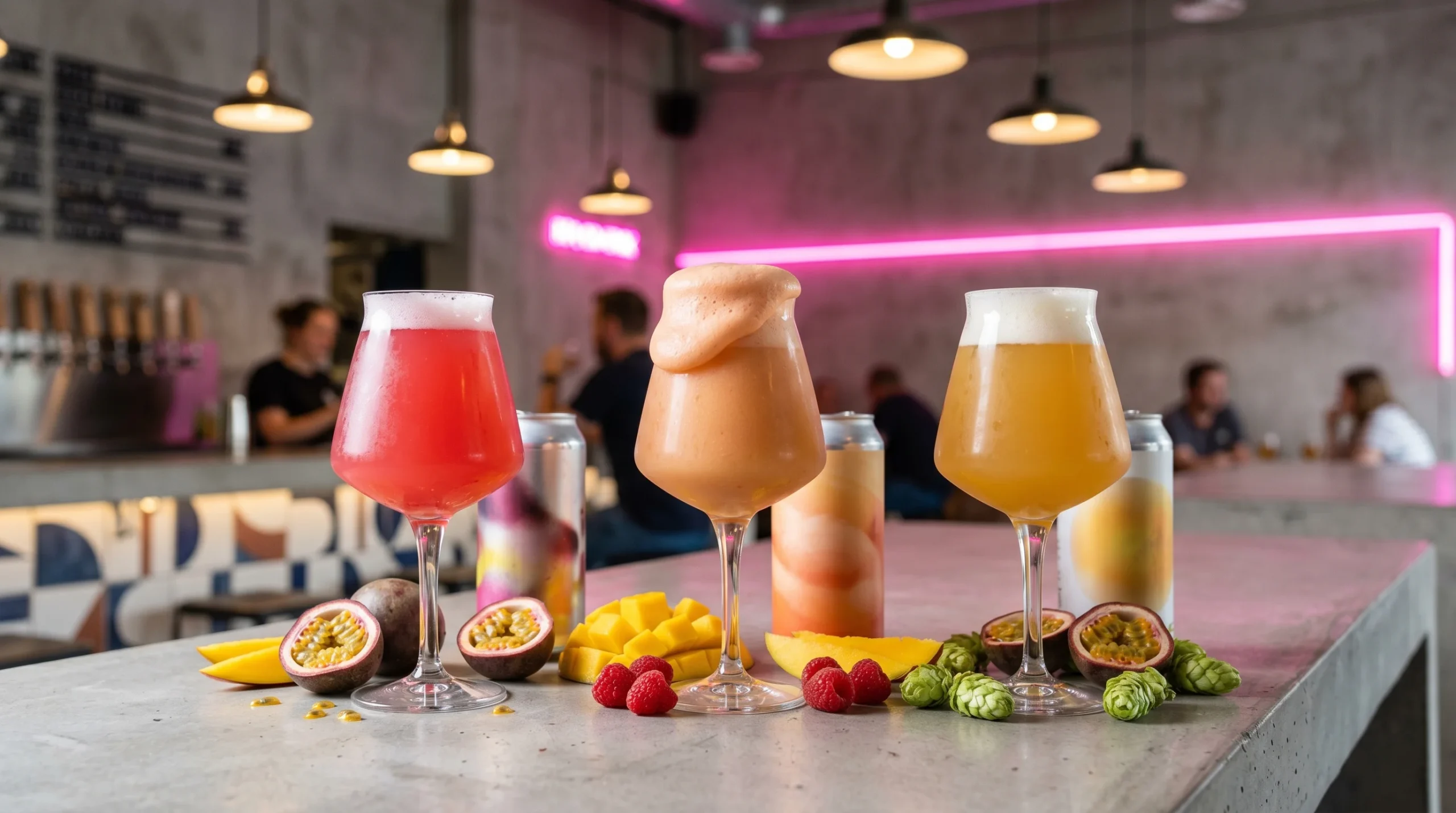
What Modern Sour Variants Share
- Color: Almost any shade: yellow, pink, red, orange, purple, sometimes neon
- Body: Medium to full (from fruit purée and lactose)
- Core flavors: Light to moderate acidity, sweetness, strong fruit aroma, sometimes vanilla, marshmallow, or cinnamon
- Good for: Newcomers to sour beer, drinkers who find heavy acidity too much, and fruit lovers
The Modern Sour Variant Styles
Fruited Sour Ale is Sour Ale with real fruit, fresh or puréed. It may feature a single fruit (cherry, raspberry, mango, passion fruit) or a blend. The fruit usually goes in after primary fermentation, which keeps its aroma fresh and avoids bitterness from tannins. This is the most common style in the group; nearly every craft brewery has at least one Fruited Sour on its menu.
Smoothie Sour Ale takes the modern trend as far as it goes: Sour Ale, lactose, large amounts of fruit purée, and sometimes vanilla or marshmallow. The result is a very full, almost mousse-like body, intense fruit aroma, and acidity softened by the lactose. Poured into a glass, it often forms a thick top layer like a smoothie, which is where the name comes from. It is the most divisive style of all. Fans call it “heaven in a glass”; critics call it “carbonated sugar.” Both have a point.
Sour IPA is a bold hybrid: IPA-style aroma hops (Citra, Mosaic, Galaxy) meet Lactobacillus. The beer carries the citrus and tropical fruit of the hops, the clean tartness of lactic acid, a light body, and a dry finish. It is for drinkers who love both IPAs and sours. Some menus list it as a “Sour Hop” or “Hoppy Sour.”
Modern Sour Variants in Vietnam
This is probably the fastest-growing group of sours in Vietnam over the past 2–3 years. Suited to the heat, popular with younger drinkers, and easy to market on social media, these variants have become the entry point to craft beer for many Vietnamese drinkers.
Several local breweries have run interesting experiments:
- Pasteur Street Brewing: several Fruited Sours made with Vietnamese fruit (passion fruit, mango, lychee)
- Heart of Darkness: a varied sour series that includes Smoothie Sours
- Te Brewery: Brett-fermented experiments and Fruited Sours
The big opportunity for Vietnamese breweries lies in the country’s own tropical fruit: passion fruit, lychee, longan, mangosteen, durian, pineapple, guava. American breweries cannot get these fresh at the quality and price Vietnam can. A lychee Smoothie Sour or a mangosteen Fruited Sour could become a signature beer that only Vietnam can make.
If you are new to sour beer and not ready for Lambic, start here. Pick a Fruited Sour with a familiar fruit (passion fruit, mango), work up to a Smoothie Sour, then a Sour IPA, and from there begin exploring the older traditions.
VIIIHow to Drink Sour Beer
Sour beer calls for a different approach from dark or bitter beer. Dark beer asks you to slow down, and bitter beer rewards freshness; sour beer asks for an open mind, open to a character that may seem strange at first and to rethinking what beer is supposed to taste like.
This section covers what is particular to sour beer. For the fundamentals of enjoying beer in general, including serving temperature, glassware, pouring technique, how to run a tasting, and the principles of food pairing, see our full guide, How to Savor Beer.
3 Things That Set Sour Beer Apart
1. Temperature matters more
Sour beer is more sensitive to temperature than other styles. Too cold, and it numbs the palate and hides the finer points of the acidity. Too warm, and the sourness turns harsh and unpleasant.
- Berliner Weisse, Gose: 5–7 °C (41–45 °F), cold and refreshing
- Modern sour variants (Fruited, Smoothie): 5–8 °C (41–46 °F)
- Lambic, Gueuze: 8–10 °C (46–50 °F), warm enough to open up the aromas
- Flanders Red, Oud Bruin: 10–12 °C (50–54 °F), close to red wine
The simple rule: the more complex the sour, the warmer you serve it.
2. Start with your nose
Sour beer often smells like one thing and tastes like another. A Lambic may smell of sweet dried fruit and funky leather yet taste dry and sharply sour. A Berliner Weisse may smell faintly of lemon yet taste as tart as unsweetened yogurt.
Spend 20–30 seconds smelling before you drink. Learn to predict the taste from the aroma, then check your guess against the first sip. Few tasting exercises in beer are as rewarding.
3. Don’t be thrown by the first sip
Strong acidity can provoke a physical reaction: a rush of saliva, squinting eyes, a puckered face. That is the body’s natural response to strong acid, not a sign that the beer is bad. The palate adapts quickly, and the second sip is much easier.
A tip for beginners: before the first sip, rinse your mouth with a little plain water. Then hold the beer in your mouth for 3–5 seconds so your whole palate can register it, not just the tip of the tongue, where sourness is felt most. Given that chance, a sour beer shows surprising depth.
IXPairing Sour Beer With Vietnamese Food
This may be the most interesting territory for pairing beer with Vietnamese food, and the least explored.
Sour beer pairs well with fresh dishes, sweet-and-sour dishes, dairy, and above all tropical fruit. The beer’s acidity echoes the acidity in the food, while the complexity of the beer, especially Lambic and the Flanders sours, adds depth to meals that seem simple.
Here are some pairings worth trying.
Gỏi Cuốn, Gỏi Xoài + Berliner Weisse
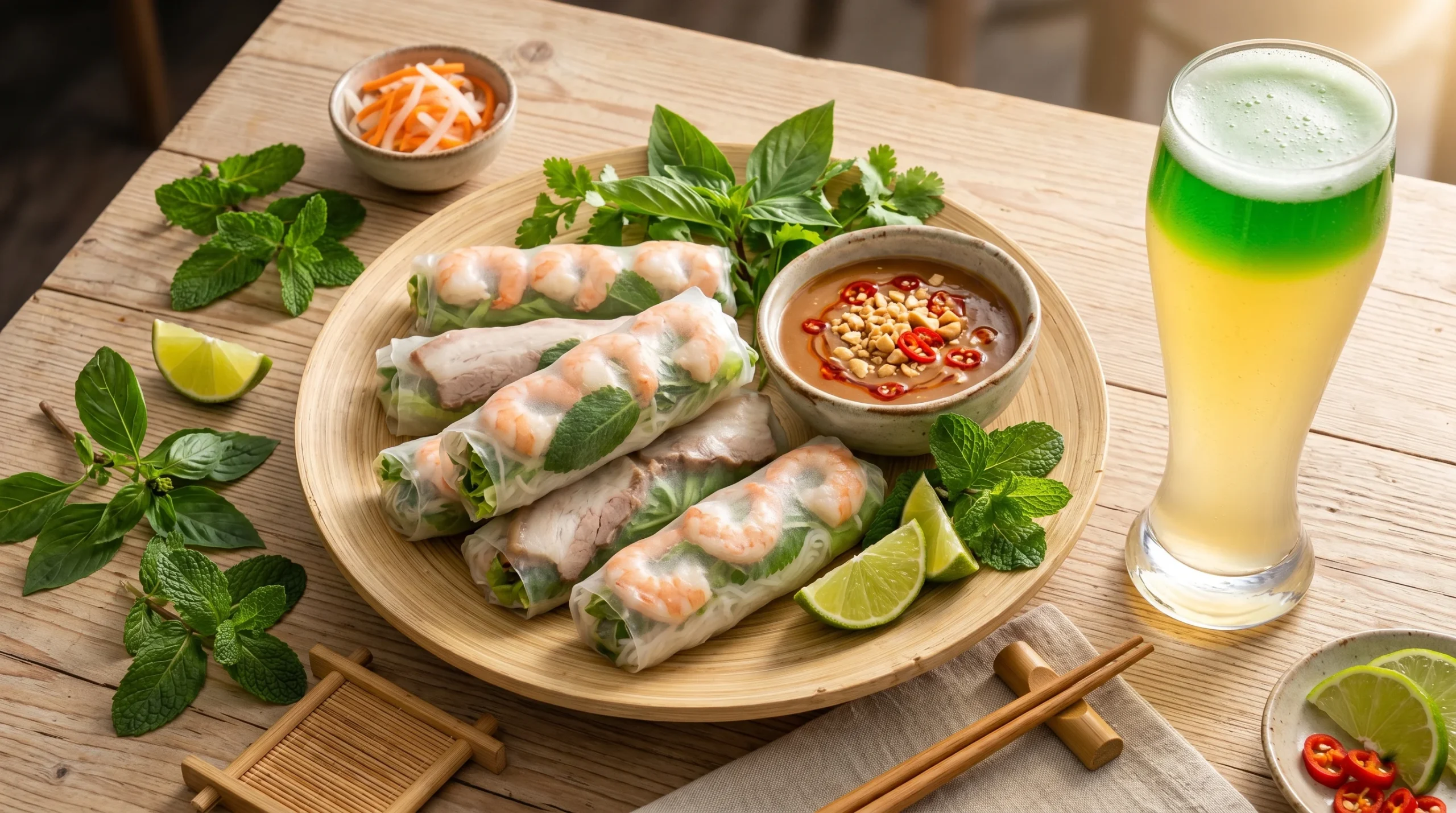
This is the ideal first pairing for anyone new to sour beer. Gỏi cuốn, with shrimp, pork, fresh herbs, and rice vermicelli, meets a light, refreshing Berliner Weisse. The beer’s gentle tartness picks up the lime in the dipping sauce without overpowering the delicate herbs.
With gỏi xoài (Vietnamese mango salad), made with green or ripe mango, a Berliner Weisse with passion fruit syrup works beautifully: the tartness, a hint of fruit, and the sweet-sour mango together are thoroughly refreshing.
Pour: Berliner Weisse, with or without syrup.
Bún Bò Huế + Gose
A pairing that breaks the rules and works anyway. Bún bò Huế (spicy beef noodle soup from Hue), hot and robust and salty from mắm ruốc (fermented shrimp paste), meets Gose, the sour beer brewed with sea salt and coriander.
The salinity of the Gose heightens the umami of the shrimp paste. The coriander echoes the fresh herbs in the bowl. The mild acidity calms the heat and keeps the meal from feeling heavy. It is one of the smartest matches between beer and the food of central Vietnam.
Pour: Gose, traditional or a lime-flavored Fruited Gose.
Phở Chua, Bánh Hỏi Heo Quay + Flanders Red Ale
This is the refined pairing: the complex dishes of the Mekong Delta meet the wine-like Flanders Red Ale.
Lang Son’s phở chua (a cold rice noodle dish in a sweet-and-sour sauce), or any of the sweet-and-sour dishes of the Mekong Delta, strikes a careful balance of meat, herbs, spices, and tangy-sweet sauce. Flanders Red, with its sour cherry, oak, and deep, layered malt, turns the meal into something like a wine pairing for Vietnamese food, much as red Burgundy goes with traditional French cooking.
Above all, try it with heo quay, the crisp-skinned roast pork served with bánh hỏi (fine woven rice vermicelli): the sharp acidity of the Flanders Red cuts through the fat, and its malt-forward body supports the meat.
Pour: Flanders Red Ale (Rodenbach Grand Cru, Duchesse de Bourgogne).
Bánh Tráng Trộn, Bánh Tráng Nướng + Fruited Sour Ale
Saigon street food, bánh tráng trộn (rice paper salad) and bánh tráng nướng (grilled rice paper), meets Fruited Sour Ale in a pairing about as cross-cultural as it gets. Bánh tráng trộn is tossed with salt, chili, fish sauce, lime, dried shrimp, peanuts, and sa tế chili oil, covering all five Vietnamese tastes. A Fruited Sour Ale, with fresh fruit aroma and soft acidity, refreshes the palate after every bite.
The tartness and the passion fruit or mango in the beer lift any fruit in the bánh tráng. The beer’s light body doesn’t weigh down street food that is already boldly seasoned.
Pour: Fruited Sour Ale with tropical fruit (passion fruit, mango, pineapple).
Raw Seafood (Sashimi, Raw Oysters, Raw Shrimp) + Belgian Gueuze
This is the connoisseur’s pairing. Gueuze, with its Champagne-like sparkle, sharp acidity, and layered aroma, is one of the finest matches for raw seafood.
Gueuze goes with raw oysters and sashimi on the same principle as a dry white wine (Sauvignon Blanc, Albariño) with oysters: acidity, minerality, and a light body that never overwhelms the delicate taste of the sea.
With Hanoi-style raw shrimp, peeled and dipped in chili salt, Gueuze cleanses the palate between bites and brings out the natural sweetness of the shrimp.
Pour: Belgian Gueuze (Cantillon, 3 Fonteinen, Boon).
Grilled or Roast Duck + Flanders Oud Bruin
Duck is fatty and strongly flavored, and it needs a beer with enough character to stand up to it. Flanders Oud Bruin, with its gentle acidity, malt-forward body, and notes of chocolate and dried fruit, fits the bill.
The acidity cuts through the duck fat, and the beer’s malt and caramel complement the crisp roasted skin. With Peking duck or the free-range duck of Van Dinh, Oud Bruin makes a meal as polished as any wine pairing.
Pour: Flanders Oud Bruin (Liefmans Goudenband).
Fried Food (Fried Chicken, Wings, Fried Fish) + Sour IPA
Crisp, oily fried food meets Sour IPA, and the combination of acidity, hops, and a light body scrubs the palate clean. It works like an IPA with fried food, where bitterness cuts the fat, but the acidity of a Sour IPA hits harder than bitterness, resetting the palate completely between bites.
With Korean fried chicken, whether yangnyeom or soy garlic, a Sour IPA’s tropical-fruit hops and tartness make an unusual match for fusion cooking.
Pour: Sour IPA or Hoppy Sour.
Goat Cheese and Soft Cheeses + Belgian Lambic
A classic Belgian pairing. Mildly tangy goat cheese meets sour, funky Lambic, two foods shaped by the same kind of wild microbes.
The Brett in the Lambic draws out the faint barnyard note of goat cheese. The sharp acidity cuts through the cheese’s creamy fat, and the light body leaves its delicate character intact.
This is a combination for a relaxed evening with a cheese board, with nothing else needed but crusty bread.
Pour: Belgian Lambic or Gueuze.
Fresh Tropical Fruit (Lychee, Longan, Mango, Passion Fruit) + Fruited Sour
Sometimes the simplest pairing is the one that works. A plate of fresh tropical fruit meets a Fruited Sour Ale: both are fresh and fruity, in different ways.
The beer’s acidity highlights the natural sweetness of the fruit. The fruit in the beer may match the fruit on the plate or contrast with it, and either way the result is interesting.
With fresh lychee, a Framboise Lambic or a lychee Fruited Sour makes a rare kind of tropical luxury.
Pour: Fruited Sour Ale or Belgian Fruit Lambic (Kriek, Framboise).
Pastries and Desserts + Smoothie Sour Ale
With its lactose and fruit purée, Smoothie Sour is a dessert beer, an easy match for tart or fruity desserts.
Lemon cake, fruit tarts, strawberry ice cream, and panna cotta all pair with Smoothie Sour. The beer’s acidity tempers the sweetness of the dessert, and its creamy body matches the dessert’s texture.
Then there are chè ba màu (three-color bean dessert), chè đậu đỏ (sweet red bean soup), and chè khúc bạch (milk-jelly cubes in syrup), a cross-cultural pairing worth exploring. The gentle sweetness of the chè, the lactose in the beer, and a touch of softening acidity make for a memorable weekend afternoon.
Pour: Smoothie Sour Ale or a Fruited Sour with lactose.
Don’t Be Afraid to Experiment
Sour beer with Vietnamese food is wide territory, still largely unmapped, and you may find a great match no one has thought of yet. Bánh khọt (crisp mini rice pancakes) with Berliner Weisse? Cơm tấm (broken rice with grilled pork, a Saigon staple) with Gose? Bún đậu mắm tôm (rice noodles and fried tofu with fermented shrimp paste) with Flanders Red?
The only rule: sour beer plus natural acidity plus tropical fruit usually works. For the rest, experiment and let your palate decide.
XNew to Sour Beer? Where to Start
Sour beer may be the biggest hurdle in beer for a newcomer. Dark beer suffers from the misconception that it is “too heavy,” bitter beer from the idea that it is “too bitter.” Sour beer faces a more damaging one: that it is spoiled.
For the uninitiated, a straight Lambic can come as a shock: sharp as vinegar, funky as a stable, with no sweetness to soften it. A first-time drinker can easily decide the beer has gone off, and miss an entire world.
That is why the order of discovery matters so much with sour beer, more than with dark or bitter beer. Follow the right path and the sourness grows on you. Go in the wrong order and you may never reach Lambic, the style many connoisseurs consider the summit of beer.
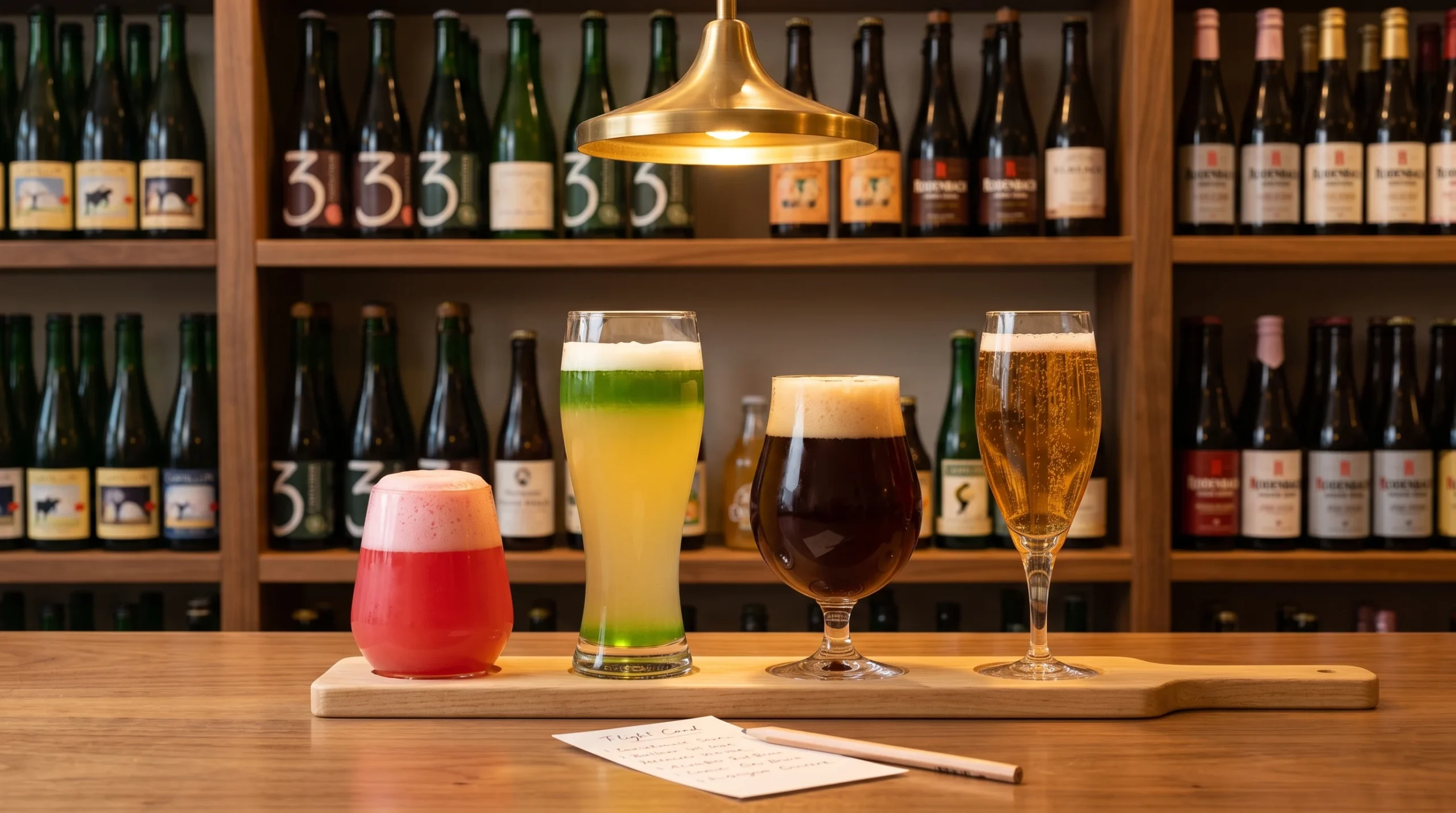
A 4-Step Path for Beginners
Step 1: Start with fruited modern sours
Begin with a Fruited Sour Ale or Smoothie Sour Ale in a familiar flavor such as passion fruit, mango, or pineapple. These are the easiest sours to drink, their acidity softened by sweetness and fresh fruit aroma.
The usual reaction after the first glass: “Oh, sour beer can taste this good?”
This is the softest way in. It also suits the Vietnamese palate, with its love of fruit and of sweet and sour together, and the hot climate, where a cold sour at midday in summer is a real pleasure.
Step 2: Move on to German sours
Once Fruited Sours have accustomed you to acidity, switch to Berliner Weisse or Gose. These are “traditional” sours but still light and refreshing. There is no sweet topping or lactose to mask the sourness, yet they stay easy to drink thanks to low ABV and a light body.
This is also where you begin to notice that sourness comes in kinds: the soft, yogurt-like lactic tartness of Berliner Weisse is different from the salty tartness, edged with coriander, of Gose.
A tip: traditional Berliner Weisse is served with a Schuss, a little raspberry or green woodruff syrup to soften it. Try it both ways, with syrup and without, to taste the difference.
Step 3: Explore the Flanders sours
Now you are ready for wine-like sours. Start with Flanders Oud Bruin, the gentler, more malt-forward, less sour counterpart to the Red Ale. Then climb to Flanders Red Ale, with its red Burgundy character.
At this stage, start pairing with food. Flanders sours go especially well with red meat, roast duck, and strong cheeses, much as red wine does. This is when sour beer becomes part of the meal.
Step 4: The Lambic family, at the top
With a solid footing from the first 3 steps, it is time for Lambic, beginning with Belgian Fruit Lambic (Kriek or Framboise). The fruit softens the sourness and funk and lets you get to know Lambic’s character without a shock.
Then try Belgian Gueuze, with its Champagne-like sparkle, layered acidity, and pronounced Brett aroma. It may be the glass you remember long after the first taste.
Finally, once Lambic’s character feels familiar, try straight Belgian Lambic, unblended and without fruit. This is the rawest, most intense form. Some people love it immediately. Others find it too much, and that is entirely fine.
Wild Ale and Brett Beer sit outside the sequence. These experimental styles are worth exploring at any stage, ranging from gently tart and funky to sharply sour and complex, and every brewery interprets them its own way.
3 Common Mistakes to Avoid
1. Starting with straight Lambic or Flanders Red Ale
This is the most common beginner’s mistake, especially among confident drinkers who feel they have tried plenty of beers and nothing is too difficult. The intense sourness and funk of straight Lambic and Flanders Red can shock a newcomer on contact.
If your first Lambic doesn’t win you over, don’t conclude that you dislike sour beer. Step back to a Fruited Sour or a Berliner Weisse and return to Lambic in a few months. The palate needs time to adjust to strong acidity.
2. Drinking sour beer too cold
This is the second most common mistake. Served at ordinary refrigerator temperature, 3–4 °C (37–39 °F), sour beer numbs the palate and hides its depth, especially Lambic and the Flanders sours.
The rule: take the beer out of the fridge 5–10 minutes before drinking and let it breathe. New layers of flavor emerge as it warms. A Gueuze at 10 °C (50 °F) is a different beer from the same Gueuze at 4 °C (39 °F).
3. Judging from the first sip
Strong acidity sets off a strong physical reaction: saliva, squinting, a puckered face. That is simply how the body reacts to acid, not a sign the beer is bad.
The first sip is always the most intense. By the second and third, the palate has adapted, and the beer becomes easier to drink and more complex. Give yourself at least 3 sips before passing judgment. Lambic and the Flanders sours in particular open up over time, and the first glass is not the same as the last.
A Final Word: Sour Beer Asks for a Different Mindset
Dark beer is rich and comforting, bitter beer bright and energizing. Sour beer demands a different way of thinking about what beer is.
It is a product of wild microbes, closer to wine than to ordinary beer, the result of months or years of microbes working on one another in wooden barrels. Chemistry, history, and culture are compressed into a single glass.
Approach sour beer as a complex fermented drink rather than as beer that happens to taste sour, and the whole experience changes.
After 3–6 months of steady exploration, something unexpected happens. The sourness stops being an obstacle and becomes the thing you look forward to. You start craving Brett funk. You can tell Cantillon from 3 Fonteinen. You understand why Gueuze is called the Champagne of beer.
That is when you have truly entered the world of sour beer.
XISumming Up: From Lambic to Sour IPA in 500 Years
This guide set out to trace sour beer from the classic Lambic of Pajottenland to the modern Sour IPA of California. Along the way it has covered 14 styles and 500 years.
From the koelschips of the late 16th century, set beneath open windows to let in the Pajottenland air, to Rodenbach’s 150-year-old oak vats in West Flanders, to the 19th-century Berlin beer halls where Napoleon called Berliner Weisse the “Champagne of the North,” to the peach-pink, fruit-topped Smoothie Sour cans of our own decade, sour beer is not a single style. It is a philosophy of time, microbes, and patience.
Within that philosophy:
- The Lambic family is the root: 4 styles, fermented entirely by wild microbes, aged in wood for years, and impossible to reproduce outside Pajottenland
- Flanders sours are the heritage: 2 refined, wine-like styles, “the Burgundy of Belgium,” a bridge between beer and wine
- German sours are the light touch: 2 low-ABV, refreshing styles that welcome newcomers
- Modern wild ales are the reinvention: 3 American-inspired styles that join Belgian tradition to modern technique
- Modern sour variants are the future: the 3 youngest and most inventive styles, which have brought sour beer to millions of new drinkers
Each family is a generation, and each style a different approach to the same basic ingredients: water, malt, hops, and a microbial world so complex that modern science still does not fully understand it.
A Closing Thought
In Vietnamese beer culture, sourness is a suspect flavor: a sour beer is a spoiled beer. The reaction is natural. Throughout human history, sourness in food has often signaled bacterial contamination, food kept too long, spoilage.
Yet after working through every style in this guide, you see the opposite. The sourness in sour beer is the product of precise control, not accident. Every glass of Lambic holds microbes the brewer has tended for years. Every Gose follows a recipe refined over centuries. Every Fruited Sour is a deliberate experiment.
Sour beer illustrates a basic truth of food and drink: there are no “good” or “bad” flavors, only flavors that are right or wrong for a given style. A sharply sour Lambic is no more “spoiled” than a crystal-clear Pilsner. Both are beer, each has its own merits, and both deserve to be understood before they are judged.
Vietnamese drinkers come to sour beer with an advantage, because sourness is already familiar from the kitchen. Lang Son’s phở chua, bún bò Huế, canh chua cá lóc (sour snakehead fish soup), dưa chua (pickled greens), and mắm nêm (fermented anchovy dipping sauce) all rely on lactic and acetic acid for part of their flavor. Sourness is no stranger to Vietnamese palates. It is only unfamiliar in beer.
Once the taste is acquired, sour beer may turn out to be the most “Vietnamese” family of beers: suited to the heat, in tune with a palate built on sour, spicy, salty, and sweet, and at home at the traditional Vietnamese table.
Remember: sourness is not something to fear. It is something to open up to.
Mentioned in this article
and 6 more linked in the text
Originally published in Vietnamese on Tạp Chí Beer.