Mosaic: The Tropics, Piece by Piece
Mosaic is an American hop with layered aromas that run from mango and blueberry to pine and damp earth. Developed in 2012, it reshaped thinking about the modern IPA.
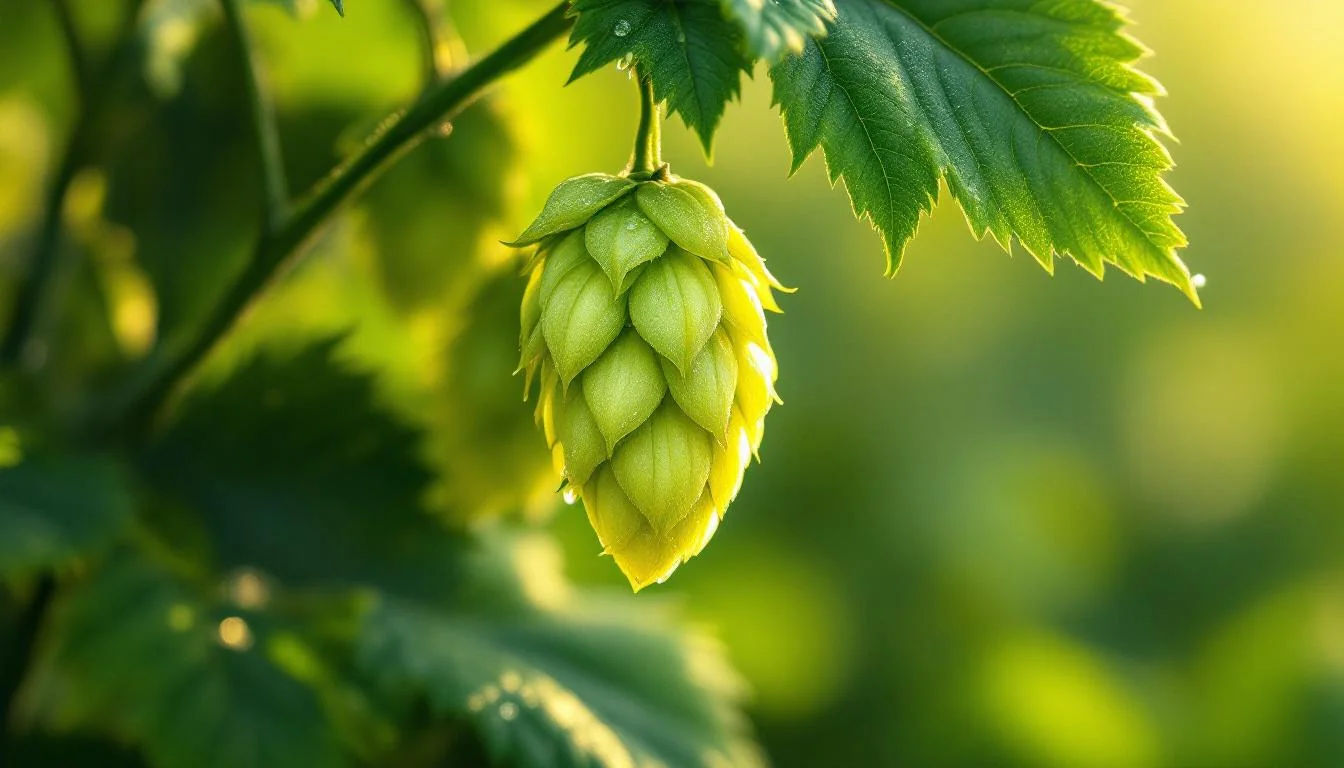
In 2012, a small Portland brewer received a sample of an experimental hop coded HBC 369. He dry-hopped a modest batch of pale ale with it, just to see. When he opened the fermenter, he stood still for a moment. It wasn’t the strength of the aroma that stopped him. It was the complexity. Mango. Blueberry. Then pine. Then earth after rain. Then orange. He couldn’t tell whether he was smelling one hop or an entire tropical garden.
That hop was later named Mosaic, and the name was no accident. A mosaic is built from small pieces, each with its own color, that resolve into a single picture when you step back. Mosaic changed how brewers think about single-hop beers: one variety could now supply the depth that once took a blend of three or four.
Its popularity hardly needs explaining. What lies behind it is more interesting: a story of breeding, of soil, and of how a hop that arrived at the right moment could reshape an entire movement.
IOrigins and History
Mosaic came out of the breeding program at the Hop Breeding Company (HBC), a joint venture between John I. Haas, Inc. and Yakima Chief Ranches. The pairing was deliberate. John I. Haas, in business since 1914, is one of the oldest hop suppliers in the United States. Yakima Chief is a group of family farms that have grown hops in the Yakima Valley for generations. When the two sat down together, they pooled their resources along with more than a century of accumulated knowledge.
The program began in the mid-2000s with a clear goal: new varieties with distinctive aromas for a craft beer movement whose appetite kept growing. Simcoe, an earlier success, was chosen as the mother, and the choice was calculated. Simcoe brought its characteristic pine and earth, high alpha acids, and, more to the point, a proven ability to adapt to growing conditions in Yakima.
The father was an experimental male listed as Nugget-derived, meaning it descends from Nugget, a classic American bittering hop developed in the 1970s. The cross produced offspring with both the strength of a traditional bittering line and the finesse of a modern aroma line.
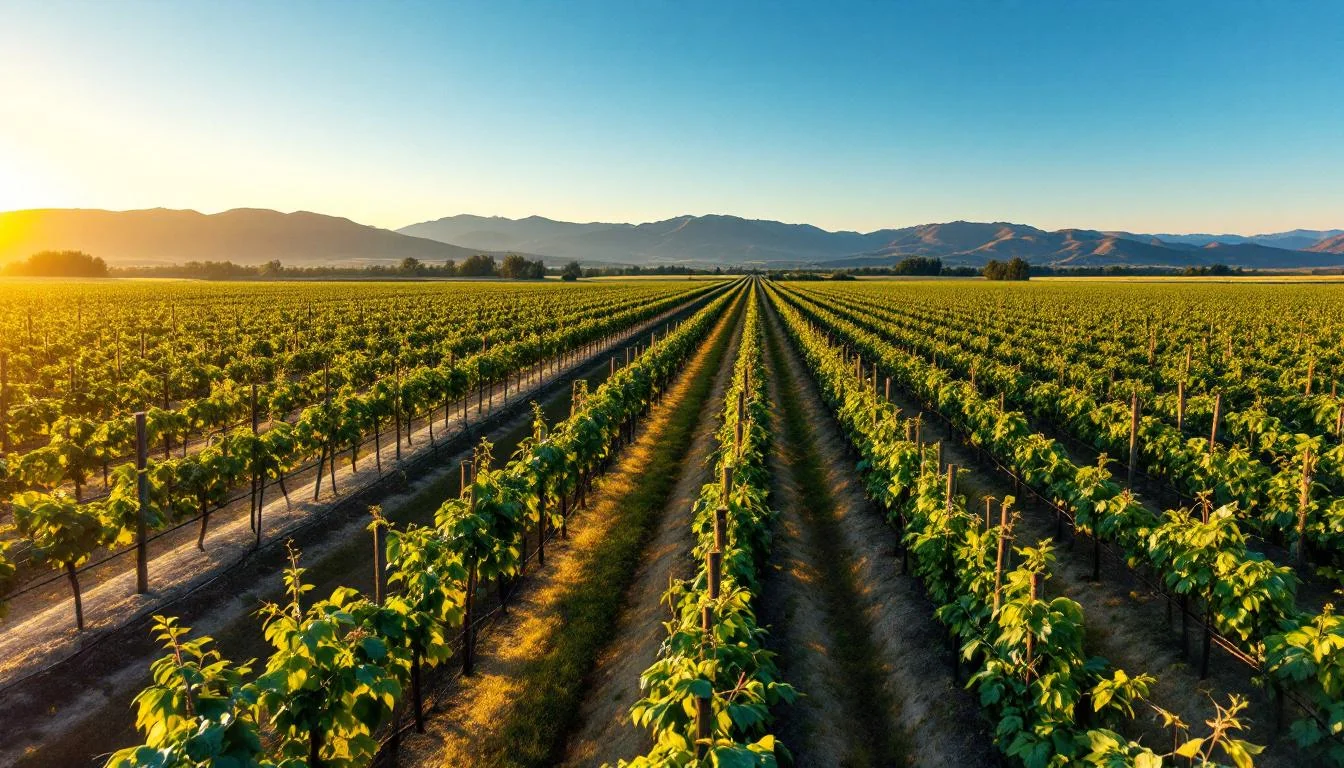
Selection took years. Hundreds of seedlings were planted, evaluated, and discarded. HBC 369, Mosaic’s internal code, emerged as a standout candidate around 2008. But the road from promise to commercial release is long. A new variety has to be grown in larger trials, tested for disease resistance, and assessed for yield. Most important, it has to prove itself in real brewing.
In 2012, Mosaic was officially released, and the timing could not have been better. American craft beer was booming, and brewmasters were constantly hunting for new ingredients to set their beers apart. Mosaic met that need precisely: a hop that could stand alone and still deliver a surprising amount of complexity.
The Yakima Valley, where Mosaic was born and which remains its main growing region, lies in central Washington. It is the largest hop-growing region in the United States, accounting for about 75% of national production. A semi-arid climate of hot summers, long days, and cool nights gives hops ideal conditions for developing their aromatic oils. An elevation of roughly 300–600 meters above sea level, together with irrigation from the Yakima River, creates a terroir that no other place can fully replicate.
IITechnical Profile
Mosaic is a dual-purpose hop, used for both bittering and aroma. Alpha acids range from 11.5% to 13.5%, high enough for bittering but not so strong that they overwhelm the aroma in late additions. Beta acids fall between 3.2% and 3.9% and give a soft bitterness without harshness.
What sets Mosaic apart is its oil content. Total oil runs from 1.0 to 1.5 ml per 100 g, a high figure next to many commercial varieties. Myrcene makes up a large share of it, from 47% to 53%, and is the compound behind the tropical aroma Mosaic is known for. Humulene and caryophyllene, two compounds common in European hops, are present as well, adding faint woody and spicy notes in the background.
Mosaic is usually harvested in Yakima from late August into early September, when the lupulin glands, the tiny glands that hold the oils and bitter acids, reach optimal ripeness. Pick too early and the aroma hasn’t fully developed. Pick too late and the oils begin to oxidize and lose their freshness. Calling the moment is a craft that Yakima growers have honed over generations.
IIIAroma and Flavor
One sniff of Mosaic explains the name. No single aroma dominates. Instead the layers stack on top of one another and shift with every breath.
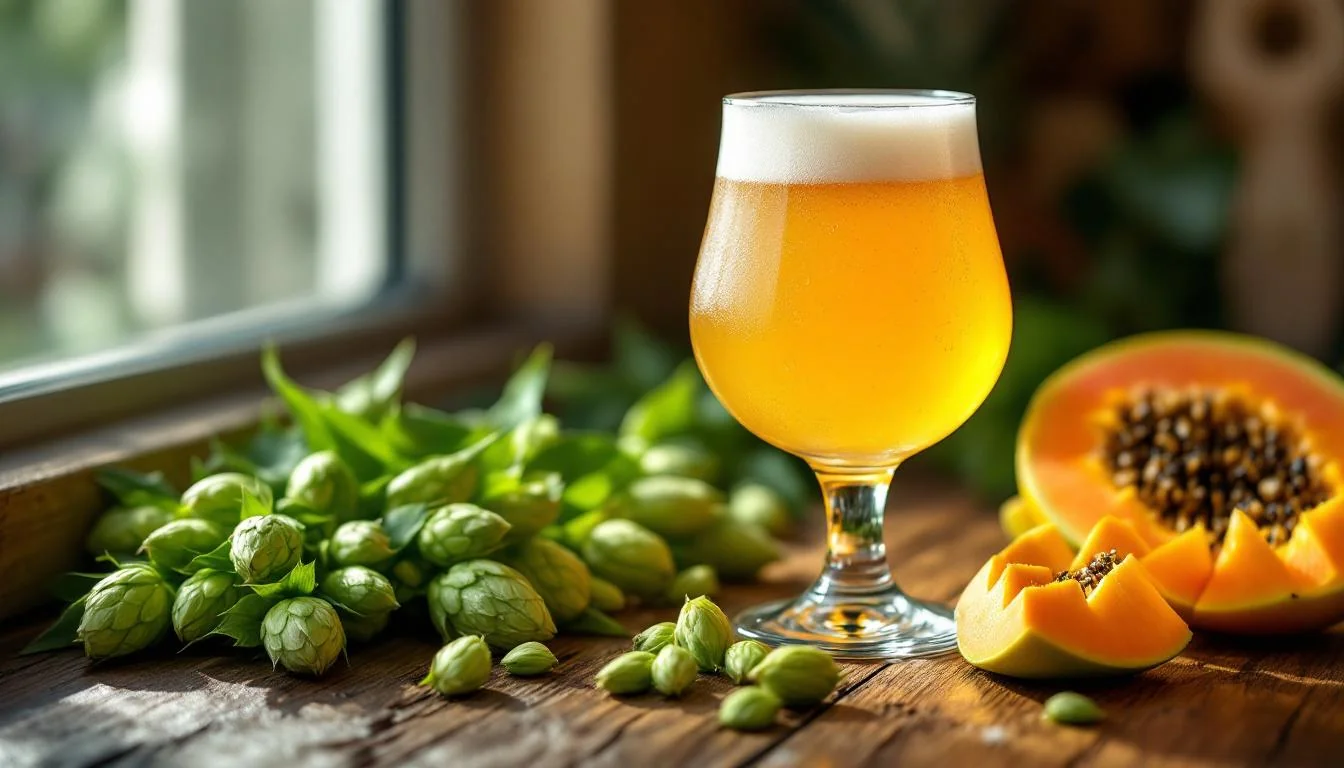
The first layer is tropical fruit. Ripe mango is the easiest note to recognize, not sour green mango but ripe yellow mango, gently sweet and a little musky. Next come papaya, a hint of guava, and white peach. A sensitive nose will also catch passion fruit, its sweet-tart scent flickering in and out at the back.
The second layer is berries. Blueberry is Mosaic’s distinguishing note, and it is rare in other hops. Not everyone picks it up, but once noticed, it is hard to forget. Alongside the blueberry are touches of strawberry and raspberry, which give the berry layer its depth.
The third layer is herbal and earthy, and here the mother, Simcoe, shows through: light pine, earth after rain, a little moss. These notes don’t crowd the fruit. They form the base and keep the whole from turning too sweet or one-dimensional.
On the palate, Mosaic comes across as ripe fruit, without the sharp sourness of some citrus-forward hops. The bitterness arrives soft and rounded, and the long finish carries a tropical echo. Some drinkers compare the finish to a fruit candy held on the tongue: lightly sweet, fragrant, and the kind of thing that sends you back for one more sniff.
Mosaic’s flavor profile also shifts with how it is used. Dry hopping brings out more fresh fruit. A whirlpool addition at lower temperatures holds on to more of the delicate aromatics. First wort hopping emphasizes the soft bitterness and the background notes. For brewmasters it is room to play, one hop with many interpretations.
IVBeer Styles That Use Mosaic
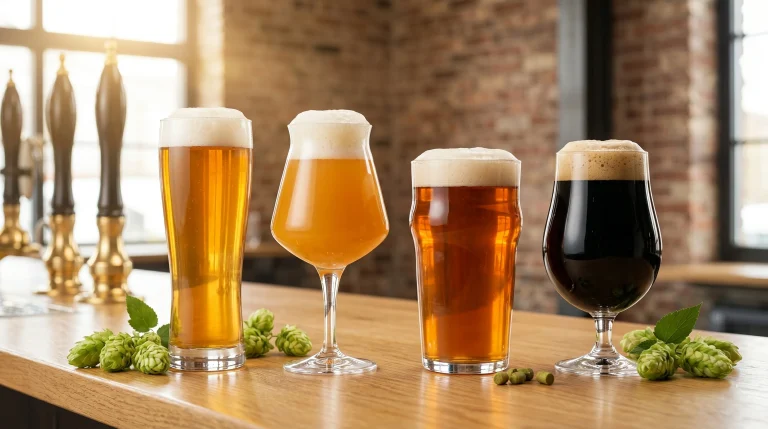
Mosaic’s natural home is the world of IPAs and other hop-forward beers. The single-hop Mosaic American IPA has become a classic of modern craft beer. With alpha acids high enough for bittering and an aroma profile this complex, Mosaic can carry an entire hop bill without help.
The New England IPA (NEIPA) is where Mosaic really comes into its own. The style’s haze and soft mouthfeel let Mosaic’s fruit come forward without harsh bitterness getting in the way. Paired with Citra or Galaxy in a NEIPA, Mosaic acts as the go-between, binding the other hops into one coherent whole.
The American Pale Ale is another popular choice. With less alcohol than an IPA, a pale ale lets Mosaic show its quieter sides, the berries, herbs, and earth that can get lost in a stronger beer. For drinkers, it is a way to get to know Mosaic in its purest form.
Lately Mosaic has begun turning up in less expected styles. Some brewers use it in American-style wheat beer, where its fruit complements the soft character of the wheat. Others experiment with it in light sour beers, where the beer’s acidity lifts the hop’s berry notes. There are even modern lagers dry-hopped with Mosaic, a pairing that sounds unlikely and makes surprising sense.
VHow It Compares With Similar Hops
Simcoe, Mosaic’s mother, is the natural first comparison. Both have pine and earth, but Simcoe leans more resinous and dank, while Mosaic carries more tropical fruit. Simcoe reads cool and piney, Mosaic sunny and ripe. Many brewers combine the two to get Simcoe’s depth and Mosaic’s brightness.
Citra is its contemporary. Both arrived during the American craft beer boom, and both are loved for their fruity aromas. But where Citra leans toward citrus (orange, lime, grapefruit), Mosaic leans toward stone fruit and berries. Citra is loud and direct, Mosaic layered. Combined, they fill in each other’s gaps and produce IPAs of real depth.
Galaxy, from Australia, offers another useful comparison. Both carry strong tropical aromas, and both can stand alone in a single-hop beer. But Galaxy goes more directly for passion fruit and peach, while Mosaic adds the earthy undertones that Galaxy lacks. Galaxy gives one bright layer of tropical fruit, where Mosaic gives several.
VIHow to Recognize Mosaic in the Glass
With a Mosaic dry-hopped IPA in hand, start by bringing the glass to your nose before drinking. Swirl it gently to release the aroma. The first breath brings tropical fruit, mango and papaya. On the second, once your nose has adjusted, berries begin to surface, with the telltale blueberry hiding behind them.
On the first sip, pay attention to the bitterness. Mosaic’s is soft, never harsh, and it doesn’t linger long at the back of the tongue. The fruit follows right after, gently sweet like ripe fruit rather than sour like a citrus hop. After you swallow, the finish brings a little earthiness, light pine and damp soil, Simcoe’s mark in the bloodline.
To take it all in, drink slowly and let the beer warm in the glass. Higher temperatures release the subtler aromas that cold beer hides. A Mosaic IPA at 4 °C (39 °F) is a different beer at 10 °C (50 °F), and both are worth tasting.
Mosaic doesn’t demand analysis. It asks only that you stop, smell, taste, and let the layers tell their own story. Sometimes the right thing to do with a good beer is simply not to hurry.
Mentioned in this article
-
Beer O L O G Y
The World of Bitter Beer Begins with IPA -
Beer O L O G Y
Wheat Beer: The Flavor of the Grain -
Beer O L O G Y
Sour Beer: From Lambic to Sour IPA
Originally published in Vietnamese on Tạp Chí Beer.