Kveik Voss: Norway’s Heat-Loving Farmhouse Yeast
Kveik Voss, a yeast handed down on Norwegian farms, ferments at unusually high temperatures, works remarkably fast, and brings a fresh orange character.
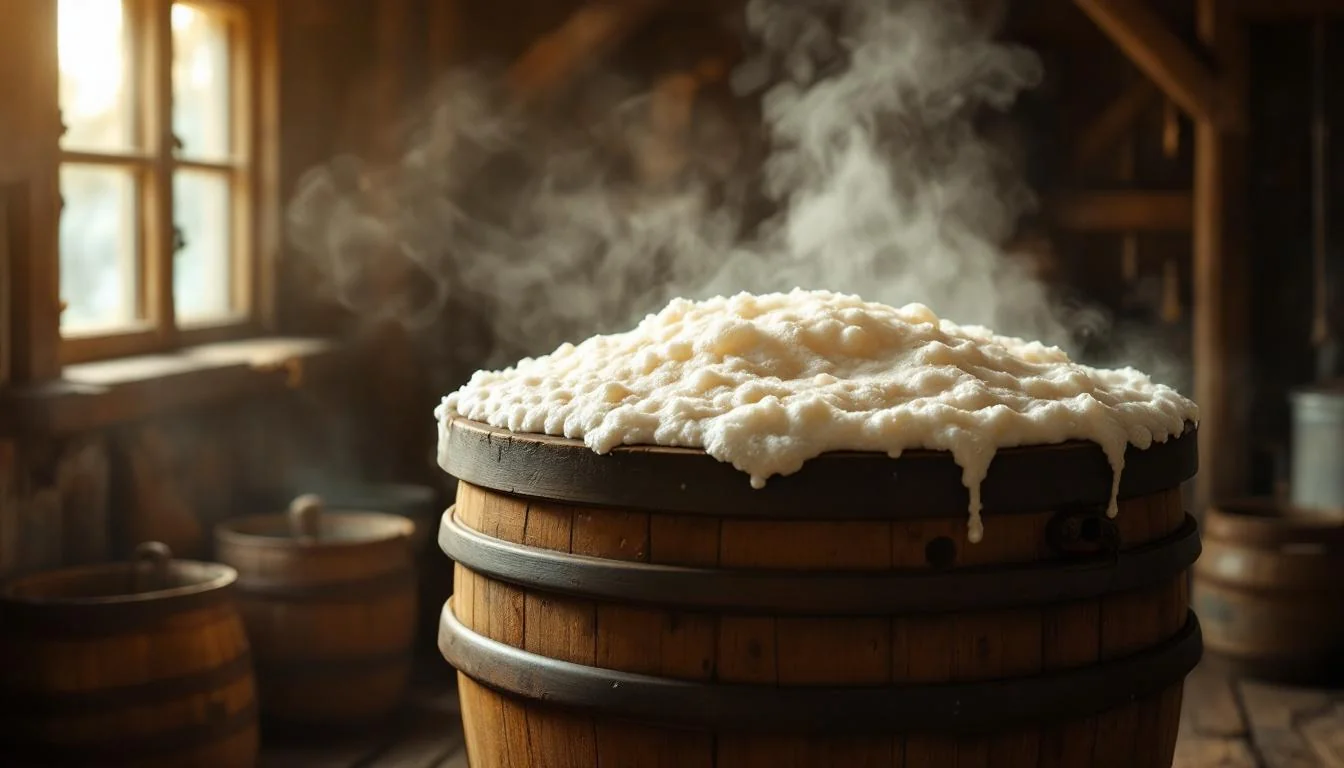
In 2015, a small parcel from Voss, Norway, reached Lars Marius Garshol, a Norwegian researcher of traditional brewing. Inside was a spoonful of dried yeast, sent by Sigmund Gjernes, a farmer whose family had kept the same yeast going for generations. No one then imagined that this pale yellow powder would overturn the rules on fermentation temperature that craft brewers had followed for decades.
Gjernes said he got the yeast from his father, who had it from his own father. How far back the tradition goes, no one knows exactly. What is known is that on remote farms around Voss, people still brew the way their ancestors did, with no temperature control and no worry about off-flavors. The yeast knows its job. And it works fast. Very fast.
IOrigins on Norwegian Farms
Kveik is not a single strain. It is the umbrella name for the traditional yeasts kept alive on Norwegian farms, mostly in the southwest, where fjords cut deep inland and the winters are long. In old Norwegian, “kveik” simply means “yeast,” though these yeasts are anything but simple.
Voss Kveik, also known as Sigmund’s Voss, was shared with researchers by Sigmund Gjernes in 2015. Gjernes lived in Granvin (now part of Voss municipality), a rural district set between mountains and the Hardangerfjord. He was not a scientist, just a farmer carrying on a family tradition: brewing for holidays with the yeast his forebears had left him.
Garshol, an IT engineer who researches traditional beer, spent years traveling through Norway, Lithuania, Latvia, and other rural parts of Northern Europe collecting yeasts that had “survived.” He took notes, conducted interviews, and sent yeast samples to laboratories for analysis. His work, above all his blog, Larsblog, became the most important body of documentation on kveik and traditional farmhouse brewing.
In 2016, Richard Preiss and colleagues at the University of Guelph in Canada began studying kveik genetics. Their results, published in 2018 in the journal PLOS ONE, caused a stir: kveik did not match any commercial brewing yeast. The strains formed their own branch of the Saccharomyces cerevisiae family tree, evidence of centuries of isolated domestication on Norwegian farms.
Voss Kveik soon became a favorite. The romance of its story helped, but the real draw was practical: it ferments clean at temperatures where ordinary ale strains throw a string of off-flavors.

IIThe Biology of a Heat-Tolerant Yeast
Taxonomically, Kveik Voss is Saccharomyces cerevisiae, the same species as most of the world’s ale yeasts. That is where the resemblance ends.
The work of Preiss and his colleagues showed that kveik tolerates unusually high temperatures. Most ale yeasts perform best at 18–22 °C (64–72 °F) and start producing off-flavors above 24 °C (75 °F); Kveik Voss can ferment cleanly at 30–40 °C (86–104 °F). Some homebrewers have pushed it to 43 °C (109 °F) and still ended up with drinkable beer.
Omega Yeast Labs and other yeast labs have isolated single strains from the traditional kveik blends. Commercial Kveik Voss usually contains one main strain, chosen for its stability and for the flavor profile brewers want. The usual recommended range is 25–40 °C (77–104 °F), with a sweet spot around 35–37 °C (95–99 °F) for the signature orange character.
Speed is its second defining trait. At 35 °C (95 °F), Kveik Voss can finish primary fermentation in 2–3 days, against 7–14 days for a typical ale yeast. The heat speeds up enzyme activity, but the kveik cells themselves also have a faster metabolism.
Flocculation is medium to high. Once fermentation is done, the yeast settles to the bottom fairly neatly, so the beer clears quickly without extra processing steps. Attenuation typically reaches 75–82%, which suits most ale recipes.
IIIFlavor and Character
Hold an IPA fermented with Kveik Voss under your nose. Orange, clear and direct, as if someone had just peeled one. That is the strain’s signature ester profile: isoamyl acetate (banana) is faint, while the orange-leaning esters, ethyl caproate and ethyl caprylate, dominate.
Fermentation temperature has a large effect on how strong the aroma gets. At 30 °C (86 °F), the orange is light, almost subtle. Push to 37 °C (99 °F) and it turns distinct, sometimes joined by mango and passion fruit. Above 40 °C (104 °F), the fruit can be too much for some drinkers, but the beer stays clean, with none of the diacetyl or other off-flavors that high temperatures usually bring.
Phenols are almost absent. That sets it apart from Belgian yeasts and German wheat beer yeasts, which produce clove, smoky, or medicinal notes. Kveik Voss gives a profile that is “clean but with character”: less neutral than California Ale yeast, less complex than a Trappist strain.
On the palate, Kveik Voss leaves a pleasant dryness without harshness. Mouthfeel is usually medium, neither thin nor as full as some English yeasts make it. Hop bitterness comes through clearly, not masked by esters or other fermentation byproducts.
Despite the speed, beer made with Kveik Voss lacks the “young” or “green” flavors typical of beer that has not had enough conditioning. Many homebrewers taste it just 5–7 days after brew day and are already happy with the result.
IVBeer Styles for Kveik Voss
Kveik Voss is not tied to any particular traditional style, since Norwegian farmhouse brewing never followed BJCP definitions. Modern craft brewers, though, have found several styles where it fits well.
IPA and Pale Ale
IPA was the first style homebrewers tried with Kveik Voss, for a simple reason: speed. A batch of Hazy IPA (NEIPA) can go from raw ingredients to glass in 10 days. The yeast’s orange note complements citrusy hops such as Citra, Mosaic, or Amarillo. The result is a bright IPA with layered fruit and a clean, dry finish.
Pseudo-lager
This is a debated use, but an appealing one. At lower temperatures, 25–28 °C (77–82 °F), Kveik Voss gives a fairly clean profile, close to a lager in its neutrality. Some brewers use it to make “lager” without refrigeration or a long lagering period. The result is not quite a traditional lager, but it is clean enough for summer drinking.
Farmhouse Ale
This is probably the style closest to kveik’s roots. Modern farmhouse ales made with Kveik Voss are fruity, dry, and easy to drink, though they lack the phenolic spice of a Belgian Saison. They take a different direction, neither better nor worse.
American Pale Wheat Beer
For drinkers who like wheat beer but not the heavy banana and clove of a German Hefeweizen, Kveik Voss is an interesting option. It adds enough fruit to give the beer some personality without overpowering the malt or hops.
VVoss and Norwegian Terroir
Voss is a small municipality in Vestland county, in southwestern Norway, with about 15,000 people. The region is known for its fjords, which cut deep inland and give it a milder climate than its latitude would suggest. Summers are short, but the daylight seems to last forever. Winters are cold and dark.
In this setting, brewing was seasonal. Farmers brewed for occasions: Christmas, weddings, funerals. They saved the yeast by drying it on wooden rings or cloth, stored it through the winter, and reused it for the next batch. That selection pressure, in which only yeast that survived drying and rehydration was kept, unintentionally produced strains with high stress tolerance.
The high fermentation temperatures were not a deliberate choice at first but a fact of life: the farmers had no sophisticated way to control temperature. They poured the wort into wooden vessels, added the yeast, and left it alone. Indoors, a Norwegian summer can reach 25–30 °C (77–86 °F). Strains that made good beer at those temperatures were kept; strains that made off-flavors were discarded, not by science but by the palates of generations of farmers.
Kveik Voss is now used around the world, and its biology still carries the marks of that Norwegian terroir: short summers, farm kitchens, and patient brewers who made good beer without needing the science.

VIRecognizing It in the Glass
If you suspect Kveik Voss is behind the beer in your glass, start with the nose. Look for fresh orange: not overripe fruit or bitter peel, but an orange just peeled, sweet and slightly tart. Sometimes there is mango, passion fruit, or a little apple, but orange usually leads.
Then taste. The beer will be drier than the aroma suggests. No lingering sweetness. No obvious banana as in a Hefeweizen, no clove spice as in a Belgian saison. Just fruit, hop bitterness where there is any, and a clean finish.
Carbonation is usually moderate, and the mouthfeel light to medium, neither creamy nor chewy. These are beers for drinking, not for slow, analytical sipping.
If the beer was fermented hot, above 35 °C (95 °F), the fruit will be stronger. If the brewer kept temperatures lower, the profile will be cleaner, closer to a neutral ale yeast. Both are Kveik Voss, showing the same character in two ways.
Perhaps the most telling clue: beer made with Kveik Voss is usually young. Very young. The yeast does not need the clean-up time many other strains do, so if a brewer is confident serving a beer just days after brewing it, kveik may be the reason.
So the next time an IPA tastes of bright orange and finishes clean and dry, it may owe something to the mountains of Voss, the Hardanger fjords, and farmers who never read a word of yeast science and simply trusted what their fathers left them.
Mentioned in this article
-
Beer O L O G Y
The World of Bitter Beer Begins with IPA -
Beer O L O G Y
Wheat Beer: The Flavor of the Grain


Originally published in Vietnamese on Tạp Chí Beer.