Black Patent Malt: Pure Black and the Burnt Edge of Classic Dark Beer
The darkest of the roasted malts, black patent has given stout and porter their night-black color and burnt edge since the 19th century.
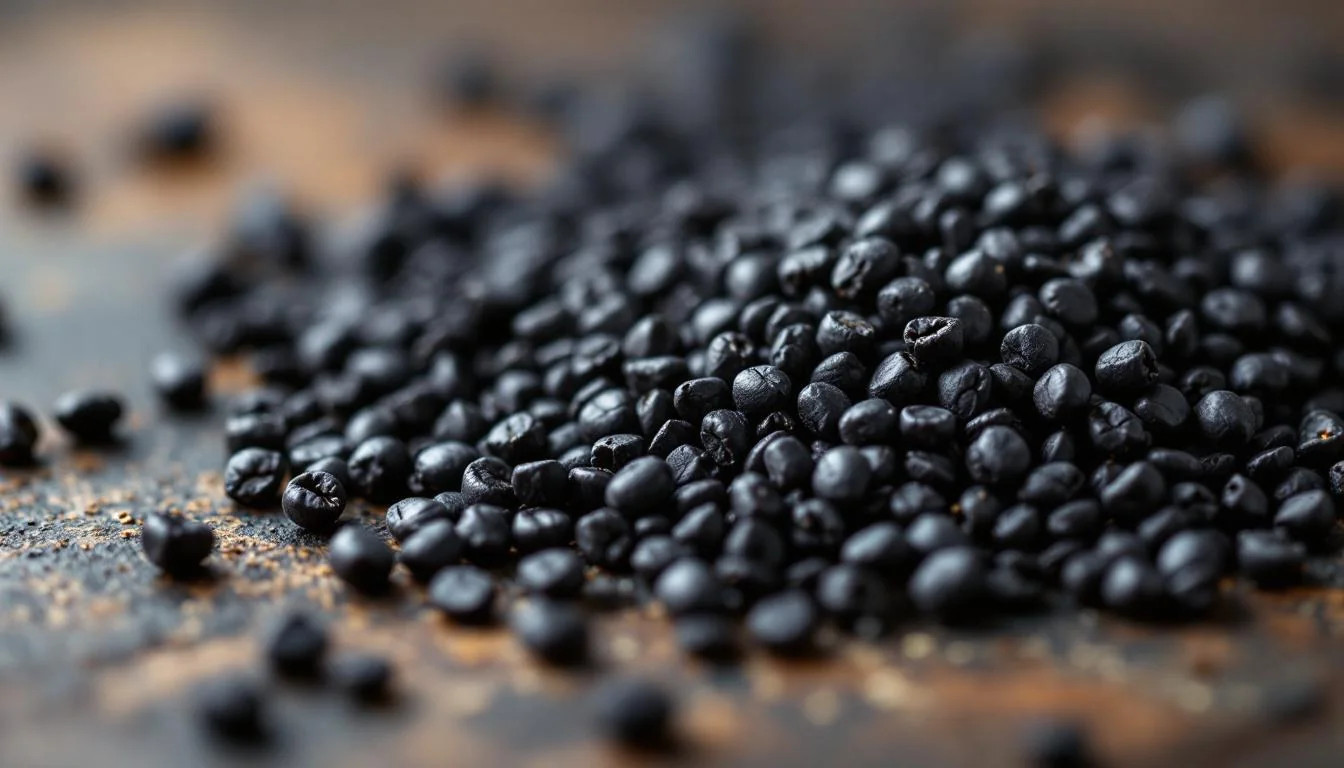
Some malts are made to be a foundation. Some are made to add accents. And then there is black patent malt — a malt made to define darkness.
No malt is blacker, and none is more intense. A few percent in the grist turns an entire batch the color of night. Black patent transformed English dark beer, and two hundred years later it still gives a true stout or porter its character.
IOrigins and History
The story begins in London in 1817, when Daniel Wheeler, an English engineer and inventor, applied for a patent on an entirely new device for roasting malt. He called it a “drum roaster,” a roaster built around a revolving drum.
Before Wheeler, English brewers made dark beer with brown malt, kilned over direct fires of wood or straw. Its color was uneven and its flavor hard to control. Worse, its extract yield was very low.
Wheeler’s roaster changed all of that. By turning the malt continuously in a closed drum at high heat, he could roast it completely black without burning it to ash. The result was a malt of absolute blackness, with an intense flavor that could nonetheless be controlled.
Wheeler’s patent, No. 4112 of 1817, created a new malt and with it reshaped the whole English dark-beer trade. Brewers could now use pale malt as their base, cheaper and more efficient, and add a small amount of black patent for the black color they wanted.
Nineteenth-century porter and stout began to change. Once murky brown, they became blacker, cleaner, and deeper. London and Dublin felt the invention’s influence, and then the rest of the world.
Technology has moved on, but Wheeler’s basic principle still applies. And the name “patent malt” survives as a tribute to the man who brought darkness to beer.
IIHow Black Patent Malt Is Made
Black patent malt starts as barley that has been germinated and kilned like any other malt. That is only the beginning.
After the initial kilning, the malt goes into a drum roaster, a direct descendant of Wheeler’s invention. The temperature is raised slowly to about 220–230 °C (428–446 °F) over two to three hours.
Inside the drum, the Maillard reaction is intense. Sugars and amino acids combine into hundreds of new flavor compounds. With black patent, the process goes further still, to the threshold of carbonization, where some of the carbohydrate begins turning into carbon.
The margin is thin. Roast too lightly and you have ordinary chocolate malt; roast too hard and you have useless ash. The roaster has to stop at exactly the right moment, when the kernels are fully black but still hold their structure.

After roasting, the malt is cooled quickly with air or water to stop the reactions. The finished kernels are jet black and reflect almost no light. Break one open and it is as black inside as out.
Major British maltsters such as Simpsons, Crisp Malting, and Thomas Fawcett all offer black patent. Each has its own recipe, but all follow the basic principle Wheeler laid down more than two centuries ago.
IIITechnical Specifications
Black patent has the highest color rating of any commercial malt: 1,300 to 1,500 EBC, or roughly 500 to 600 degrees Lovibond. Pale malt, for comparison, is about 5–7 EBC.
Its extract is well below that of base malts, typically only 65–70% against 80% for pale malt. That makes sense, since much of the starch has been carbonized in the roaster. But no one uses black patent for efficiency. Brewers use it for color and flavor.
Protein runs 10–13%, but most of it has been denatured by the heat, so it adds little to body or head retention.
Moisture is very low, usually under 3%. The malt is dry and brittle, mills easily, and keeps a long time in cool, well-ventilated storage.
Black patent has no diastatic power left; roasting destroys the starch-converting enzymes entirely. It is therefore always used alongside an enzyme-rich base malt, never on its own.
Typical usage is 3–10% of the grist. With color that high, a small amount is enough to turn a beer completely black.
IVFlavor and Color
Color is the first thing anyone notices. Black patent does not give brown, and it does not give ruby. It gives black, absolute black, so dark that no light passes through even when you hold the glass up to a strong lamp.
But color is only the surface. Flavor is where black patent shows what it can do.
The first aroma is burnt, but not the burn of an accident. It is deliberate, like dark-roasted espresso, like charcoal after the flames have died. Some people call it burnt toast. Accurate, but not the whole picture.
Beneath the char lies a more complex layer: black coffee without sugar, 90% dark chocolate, a light touch of smoke. In the more refined versions there is sometimes black licorice as well.
On the palate, black patent brings its own bitterness, the bitterness of roast rather than hops. It is dry and lingering, like the last sip of espresso in the cup. A light astringency comes through too, from tannins formed during roasting.
At high rates, black patent can turn acrid: sharp and harsh. That is the line brewers have to weigh. Too much overwhelms everything else; the right amount creates depth.
Experienced brewers often pair black patent with lighter roasted malts such as chocolate or brown malt. Together they cover a full range of flavor, from light caramel to char, rather than a single note.
VKey Beer Styles
Irish Dry Stout is black patent malt’s natural home. Guinness, the most famous example of the style, has used roasted barley instead of black patent since the 1930s, but many other breweries have kept to the traditional recipe with patent malt. Murphy’s and Beamish, both from Cork, are typical examples.
Across the world of dark beer, black patent is essential to the classic English-style versions. Imperial stout, the strong black beer exported to Russia from the 18th century on, often relies on black patent for its color and intense roast bitterness.
Traditional porter is black patent territory too. Nineteenth-century porter recipes often combined brown malt, chocolate malt, and a small share of patent malt, for a complexity no single malt could reach.
Foreign Extra Stout, the version shipped to the tropics, uses black patent to build a robust flavor that can survive harsh shipping conditions. Guinness Foreign Extra Stout is still brewed and widely sold in Africa and the Caribbean.
In some strong beers, such as Baltic Porter and Russian Imperial Stout, black patent plays a key part in building the characteristic roast foundation.
Beyond dark beers, black patent sometimes appears in very small amounts in other styles, purely to adjust color without noticeably changing flavor. Some brewers of Irish Red Ale add a pinch of patent malt for the deep ruby hue they want.
VICompared With Similar Malts
Among British roasted malts, black patent sits at the far end of the color spectrum. But it has company.
Chocolate malt, its closest relative, runs 800–1,000 EBC. It brings chocolate and coffee but none of black patent’s char. Many brewers prefer chocolate malt because it is “friendlier” and less harsh.
Roasted barley is the direct rival, especially in dry stout. The basic difference: roasted barley is unmalted barley that has been roasted, while black patent is roasted malt. Roasted barley tastes drier and more coffee-like; black patent leans toward burnt.

Carafa Special, from Germany’s Weyermann, is a more modern take. It is made from malt dehusked before roasting, which cuts astringency and harshness considerably. Carafa is smoother, but it lacks the “edge” of traditional black patent.
Midnight Wheat, a black-roasted wheat malt, suits brewers who want black color without heavy roast flavor. With no husk, it adds color while leaving almost no trace of flavor.
For brewers, the choice depends on the goal. For black color and classic, traditional roast, black patent. For something smoother and more modern, Carafa Special or Midnight Wheat.
VIIHow to Recognize It in the Glass
When you pick up a dark beer made with black patent, hold it up to the light first. If no light gets through, even at the thinnest edge of the glass, that points to patent malt.
Bring the glass to your nose and breathe in slowly. If char comes first, like overdone toast or glowing embers, black patent is there. That smell is different from the pure coffee of roasted barley or the sweet chocolate of chocolate malt.
Take a small sip and let it spread evenly over your tongue. Roast bitterness shows up at the back of the palate, not along the sides of the tongue where hop bitterness sits. A little astringency or harshness is the mark of black patent used at a high rate.
After swallowing, pay attention to the finish. Black patent leaves a long trail, bitter and dry, like cold espresso, and it lingers longer than lighter roasted malts do.
Try a Guinness, brewed with roasted barley, next to a Murphy’s, brewed with black malt. The difference is subtle but clear, and it shows what black patent contributes.
Once you have found it, pause for a moment.
The darkness in the glass is not simply the absence of light. It is two hundred years of history, the roaster’s patience, and the thin line between roasted and burnt, pressed into one mouthful of black beer.
Mentioned in this article
-
Beer O L O G Y
Dark Beer Is Not One Style -
Beer O L O G Y
Strong Beer: When Alcohol Becomes an Art
Originally published in Vietnamese on Tạp Chí Beer.