Märzen
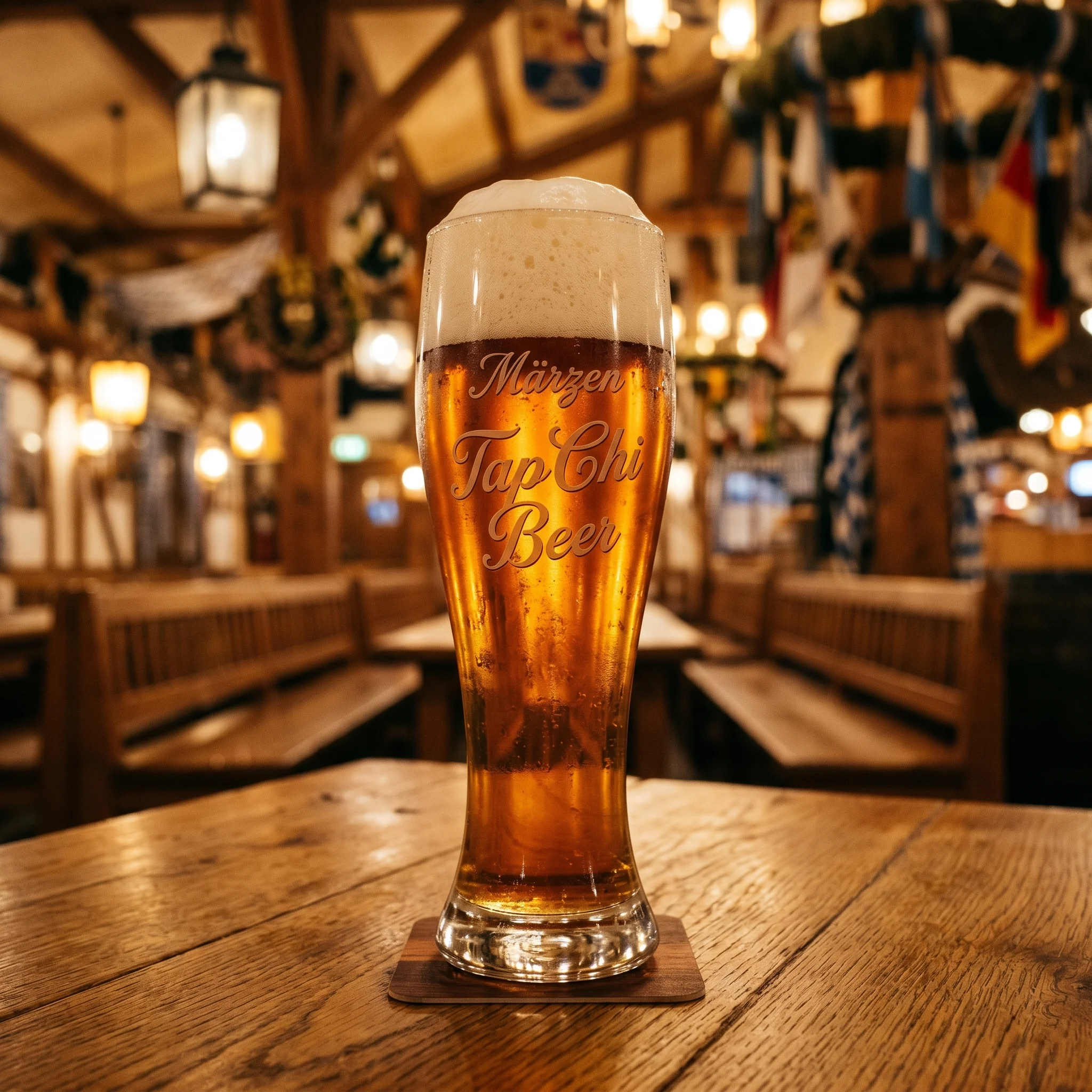
Märzen is a traditional German lager style, made famous by Oktoberfest. It pours deep gold to amber, with distinct malt flavor and a rounded mouthfeel.
The name “Märzen” comes from März, German for March. Brewers once made the beer in March and lagered it for months, then served it in the fall. That long conditioning leaves it smooth, clean, and balanced.
On the palate it usually shows toasted bread, slightly sweet malt, and a touch of biscuit, while the hops add only a light bitterness, enough to keep it from tasting sweet. It pairs well with grilled dishes, sausages, and other full-flavored food.
Appearance
- Color
- Deep gold to amber, the warm hue typical of Oktoberfest beer.
- Clarity
- Usually very clear and bright, typical of German lagers.
- Head and carbonation
- Fairly thick, fine-bubbled, off-white head.
Aroma and flavor
- Malt
- Prominent toasted bread, biscuit, and slightly sweet malt.
- Hops
- Low to medium-low bitterness, mainly to balance the malt.
- Esters
- Almost no pronounced fruitiness.
- Phenols
- None.
- Alcohol
- Moderate and smooth, easy to drink.
Mouthfeel
- Body
- Medium, fairly mellow and rounded.
- Carbonation
- Medium, keeping the beer fresh and easy to drink.
- Finish
- Lightly malty and slightly dry, fairly balanced.
- Attenuation
- Medium
Ingredients
- Malt
- Pilsner malt, Vienna malt, Munich malt
- Hops
- German noble hops
- Yeast
- Lager yeast (Saccharomyces pastorianus)
- Water
- Moderate mineral content
Food pairing
- Starter
- Grilled sausage
- Cheese
- Jalapeño Jack
- Dessert
- Coconut flan
Glass and temperature
- Glass
- Flute
- Serving temperature
- 7–12 °C (45–54 °F)
Glossary How to read the numbers and terms in a style profile
Measurements
- OGOriginal Gravity
- How dense the wort (the beer before fermentation) is, in other words how much sugar has been extracted from the malt before the yeast goes in. It is measured against pure water, which has a gravity of 1.000 at 15.5°C (60°F). An OG of 1.050 means the wort is about 5% denser than water. The higher the OG, the more sugar the yeast has to work with, so the finished beer usually has more alcohol, a fuller body and a more noticeable sweetness in the finish. A low OG (1.035–1.040, for example) tends to give a light, easy-drinking beer with little alcohol and little sweetness.
- FGFinal Gravity
- The gravity of the beer once fermentation is complete, when most of the fermentable sugar has been turned by the yeast into alcohol and CO₂. Because so much of the sugar is gone, FG is always lower than OG. A batch with an OG of 1.050 and an FG of 1.010 has had almost all of its sugar “eaten,” giving a dry beer with little sweetness and about 5% alcohol. A higher FG (1.018–1.020, for example) leaves more unfermented sugar behind, for a sweeter finish and a fuller body.
- ABVAlcohol By Volume
- The strength of the beer, given as the percentage of alcohol in its total volume: 5% ABV means 5 ml of alcohol in every 100 ml of beer. The figure is always higher than the same strength measured by weight (alcohol by weight). Brewers estimate ABV from the drop between OG and FG: ABV (%) ≈ (OG – FG) / 0.0075. With an OG of 1.050 and an FG of 1.012, (1.050 – 1.012) / 0.0075 ≈ 5%, so the finished beer is about 5% alcohol. Put simply, the higher the OG and the lower the FG, the stronger the beer; when OG and FG sit close together, the beer is light.
- IBUInternational Bitterness Units
- The measure of a beer’s bitterness, based on the hop alpha acids dissolved into it: 1 IBU equals 1 mg of isomerized alpha acids per liter of beer. The scale runs from 0 (no bitterness) to more than 100. Most drinkers only perceive differences between about 8 and 80 IBU; below 8 the bitterness is hard to detect, and above 80 the palate stops telling levels apart even when the beer is more bitter. A light lager usually sits at 10–20 IBU, while an IPA can reach 50–70.
- BU:GUBitterness Ratio
- The ratio of bitterness (IBU) to the potential sweetness of the wort (OG), which shows how the beer is balanced. Around 0.5 is balanced; below 0.5 the beer leans sweet, above 0.5 it leans bitter. To calculate it, divide the IBU by the last two digits of the OG (dropping the leading 1.0): a pale ale with an OG of 1.052 and 37 IBU has a BU:GU of 37/52 = 0.71, fairly bitter for its sweetness. Carbonation also shapes this impression but is not part of the formula.
- SRMStandard Reference Method
- The color scale for beer, usually running from 2 to 40 and above: the lower the number, the paler the beer; the higher, the darker. It is an analytical method based on how much light the beer absorbs, published by the American Society of Brewing Chemists and widely used to put a number on color. SRM 2–3 is straw, 5–6 gold, 10–12 copper, 16–17 chestnut brown, 25–39 dark brown, and 40 and above is black. Beyond 40, the eye can no longer tell the difference.
- CO₂ VolumesCarbonation
- How much carbon dioxide is dissolved in the beer, expressed as volumes of gas per volume of beer. Most beers fall between 2.2 and 2.7 volumes, with the full range running from about 1 to more than 3. The CO₂ is a natural product of fermentation by yeast and other microbes. To picture it: a keg (a metal beer barrel, usually 30–50 liters) at 2.5 volumes holds enough dissolved CO₂ to fill 2.5 kegs of the same size. That dissolved gas gives the beer its sparkle, its freshness on the tongue and its white head.
- AAApparent Attenuation
- The percentage of the malt sugar in the wort that the yeast turned into alcohol and CO₂ during fermentation. For most beers it falls between 65% and 80%. Above 80% the yeast has worked hard, leaving a dry, crisp beer with little sweetness and a light body; below 60% a good deal of sugar remains, for a sweeter, heavier, richer beer. The formula is [(OG – FG) / (OG – 1)] × 100: a batch with an OG of 1.080 and an FG of 1.020 has an AA of 75%, meaning about three quarters of the sugar was consumed, for a moderately dry beer with a lightly sweet finish.
Sources: CraftBeer.com, Beer Styles Study Guide; BJCP.org, Beer Judge Certification Program.
Originally published in Vietnamese on Tạp Chí Beer.


