Rothaus Tannenzäpfle: A Small Treasure from the Black Forest
Tannenzäpfle is the classic German Pilsner from the Rothaus brewery, with a fine hop bitterness, a light-to-medium body, and a finish that lingers.

Some flavors are made to linger rather than make noise, settling in quietly and staying on like a fond memory. In the cool highlands of the Black Forest, in a country full of famous beers, there is a straw-gold beer like that, known by a name as affectionate as a nursery rhyme: Tannenzäpfle, “little fir cone.”
It does not need to shout. Its appeal comes from plain purity: spring water from a thousand meters up, skilled brewers, and more than two centuries of history. This is the story of a modest beer that became a legend.
IRothaus and Its Black Forest Pilsner
Rothaus has been building its name since 1791, deep in the Black Forest, with mountain air around it and untouched groundwater beneath. In the early days, the story goes, its beer was poured only for monks and miners, a rare luxury in the forest.

The turning point came in 1806. The monastery closed, and Rothaus passed to the Grand Duchy of Baden, officially becoming a “State Brewery,” a rare distinction that lends the brand a character of its own, stately yet approachable. From 1956, when Tannenzäpfle was launched, the beer began to travel beyond its home forests. Later it spread across Germany, and Rothaus went from local favorite to national point of pride. It remains a leading name in German brewing today, its heritage intact.
Then came the brewery’s most prized beer, Tannenzäpfle. In the Black Forest dialect, “Tannenzäpfle” means “little fir cone,” and perhaps the brewers meant the small cone printed on the label as a quiet nod to home. The name has been official since 1956. At first this was the locals’ everyday beer, but its quality and balance went on to win over serious beer drinkers and young students alike, and today it is part of Baden-Württemberg’s identity, a small, modest beer with an outsized reputation.
IIA Classic German Pilsner
Tannenzäpfle is a quiet beer. It does not overwhelm; it wins you over step by step. It is a clean, graceful lager and a textbook German Pilsner, with a character of its own, clearly distinct from the deeper, warmer pilsners of the Czech Republic.
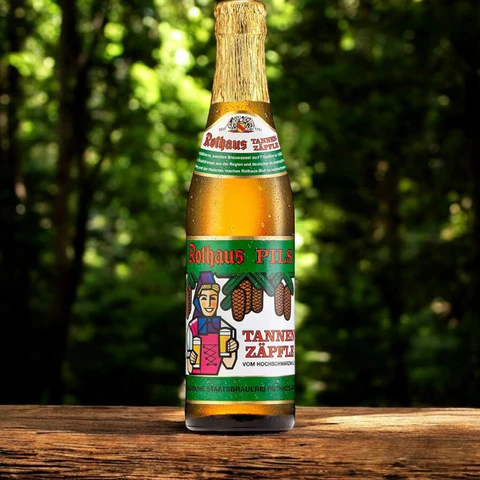
In the glass it is a bright straw yellow, crystal clear, as though the morning light filtering through the Black Forest pines had found its way into the beer. At 5.1% ABV, it has just enough strength to warm you.
The bitterness is the heart of Tannenzäpfle. Never gruff or harsh, it shows up in the finish as a sharp, dry note (around 30–40 IBU) that lingers. Aromatic German hops, Hallertauer and Tettnanger, supply it, and it fades as cleanly as it came, leaving the palate crisp. The light-to-medium body keeps every sip refreshing, easy, and oddly compelling. This is not a beer to rush; it rewards slow attention to its balance.
IIIServing Tannenzäpfle
Drinking Tannenzäpfle can be a small ritual that ties you to the Black Forest, and the beer repays careful handling.

Serving Temperature
Serve it at 6–8 °C (43–46 °F), the cool of an old cellar. In that range the hop aromas come through in fine detail and the bitterness stays clean and sharp. Below 4 °C (39 °F) the cold numbs everything, and the beer goes silent.
Glassware
The glass matters. A tall, tapering pilsner glass holds up the fine, creamy white head and lets the aroma open out. A slender flute also works well, sending its bubbles up in quick streams and carrying the flavor through to the last breath.
Food Pairing
Tannenzäpfle is an easy partner at the table.

- With traditional German food: it sits well beside a salty Brezel, cuts the richness of roast pork knuckle (Schweinshaxe), and balances the fragrant spice of Currywurst. These are the flavors of its home.
- With fresh seafood: the beer’s clean bitterness cuts through the richness of salmon and brings out the fresh sweetness of sashimi.
- With lighter dishes: a cool green salad or a piece of mild goat cheese makes the beer taste even crisper and more refreshing.
When to Drink It
Tannenzäpfle fits life’s better moments: unwinding after a long day, when the worries fade with each cold sip, or a picnic or backyard barbecue full of laughter. Above all, it is an easy way into German beer, a gentle first step for anyone curious about the craft of brewing.
IVConclusion

Each sip of Tannenzäpfle carries a story that has matured over time: cool air from a thousand meters up, a bitterness as sharp as pine needles, and the warmth of a history kept alive for generations.
Its strength is purity: a simple beer that persuades through balance rather than show, as quiet and as deep as the Black Forest itself.
In the rush of daily life, it is a reminder that calm can still be found in a glass, and it remains one of Germany’s small treasures.
Originally published in Vietnamese on Tạp Chí Beer.
More German Pilsner
About this style
German Pilsner
Suntory Premium Malts: Old Craft, Modern Technique

German Pilsner
Trumer Pils: A Ray of European Sunshine

German Pilsner
Radeberger Pilsner: Saxony in a Glass

This beer is in the library of the BeerLens app. Scan the label to identify it, then keep your own tasting notes.