Burton-on-Trent Water: How Gypsum Built the World’s Pale Ale Capital
The sulfate-rich water of Burton-on-Trent produced English IPA and gave brewers a term for recreating it: Burtonisation.
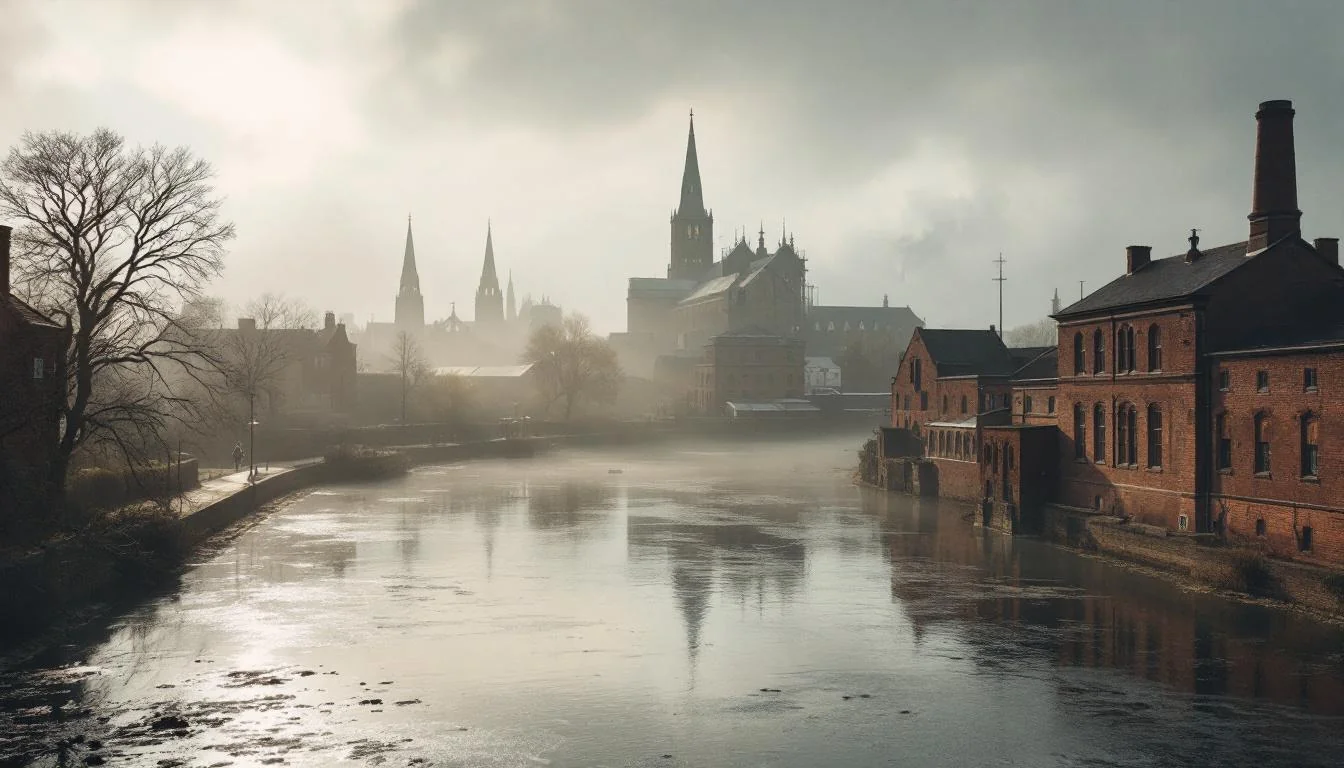
If any single water supply has changed the brewing industry worldwide, it is Burton-on-Trent’s. Throughout the 19th century, this small town on the River Trent in Staffordshire, England, was the Pale Ale capital of the world. It owed that position to a bed of gypsum deep underground, not to luck.
Wine has its terroir: the soil, climate, and people that give a wine a character no one else can copy. In beer, the terroir is the water, and no place shows it more clearly than Burton-on-Trent. The term “Burtonisation,” meaning the treatment of water to mimic Burton’s, is now part of every modern brewer’s vocabulary.
IGeography and History
Burton-on-Trent lies in the English Midlands, in Staffordshire, about 40 km northeast of Birmingham. The town grew up in a broad valley where the Trent flows over unusual geology: beds of gypsum and limestone from the Triassic period, some 250 million years old.
Brewing in Burton dates to the 11th century, when the monks of Burton Abbey found that the local well water made an ale of unusual clarity and crispness. Only in the 18th century, though, did Burton rise to become the center of the brewing world.
The turning point came through the Baltic trade. Russian merchants had a particular taste for Burton Ale, a rich, sweet, strong beer. When Napoleon blockaded Baltic trade in 1806, Burton’s breweries had to find new markets, and they turned to India, a British colony thirsty for beer.
In 1822 Samuel Allsopp tried brewing to the recipe of Hodgson’s India Ale, a London beer, but with Burton water. It worked better than anyone expected. The sulfate-rich water made the hop bitterness sharper and cleaner. Burton Pale Ale soon took over the export trade, then the home market in England as well.
By 1888 Burton had more than 30 large breweries producing 1/4 of all the beer brewed in England. Bass, Allsopp, Marston’s, and Worthington all called the town home. A place of fewer than 50,000 people set the taste in beer for an empire that reached around the globe.
IIThe Mineral Profile
Burton water is known for its very high mineral content, sulfate above all. It is one of the hardest waters ever used in traditional brewing.
Calcium ranges from 268 to 295 mg/L, well above most other brewing waters. It supports enzyme activity during mashing and helps proteins precipitate, which gives a clearer beer.
Sulfate is the defining mineral, at 638 to 725 mg/L, 10–15 times the level in many other brewing waters. It works with the hops to produce a dry, sharp, decisive bitterness, the unmistakable signature of English Pale Ale.
Magnesium sits at 24–40 mg/L, serving as an enzyme cofactor and supporting yeast health. Chloride is only about 25–36 mg/L, far below the sulfate, which tips the sulfate-to-chloride ratio firmly toward hop-forward beer.
Bicarbonate is moderate, around 200–260 mg/L. For pale beers such as Pale Ale, Burton brewers usually treat the water to bring bicarbonate down and keep the mash pH from rising too far.
IIIHow the Water Shapes Flavor
The unusually high sulfate-to-chloride ratio of Burton water has a distinctive sensory effect, known as the “Burton snatch”: a light sulfur note, sometimes compared to a freshly struck match or, very faintly, to boiled egg. It sounds unappealing, but in the right amount it adds depth and complexity.
High sulfate fundamentally changes how hops come across. The bitterness turns crisp and dry and finishes cleanly instead of lingering. That is why English IPA and Pale Ale have a bitterness unlike that of American or German beers, a difference that comes from the water as well as the hop varieties.
High calcium also supports a healthy fermentation. The yeast flocculates well, dropping to the bottom quickly and completely. Traditional Burton beers were famously bright even without filtration, partly because of the water.
Water hardness affects malt extraction too. Burton beers usually have a medium-light body, which lets the hops show without the malt crowding them. That hop-leaning balance later became the benchmark for Pale Ale brewing around the world.
Burton water does not suit every style, though. Dark, malt-forward beers such as Stout and Porter struggle with it, because high sulfate pulls a harsh, astringent bitterness from roasted malt. This is why Dublin, whose water is rich in bicarbonate and low in sulfate, became the home of Stout.
IVStyles Born in Burton
Burton-on-Trent is the birthplace of some of the most important styles in brewing history, above all English IPA and English Pale Ale.
Burton Pale Ale is the original style, born in the 1820s. Its color is a bright golden amber, “pale” only next to the Porter and Brown Ale that were popular at the time. English hops such as Fuggle and Golding lead the aroma, and the bitterness is sharp and dry, with a clean finish.
English IPA grew out of Burton Pale Ale, with more hops and more alcohol to survive the long voyage to India. Burton water is ideal for it, since the sulfate lifts the hops without making the bitterness coarse.
Burton Ale is an older style, sweeter and fuller than Pale Ale, and was once exported to Russia and the Baltic. It is rarely seen today, though a few breweries have revived it as part of their heritage.
English Strong Ale and English Barleywine are also bound up with Burton. Breweries such as Bass made high-strength beers to be laid down for years, relying on hops and alcohol as natural preservatives.
Even as the craft beer boom brought American IPA and a wave of hop-forward variations, the foundation still traces back to Burton. Modern West Coast IPA relies on Burtonisation, adjusting water to mimic Burton’s sulfate-to-chloride ratio, even with entirely different hops and malt.
VThe Breweries That Made Burton’s Name
Bass Brewery, founded in 1777, is probably the name most closely tied to Burton. The Bass red triangle was the first trademark ever registered in Britain (1876). Bass Pale Ale was once the best-selling beer in the world, exported to every corner of the British Empire.
Marston’s, founded in 1834, is known for the Burton Union system, a fermentation method using linked oak casks. It is the last brewery still running a traditional Burton Union, and Pedigree Bitter, fermented in it, has a character other breweries cannot copy.
Allsopp’s Brewery rivaled Bass on equal terms in the 19th century and pioneered the export of India Pale Ale. It no longer exists as an independent company, but Allsopp’s still appears in every book on brewing history.
Worthington, now part of Molson Coors, still brews White Shield, one of the oldest English IPAs in production. White Shield is bottle-conditioned, so it can be cellared and will keep developing in the bottle.
VILessons for Today’s Craft Brewers
Burtonisation is standard practice in craft brewing today. Any brewer who wants to make hop-forward beer needs to understand it and be able to move their water toward Burton’s profile.
The first lesson: the sulfate-to-chloride ratio sets the balance between hops and malt. More sulfate brings the hops forward; more chloride softens and rounds out the malt. At roughly 20:1, Burton leans entirely toward the hops. A craft brewer can adjust the ratio to suit the beer without copying Burton exactly.
The second lesson: water is an ingredient, not a fixed condition. With modern equipment a brewer can start from reverse osmosis (RO) water and build whatever mineral profile they want. Understanding why Burton water works is what lets a brewer make informed choices instead of simply copying a recipe.
The last lesson: terroir in beer is real, but it can be recreated. In wine, terroir belongs to a particular piece of land; in beer, it comes from knowledge. A brewer in Vietnam can make a true Burton-style beer once they have mastered the principles of water.
Burton-on-Trent is a reminder that beer is about place as much as recipe and technique: rock laid down 250 million years ago shaped how the whole world drinks. Water is beer’s terroir, and understanding it begins with curiosity and some humility before nature.
Mentioned in this article
Originally published in Vietnamese on Tạp Chí Beer.